
The Productivity Sweetspot ~ Episode 9
Your Inner Child Is Running Your To-Do List – Here’s How to Take Back Control
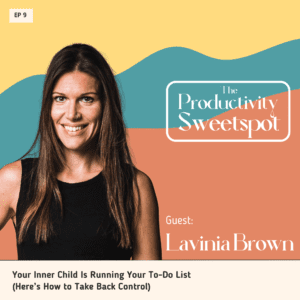
Struggling with procrastination, burnout, or perfectionism? These common productivity blocks may stem from deeper emotional wounds tied to your past. In this episode, Lavinia Brown, a trauma-informed psychodynamic coach, unpacks how unresolved inner child wounds can impact your productivity and overall well-being.
Lavinia shares how these emotional scars from childhood create unconscious patterns that hold you back in both your personal growth and productivity. By identifying and healing these wounds, you can break free from stress, overwhelm, and the constant pressure of perfectionism, stepping into a more aligned and fulfilled version of yourself.
Through compassionate guidance, this episode offers actionable insights and practical tools to address emotional blocks and integrate inner child healing into your daily life. Learn how to transform your productivity, relationships, and self-awareness by tackling the root causes of procrastination and burnout.
In this episode, we cover…
Quotes from this episode
Transcript
In this episode, we cover…
- The Inner Child Explained: Learn what is the “inner child”, how it forms during childhood, and why it significantly impacts our adult behaviors, including productivity.
- How Emotional Wounds Create Productivity Blocks: Discussion on how unresolved childhood experiences can manifest as unconscious patterns, leading to perfectionism, procrastination, or feeling stuck.
- Healing the Inner Child: Lavinia provides actionable strategies to identify and heal inner child wounds, including recognizing triggers, practicing self-compassion, and breaking harmful cycles.
- Practical Tools for Conscious Productivity: Discover simple yet effective tools for integrating inner child work into daily life, enhancing both emotional well-being and productivity.
Quotes from this episode
“Productivity isn’t just about ticking boxes; it’s about uncovering and addressing the emotional blocks that keep us stuck.”
“Healing your inner child is not about blaming your past but creating a brighter, freer future for yourself.”
“Your inner child doesn’t need perfection; it needs acknowledgment, love, and compassion.”
“True productivity begins with self-awareness and honoring your emotional well-being.”
“Many of us adopt coping mechanisms—like perfectionism, people-pleasing, or catastrophizing—to get love, attention, and validation that we didn’t feel we received as children.”
“If your need feels urgent, manic, or physically visceral—like you must fix the mess or quiet the noise immediately to feel safe—that’s your inner child trying to create safety.”
Transcript
ANNE RAJOO
Productivity struggles like procrastination, burnout or perfectionism often come from unresolved emotional wounds from our past, and because productivity is more than just time management, I am excited to speak to Lavinia Brown, a trauma-informed psychodynamic coach who has dedicated her work to helping mamas heal their inner child, overcome unconscious pattern and become the conscious authentic parents, partners, women and leaders they aspire to be. Our topic today is one that impacts so many of us without even realizing it. So let’s dive in and discover how our inner child influences our productivity.
Welcome to the peaceful productivity pod. I’m your host, Anne Rajoo, and together, we redefine productivity and find your sweet spot where performance meets happiness.
Welcome to the Peaceful Productivity Pod.
LAVINIA BROWN
Thank you so much for having me.
ANNE RAJOO
So we are here today to explore what the inner child may have to do with productivity, and I think it’s the best place to start is to talk about what is the inner child and how, yeah, does it influence as an adulthood? And what does it mean? You’re the expert there, so shoot away.
LAVINIA BROWN
Yeah. So the inner child is the energy that you hold within you, whatever your age of that little girl, you also have an inner teenager and in a in a young adult, but I like to kind of lump it all in with the inner child. It’s the old version of you. And the problem with the inner child is that she brings her wounds with her until those wounds have been processed consciously. So what the inner child needs most is love, validation, attention, if you didn’t get that as a child, not because your parents didn’t want to give it to you. Most of our parents tried their best. Of course, they wanted to be good parents. They loved us, but many of them were overwhelmed or stressed or had economic worries, or they had their own sets of trauma, or they didn’t have the tools.
Whatever the reason, many of us didn’t get that attention, love, validation in the way that we needed it. We may have got attention, love and validation, but it’s the way that we needed it, and usually there’s a gap between the two. So those wounds until they’ve become processed consciously, and that’s what I do with women. They come along with us.
So when we’re saying wounds, what does that mean in terms of your podcast productivity? That could be imposter syndrome, it could be perfectionism, it could be people pleasing. It could be black and white thinking. It could be catastrophizing. It could be addictions, right? It could be any kind of coping mechanism that we adopted as a child or teenager or young adult to get that love, attention, validation, because it wasn’t there anyway. It wasn’t there unconditionally. So many of my clients, me included, I was the family therapist. I was the family kind of entertainer, clown. When everyone was depressed and sad, I had to be like, Oh, well, let’s do this and look at it this way. And no, you’re not you’re not bad, you’re great. And having to turn things around into the positive. The whole time, I had to be a well, I didn’t have to be. I was a people pleaser. I was still am a perfectionist. All of these coping mechanisms are showing us how we felt at the time we had to behave in order to get our needs met, lab, attention, validation.
So what I do with women is I help them to learn how to give that to themselves, rather than looking for it externally. When you do that, you no longer have these coping mechanisms, because those wounds are no longer there. So your inner child is still with you. She doesn’t go anywhere. She’s part of you, but you have the tools to make sure that she’s in the back seat of your life, not in the driving seat. And that’s really important at work in relationships, especially intimate ones. And parenting, we don’t want to be parenting for my inner child, it’s a nightmare.
ANNE RAJOO
Oh, wow. This is so interesting. I mean, definitely the perfectionism relates like resonates very much, the addiction, sort of to busyness and doing like, I know that for myself, I want to fix things by making them right and doing something about it. And yeah, there’s so many things that I’m like, Yeah, I know there’s some wounds there, but wounds always feels like a strong word, and I feel also it feels like sometimes hard to point our finger, like, let’s say the people who listen to this podcast, they want to be more productive, and they might be like, Oh, I don’t have like, a how do they can? How can they build a connection, which may maybe their childhood wound, which maybe they don’t know, because I guess it’s a lot of unconscious is there something they can do to. Sort of start understanding where might the perfectionism come from, or where might this imposter syndrome, syndrome come from, or catastrophizing. I recently had a client who was very much into the catastrophizing. How can they uncover what might be behind.
LAVINIA BROWN
That’s a really good point. The way I describe it is that if you feel that these adaptive behaviors, coping mechanisms, come with a kind of manic feel, if they feel urgent, if they feel visceral, quite physical, if it feels like you’re not going to be okay, if you don’t do this, then you know it’s the inner child. So for example, a messy house, silly example, but a common one, a messy house, you might come in and go, Oh, my God. Oh, and get really triggered by the mess. You may not get triggered by the mess. You may be like, Oh, messy house. Who cares? Another example is kids fighting noise like everyone’s screaming. Things are being thrown around. It doesn’t feel safe again. Is your reaction to change that environment, the messiness, or the noise levels immediately because it feels unsafe, because the need is urgent and a bit manic, or is the need, ah, it’s bit messy. I’ll just straighten out some cushions. I’ll do that later. Or it’s a bit noisy, kids, could you just, could just pipe down, please? I can’t hear myself doing thanks. There’s a big difference. So you’re having that visceral Oh, my God, I don’t feel safe.
So in other words, my coping mechanism, my adaptive behavior, is going to make me feel safe. IE, the kids must shut up. I cannot stand this noise. I must tidy the house immediately. Then you know that it’s linked to a wound. And, yeah, maybe wound is strong, but we’re talking about strong feelings. It. You know, I could say trauma. I say wound instead of trauma, because most people are like, Oh, trauma. Oh no, don’t have trauma. It is trauma. It’s attachment trauma, not big T trauma, small t trauma. You weren’t seen, you weren’t understood, you weren’t heard. That’s why you had to create these ways of being to get your needs met. You shouldn’t have had to have done that. You should have felt loved, safe, needed, understood, heard, however you were behaving, whatever you did, whatever you said, but most of us didn’t, because our parents didn’t know how to create that environment. So we became the ones that had to create it for ourselves, which is where that manic urgency comes in. If that’s there, if it feels visceral, if you feel, oh, I need to do this in order to feel safe, that’s the question you want to ask yourself. Then you know that it’s a wound or attachment trauma.
So going back to your example, imposter syndrome, catastrophizing. Catastrophizing is a way of making the worst possible situation real, so that you are in control. It’s obviously a fake control, because you don’t know that that’s going to happen, but you’re you’re creating that scenario so that that inner child no longer feels manic or urgent, she feels in control, she feels safe. So it’s always about the inner child trying to create safety. That’s how you know that it’s, it’s going back to the past. And then what you would do is you would work with that feeling. We can go into that later if you want to. Yeah, does that answer your question?
ANNE RAJOO
No, I love that. This is really great. I think this is it’s definitely confirmed to me. You know, I mentioned to you that I’ve definitely have some wound there that has blocked my productivity in certain ways. And it’s exactly that feeling of like I cannot do the work I want to do and that I had planned to do, because there are really strong emotions. And I think it really helps to understand that this is the pointer towards because obviously, yes, there is perfectionism, but I have also learned to sort of work around it, or work with it. I don’t have this really strong feeling about the perfectionism, but where I struggle a lot is with the speaking and with the putting myself out there. So launching the podcast has brought back a lot of really strong emotions. And I just mentioned before, before I hit record, I had felt a bit nervous with you as well, because there is a big wound for me that I’ve uncovered. And every time I’m trying to do something that means putting myself out there, I start to be perfectionistic about it, because I obviously want to make sure that I’m not gonna get a tongue twister, and that I’m know exactly what I want to speak about and all these things. And I recognize that normally on like an enormous scenario, I don’t really care. But if it’s something a bit more important, or if it’s something a bit more, where I feel there might be people judging, and I just take so much longer to do the work, and that’s again, blocking my productivity. And I think, yeah, for me, that was fascinating to discover that about myself, and I assume so, like you said.
LAVINIA BROWN
The importance of what you’re being asked to do, there is no greater importance than your. Your father, connecting to you, right? There is no bigger need in life, because when you’re small, that’s life or death. If you don’t have a safe mother, father, family unit, primary caregivers, you are likely to die. Yeah, of course you could try and survive in the wild, but not easy, right? You need safe adults to look after you. So that’s where the perfectionism comes in. You needed to be perfect, or you thought you needed to be perfect in order to feel safe, in order to feel loved.
So that’s where it comes in, and many of these adaptive behaviors are also trying to shield us from rejection. Same thing, it’s just the flip side of it is either seeking love and attention or trying to avoid rejection, which is the same wound.
ANNE RAJOO
So how could I go about, you know, healing it, or what could I do? I mean, you said it’s all about giving yourself love and compassion. But what is an example you can bring from working for your child, with your clients, how you help them, giving them the love. Because sometimes that’s not so straightforward.
LAVINIA BROWN
I feel no totally if you’re not used to it, and if it’s not familiar, it will feel uncomfortable. Right, being being treated kindly, compassionately, having the space to have your feelings considered. Right?
Many of us didn’t grow up in environments where decisions were made collaboratively. My parents were very authoritarian. It’s like, you’ll do what we say, end of you don’t get spanked. So to have someone be all of these things that we didn’t experience can feel very uncomfortable because it’s unfamiliar. So the way that I do it is through the inner parent. The inner parent is external to you. She’s not you. She’s external, and she is there, I say she. It could be a he, it could be an animal, it could be an energy. It could be an angel. It could be whatever presence feels supportive and loving and kind and nurturing to you safe, then that external being is there to provide you with that feeling of comfort and safety whilst you work through your feelings. In other words, they are re parenting you. So if your parents weren’t able to hold space for you while you had big feelings, most of our parents weren’t, yeah, then you won’t know how to regulate yourself. You didn’t learn that as a child. You probably learned it as an adult. I certainly did. The inner parent helped me do that. That’s what they are there for. They are standing in for this parent that we never had, creating the space for us to feel our feelings in a relaxed body. If you don’t know how to relax your body, to feel your feelings, your feelings just overwhelm you, and you end up with chronic depression or rage, or, you know, anxiety, panic attacks, all these things are and not being able to handle, manage our feelings.
So we have to learn how to do this, not only for ourselves, but for our children, right? We just because we didn’t learn how to do it doesn’t mean that we’re not going to teach them. So that’s what’s really hard for mums. It’s why I work with mums, because we’re in this sandwich. We don’t know how to necessarily regulate ourselves, and yet, here we are being expected to co regulate our kids, but actually their feelings are very triggering. So, you know, I’m talking about parenting, but it could be just as, just as relevant at work, you know, your boss says something that you feel is dismissive. A colleague cuts you off in a meeting somewhere, a friend leaves you on red and doesn’t get back to you. All of these things can bring up these old, stuck feelings of rejection. So we want to go back to those feelings. We work with those feelings that are coming up now because they’re old, they’re not about what just happened. And we go back to the experience, if we can remember it, we feel it with the inner parent holding space for us to be there. Obviously you’ve connected with your inner parent and created that relationship already. That takes a while, and when you do that, those feelings aren’t there to be stirred up anymore.
So it’s a combination of releasing old stuck feelings from your body, because that’s where they’re stuck, and having this inner parent relationship that you can call on at any moment to help you to feel safe, whether you’re at work, parenting, with friends wherever
ANNE RAJOO
I like that. And while you were talking, I was really thinking of, how could I do that practically for myself or anyone I’m working with? For example, that client with the catastrophizing I think and correct me if I’m wrong. But what I’m thinking of is that we could sort of practice talking nicely to ourselves in those moments and really acknowledging okay. This is something that may come from childhood, and that’s okay. And these are emotions, and we are now grown up so we can handle it, and maybe it’s part of we’re doing something that’s, you know, like maybe working on a project that is new, and there’s some rough and stretching, and that’s all okay and to talk nicely. But I think a lot of women, actually, and me included, talk quite negatively when these things come in our way, and it sounds like that is absolutely not helpful in those moments. We need the love and care.
LAVINIA BROWN
Totally, and it doesn’t necessarily come naturally. A lot of my kids like but I don’t know what to say. I don’t know what to do. And I say, Okay, well, if you don’t know what to say or how to be kind and compassionate, it took me a long, long time to get this. You kind of fake it until you make it. I mean, when I started this, I wasn’t a mum, but I say to those that are mums, what would you say to your child? Say your child fell over. They’ve got blood coming out of their knee. They’ve grazed it. What would you say in that moment? You probably don’t go into a big spiel. You just go, Oh, that looks really painful. Come here, I’m here. It’s okay. You’re not saying more than that. It’s just a few key words.
If you don’t have a child, you could imagine what you might say to a child. You can imagine someone in a movie, right? Everyone’s seen the perfect mum in a film or on TV at some point. I mean, my dad, my inner parent, Dad, I used to pick. I still do Dumbledore from Harry Potter, so I was just like best dad. I just love you. So he’s like my dad, he’s like my inner parent. So you can pick someone from a movie, there’s always going to be someone you can draw on who’s got those kind words that will do that calming down for you. But I think the most important part to highlight which people forget and you didn’t do it, you did it perfectly, is that in a parent isn’t about fixing, it’s not about saving it’s not about saying, Oh, you’re catastrophic, but that’s not going to work. No, let’s be logical about this. And that’s kind of cognitive behavior therapy, like, oh, well, what’s the likelihood of that happening? Is that realistic? In my book, it doesn’t that doesn’t matter. In that moment, you are not in your logical brain. You’re in you’re scared inner child, and your inner child does not think logically. She doesn’t think about the consequences or the rationale.
So forget that, meaning that might work temporarily, definitely, I’m saying, I’m not saying don’t do it. But if you want to get rid of this permanently, which is absolutely possible, it’s not like you’re going to catastrophize the rest of your life. You go towards the feelings, oh, wow, you’re terrified. Yeah, that feels really, really scary. How does that feel in your body? Yeah, wow. Oh, can feel that. And you know what, I’m right here. I’m right here with you as you feel that. Where, where can you feel it? Now, is your throat? Yeah, your throat is tight. Chest. Are you breathing for? Yeah, oh, this is awful, yeah, I’m not, yeah. So you think this is going to happen? That would be awful. That would be really awful. Yeah. So you’re you’re creating space for her thoughts and fears to be held and to be heard. That’s not what she got as a child, probably, I’m guessing. So you’re saying, Tell me more. Tell me more. Let’s go into the fear and what will happen next, and what will happen next, and then what Go, go into it. And all the while, you’re having space held for you, so you’re staying this is obviously something you practice in a relaxed body whilst feeling fear. And then when you’ve done that, once you’ve done it, once you can do it anytime.
That’s what the aim isn’t, never to feel fear. Fear is part of life. The aim is to be able to manage your fear and not let it take over. So again, it’s back to the inner child in the back seat. You don’t want your inner child in the driving seat, so we get her in the back seat by having a safe driver. I guess that’s saying, you know, and feel your feelings. I get that you’re having that feeling so you’re validating, you’re not saving, you’re not fixing your meeting. I know, yes.
ANNE RAJOO
Yes, yeah, the fixing and the rationalized rationalizing never worked. I mean, I know rationally that you know nothing is going to happen if I twist my tongue on a podcast interview, but if I tell that myself, it’s not going to make a difference. But I love like the way you were saying that, and I can tell that you are very practiced in it, but it really felt, felt like just having a good friend next to you was just there to listen. Yes, absolutely.
LAVINIA BROWN
It doesn’t have that’s a really good point. Doesn’t have to be an inner parent. Can be an inner Big Sister, in a best friend, in a therapist, in a coach. You know, whatever it is that you need in that moment. That’s what that presence does productivity and inner child?
ANNE RAJOO
Is there anything else that you think is important to mention how that might be connected?
LAVINIA
Not really. I think the main point is, if you feel manic or there’s an urgency about anything you want to do, whether it’s about achieving something, whether it’s about whether you have any time to do it, whether it’s you have any time left, it feels like time is running out, whether you you know, because deadlines, that was a really big thing for me. Deadlines, what other people think of you? Employers, employees, colleagues, all of these things. If they feel visceral, it’s not you, it’s your inner child. And of course, your inner child is feeling that because that’s what she does, and it probably links to something in your past, so it’s always identifying the quality of that feeling and not trying to dismiss it.
We’re human, of course, we feel a range of emotions. You’re going to have negative and positive emotions. Just because you’re productive doesn’t mean that you don’t also have fear. And terror and boredom and shame in there, right? We can be productive and scared, productive and ashamed, but we’re normalizing the negativity, creating space for it, maybe journaling it out, and always having that safe other to be there with you, feeling it with you, because that’s probably not what you got when you were a child.
ANNE RAJOO
Cool. I love that. This is so interesting. I’m definitely have to do a little bit more digging into my past about my own wound there. But I think it’s, it’s just, I love that conversation, because it takes away from the usual productivity and keep doing and just keep finding ways to produce more and do more when maybe there is something there that blocks it, and something that is unconscious, unconscious and just something that is old from a little childhood experience, little or big, whatever it is, but it’s just not always just so beneficial to just push through things.
LAVINIA BROWN
And I think this is what I love, and that’s probably what happened to you as a child. I know that I was I felt I had to be strong, I had to be brave, I had to be resilient, I had to be tough, had to be self-sufficient, self-reliant, self-resilient, all of it, no because that then became armor, and then it’s very hard. And as you know, certainly for me, when you become a mum, that armor has to come down because you have to let your kids in. And I found that one of the hardest things to do, actually, I was an armored tank getting through life very nicely by myself. I’m not wanting anyone. And then your kids come in and you’re like, oh, maybe this armor isn’t serving me quite so well. So it’s about finding that strength, that soft strength, that strength that comes from within, which is, again, I mean, I can’t emphasize it enough, safety, emotional safety.
If you feel safe, you can do anything. You do anything, and it’s not in a manic way. It’s not in an urgent way. It comes in a relaxed, not worried about time. You don’t care what other people think of you. It’s all about feeling safe. So anything you can do to help the inner child feel safe will boost your efficiency, productivity, leadership, all of it.
ANNE RAJOO
Love it. Amazing. Thank you so much. Lavina, that was amazing.
So let’s remember true growth isn’t about pushing through. It’s about showing up with compassion, love and kindness. I got goosebumps when Lavinia said, when we heal our inner child and feel emotionally safe, we can do anything. And that’s my takeaway from this episode. Wondering what is yours? Follow me on Instagram at underscore. Anne Rajoo, underscore, and let me know. Let me know what you thought about this episode, and if you recognize maybe some patterns that could be caused by some childhood wounds and that are now affecting your productivity, send me a message and let me know.
And as always, please share the episode with anyone who could use a little bit more peaceful productivity in their lives.
And if you’re curious about starting your own journey towards peaceful productivity. Download my free resource, the wheel of peaceful productivity, which is there to guide you towards the eight dimensions that help to create more life, work, fulfillment. And it’s really a great starting point for peaceful productivity.
And next week, I’ll be talking to April beach, and we were speaking about how big online launches that we’ve seen and rapid success that we’ve seen online have often influenced us to focus on doing more, following trends, pursuing strategies that aren’t actually aligned with our current stage within our business, and which is causing us to feel overwhelmed and spread follow too thin. So if you’re curious and want a bit more business productivity, come back next week and until then, be peacefully productive and catch you next time!
Listen on your platform of choice


View all episodes
Get more of Lavinia
Do you struggle with being productive?
Discover where to start when creating business harmony and work-life fulfillment with the Wheel of Peaceful Productivity
Keep In Touch with Anne
Subscribe to her newsletter
Peaceful Productivity Letter
Join hundreds of readers and enjoy three actionable tips on how to make the most of your time.
Thank you!
You have successfully joined our subscriber list.