
The Productivity Sweetspot ~ Episode 26
Morning Routines That Set You Up for Success (Not Stress)
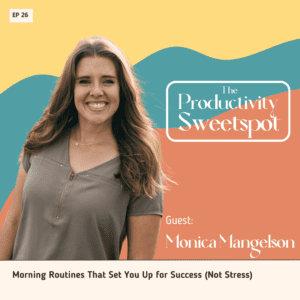
What if your morning routine didn’t feel like just another to-do list? In this episode of The Productivity Sweetspot, I’m joined by Monica Mangelson to talk about how to build a rhythm that supports your energy instead of draining it.
We dive into the power of intuitive planning — creating structure based on your natural flow rather than external expectations. Monica shares how tuning into your body and emotional state each morning can boost mental clarity and help you lead your day with intention.
We also unpack why weekly planning (instead of hyper-scheduled daily plans) can reduce stress, and how cultivating presence in the morning can shift the tone of your entire day.
This conversation is full of simple mindset shifts and practical tools for energy management, especially for anyone who has struggled with the pressure to “start strong” or check all the boxes before 9 a.m.
Whether you’re building a new routine or looking to soften the one you’ve got, this episode will help you reconnect with your mornings — and yourself.
In this episode, we cover…
Quotes from this episode
Transcript
In this episode, we cover…
- What makes a morning routine feel like a burden — and how to change that
- How to bring presence into your first waking moments
- The benefits of planning your week based on energy management rather than rigid goals
- Using intuitive planning to support your mental, emotional, and physical state
- Tools to create mental clarity without needing a perfect morning
Quotes from this episode
“Trust yourself more than the gurus who don’t even know your name.”
“What do I need right now to thrive?”
“Routines are fantastic because it’s our brain’s way of cutting out all the extra decisions… but not if you’re using them to beat yourself up.”
“Sometimes it’s a gym session where I’m pouring buckets of sweat. Sometimes it’s a dance party in my bathroom.”
“I wanted to be a runner… but I hated it. I didn’t actually want to run — I wanted to feel free, feel good in my body.”
Transcript
ANNE RAJOO
I have a love hate relationship with morning routines, and we’ll probably chat about that. But I think a lot of productivity gurus suggest that we should be following morning routines. And I think sometimes that can feel very rigid and unsustainable. And I’m excited to have Monica Mendelsohn with me. Hi, Monica, hello. So you gonna share a bit of a different approach to morning routines. I think we’re going to talk a little bit more about intuition and energy, and that sounds like a morning routine that it’s more to my liking, because for peaceful productivity, it’s a big part to really listen to ourselves, to be mindful, to use intuition and all of that good stuff. So yeah, why don’t we start by getting into the reasons why you even talk about morning routines. How come?
MONICA MANGELSON
Yes, oh my gosh, I’m so excited to talk to you about this, because I have that same love hate relationship to morning routines that you do. And this actually started like at the beginning of, really, my big self development journey, and my husband and I were kind of going on this journey at the same time, and we, just like you heard, all of the things, you know, have a morning routine. Get up early. Get up earlier. Do it again, you know, and keep going and get all these 37 things done before Did you ever have breakfast? And I was like, That sounds fantastic. And the crazy thing was that my husband was very good at doing it. He would get up so early, journaling, done, meditation, done. He’d do all these cool things, and then I would wake up and he’d already done all these things. I was like, Man, I want to be more like you. And so I would try to force myself to keep pace with my husband and with his morning routine. I would try to get up the same time he did. I would try to do all the same things, but I found that I would get up early, and then I would go sit on the couch to go do my journaling or my reading or whatever, and then I would fall asleep on the couch, and then I would just beat myself up. I was always go angry. I’m like, why can’t I do this? Why can’t I have the same morning routine that he can have? And why can’t I I’m just lazy. I’m just, you know, all these things, like it was, I just be feeling as fuel to beat myself up, because it’s what all the gurus told me to do. So obviously, like, I just needed to nail that one thing, and my whole life would be great. Fast forward to where I’m at today, where I’m like, that’s absolutely ridiculous, and we are all so, like, such individuals, we have different needs. We have different needs. Like on different days, like no two days are going to be the same. And so I just really love this topic of being able to tune back into yourself, being able to trust yourself more than the gurus who don’t even know your name, to be able to set up a routine that works for you, that works for your nervous system, that works for your body, that works for your spirit and one that follows your intuition instead of just following somebody else who’s telling you what to do with your life.
ANNE RAJOO
Yeah, some prescription that doesn’t really take into consideration who you are, where you are in your life, what phase you’re in, like my lost hate relationship and my city time was literally when I was getting up at 4am because I had, at that point, two little children. My children are very early risers. No matter what I’ve tried. My oldest always wakes up at 5am on the dot. Even if he goes to sleep at very late, he will wake up. So I, at some point, got up at 4am to do those things, journal, meditate, do yoga, or just even have a bit of quiet time, because my kids are very energetic. But obviously getting up at 4am is not very sustainable when, as a mom and business owner and I work in a time zone where I often have calls like, right now it’s evening, because where you are in the world is a completely different time zone. So I often had to sleep, like, just not enough sleep, and that was not sustainable. But I thought, like, oh, well, that’s what I’m supposed to do, and like you, that will sort out my life. And it didn’t work. So, yeah, it’s just, it’s just a prescription that is not necessarily right for everybody. And I think it’s cool that it works for some people, but for many people it doesn’t. And so I’m curious, what is your morning routine? Maybe you want to walk us through it, and then maybe you want to talk about how you got to it. And you know what other people could do, the listeners could do if they feel their morning routine isn’t quite working for them?
MONICA MANGELSON
So I feel like it’s taken me a long time to really settle into a morning routine. I’ve kind of done the pendulum swing. From, I have to be super rigid. I have to do exactly what everyone is going to do. I have to keep up with my husband, just going to the other side of my like, forget it. I’m just not going to have any kind of morning routine at all. And so now I’ve definitely kind of settled more in the middle. And I feel like for me, what’s important is I have been able to recognize what things that happen in the morning. I thrive better. So if I do have some kind of movement, any kind of movement in the morning, it helps me. If I drink water first thing in the morning, it helps me so much. And then I also have kind of just like a wake up routine of, like, I give up, I I wash my face, I put on, you know, some moisturizer or whatever. And it just helps me kind of get into a really simple routine of, okay, now I’m ready to work. So routines are fantastic because it’s our brains way of of cutting out all the extra decisions, and it really can help us get into the mental space of, okay, now it is time to work. But what gonna work is if you are trying to beat up yourself, if you’re trying to, like, go against what your body and your brain is actually needing, and you’re just trying to do what somebody else had to do because somebody else said to do it, it’s not going to work for you. So one of the most important things you can do is ask yourself, what do I need right now to thrive? What do I need to do to set myself up for success? So I have this broad category of I know I need some kind of movement in my day, so when I wake up, I can say, Okay, what kind of movement does my body need right now, sometimes my body needs to go to the gym and I have a really hard workout where I’m pouring buckets of sweat, and that’s what I need. Other times I need to just go on a walk or do some yoga, or sometimes it just is like a dance party in my bathroom. It’s all I need, and that’s what my body is looking for and craving, especially as women, where we have this natural rhythm, this natural cycle, where sometimes during the month, we’re going to have tons of energy, and we’re going to feel really good, really ready to, like, hit the gym and go and just go, go, go, go. And then we have other times where our body naturally slows down, and naturally it’s going to be like, okay, like, we need to be more reflective. We need to be softer on our bodies, and we need some more restorative time. And so being able to kind of follow that natural cycle is so important, and it makes morning routine so much fun. Like, I don’t hate going to the gym, because I go when I want to, and sometimes I go to the gym and I just walk in the treadmill, you know, because that’s like, what my body needs in that moment, and that goes against what everybody like has ever told me to do ever. But I am so much happier, I am so much healthier, and I start my day so much further ahead than when I’m like, Man, I’m trying to keep up on all this checklist, and I just can’t get there.
ANNE RAJOO
And I think it’s really like these rigid routines are really setting us up for failure, for like, disappointment, because, like you said, we’ve different moods and different energy levels. And I think as long as we know that is the bucket of movement, or whatever else it could be for someone, and we do something that falls into that category, we tick the box and we can be, yes, I’ve done it, and we confirm to ourselves that we’re able to show up, to ourselves, that we’re able to do this routine, habit, or whatever you want to call it, and it’s not like, oh, but today I didn’t do my 30 minutes run. And now, why do I even bother tomorrow? Or why do I even try at all? Because I think this one happens a lot when it’s very rigid, and then we just physically can’t.
Or, like, I’ve mentioned to you, my kid is sick today, that comes in the way, and then you’re like, what’s even the point? And that’s the worst thing. So yeah, I love that.
MONICAL MANGELSON
Yeah, adjusting. And that happens so much when it’s not something that born is born, naturally, of you. So my favorite example to use is, for a while I really wanted to be a runner. I was like, man, runners just seem so happy, like, I want to be a runner. And I worked so, so hard to be a runner, and I read my first 5k doing all these things, and I hated it. Every step of the way was torture for me. I absolutely hated it, but it wasn’t something that was born like from me, like it wasn’t something I actually wanted. It was like, Oh, I see this poster of her running, and she looks happy. But I wanted us to be happy. I wanted to feel free. I wanted to I wanted to lose weight at the time too. I wanted to feel good in my own body. I had nothing to do with running, and because I didn’t actually want to be a runner, and I hated it, I set this goal because I felt like it’s what I was supposed to do to check off all these boxes every step of the way was an uphill battle, where, if you can find a why, if you can find something that really resonates with you when you’re setting up your morning routine, in particular, it’s going to be so much easier to not fall off the bandwagon. It’s going to be so much easier to continue going because, you know, you have a deeper, a longer why? So for me, in my morning routine, I used to be, you know, I tried to do all these things. I tried to go running every morning like that. Was in the same era where I was trying to be somebody else, where now I know that I can be my best self when I start with movement, so it is so much easier to add that into my day, because I know the end results are are so good, and I know that that’s naturally what I want like. I want to have days where I feel so good. I want to have days where I’m tuning into my intuition and I feel inspired, and everything feels easier. And I know if I do that, like if I start my day with movement, if I start my day with water, then I’m setting myself up for success in that area. Does that make sense? It just makes such a big difference when you know why, and you’re doing this for you, and not because somebody else told you that’s what you were supposed to do exactly.
ANNE RAJOO
I love that, and you mentioned intuition. So let’s get there. Let’s go there. I recently recorded an entire podcast about intuition, so it’s something that I’m very curious about, and that I’m sort of like, really tapping into myself these days. But how would you use your intuition exactly, specifically in your morning routine.
MONICA MANGELSON
Yeah, intuition is such a powerful tool that more of us need to be tapping into, and it takes a lot of practice. But the good news is that your intuition like never leaves. You could be have been ignoring it for 20, 3040, years, and it’s still there inside you, and you just need to practice like tapping back in. And essentially, your intuition is just your body and your soul trying to speak to you. But it’s so we’re so bombarded with outside stimulus that it’s hard for us sometimes to turn inwards and to check inwards. And so creating a quiet space, creating even just a moment in time where you can say, what do I need? What do I want to eat today? What do I want to do today? And then it takes some time to practice like, okay, so I guess I really get to handle breakfast. I used to kind of have like this. I only eat this every single day for breakfast. This is my breakfast that I have every day. But the thing is, it was boring to me, and I don’t know. So sometimes I would be like, Okay, I’m eating my yogurt parfait every single morning. And then all of a sudden I’d be like, now I’m eating popcorn. So I mean all this junk food, because that’s not what I want to be eating. So just creating the space where I’m like, Okay, what does my body how can I fuel my body today in a way that’s going to sustain me for the rest of the day? And just creating that that space to just like, stop and listen. And sometimes the body’s like, I just am craving something sweet, so then I can make a smoothie. Or sometimes that body’s like, I just need something like hearties. I can make avocado toast with eggs and sausage. You know? I can make. I can make a breakfast that is going to fuel my body today, in this moment, and it’s teaching my body that it can trust me, that I’m going to take care of it. Because our body is always, always, always trying to communicate with us. It’s always trying to tell us what we need, and the more we go ignoring it, the more our bodies are going to start crying out for help more and more and more. But then we can just learn to trust ourselves. When we tune in and we meet our needs, we can learn how to trust ourselves. And as I’m saying this, I’m already hearing all of the objections that people be like, okay, yeah, but when I tune into my body, it wants cookies and cakes and margaritas, and it doesn’t want, like, healthy food. And I just want to, like, create this, this moment here where I can say yes, like, yes, your body, at first is going to say, I want all of these things and I want all this junk food, because we’re naturally made to crave food that, like, packs on the energy and keeps it in storage, and we’ve created this deficit when we’re not listening to our bodies. We’ve created a deficit where our body doesn’t always know that it’s going to get what it needs, because we haven’t been giving our body what it needs. And so as you learn and tune into your intuition and as you follow what your body needs, there’s a really important step that you need to do afterwards, to check back in with your body and say, Okay, how am I feeling? Maybe I ate ice cream for breakfast. How does that make me feel? You know, and most of the time you’re gonna be like, Oh, I had brain fog. I get those little sick and bloated, and it was just not good. And you can finish that cycle where you go, okay. Now I know I will give my body what it needs, but also my body is going to tell me what it needs to help me thrive. And now that I’m connecting the fact that I ice cream for breakfast to the fact that I have all this brain fog and I’m not getting anything done today, it’s going to help you create healthy habits really, really naturally, and it’s going to help you be able to trust your intuition and your body so much more, because your body is now going to know, okay, I know that she’s going to give me what you need. I know that I’m going to get what I need, and I can communicate that taking care of me. And so now I can kind of relax, and you’re going to naturally find yourself falling into much, healthy.
ANNE RAJOO
I love that. Yeah, when you were talking, it came at some point I was, you know, going for a walk in the morning, and I would walk into a podcast because I wanted to be, you know, hyper productive. Don’t waste any time just just walking, like just walking. It’s just not good enough. It has to be productive. And then at some point I stopped listening to a podcast, because I realized that I really needed that quiet time where I could think, because my day is so go, go, go with work and kids and everything else that I don’t have a lot of quiet time where my brain can just go where it wants to go. And this is then where I started to have more of this intuitive feeling of like, what do I actually need this morning? Because my morning routine starts when the boys are out of the house. I go with my dog, then I come back, and then I have another coffee, and I ease into everything. But it was really with these walks that gave me some space that I would only understand. Okay, yeah, the coffee is nice, but then back then I would be straight to the laptop and straight into work. Now I take my time with the coffee, and I sit down and I think, and I make plans, and I check in with my goals for the day, and like, it’s it’s become a routine, but also a ritual, like how I start my day, and that really made such a difference for me. And I
think it’s really started with giving myself the space time to listen to what’s going on. Yeah, what do I actually really need? And I love that.
MONICA MANGELSON
Yeah, I love that. I’d be curious like, if you noticed any improvements as you created that quiet space to listen to your thoughts, and what areas Did you see improve?
ANNE RAJOO
I think a lot of time is really some clarity comes to me around work, like some project that I’m working on, and maybe it’s just like sort of ticking along, and I’m, you know, I’m following the steps that I’m supposed to follow. But when I go for a walk in the morning, then there’s like an idea that just spots, Oh, I haven’t gotten back. Why am I not doing this? Or it’s, I don’t know, a conversation that I had with someone that just sort of plays back in my mind, and then it becomes a deeper meaning, something like, yeah, that person said this and this, like, I’ve noticed that it stuck with me, whereas if I was too busy and listening to a podcast, I probably wouldn’t even realize that there was something there that still the day off. So, so it’s in my mind. So yeah, I think it’s more these, like deeper, deeper thoughts, not just, oh, I have to do this today and I have to cook lunch and I have to pick up my children, but more the creative side, or the really, the more tuned in the connection between brain and body, which for me has always been a challenge, because I’m a very brain, brainy person, not so much in tune with my body, but the stillness and now starts to happen. So that’s why I really enjoy that.
MONICA MANGELSON
Yeah, that’s so beautiful. I just our brains. I’m just such a neuro nerd, like I’m just such a brain nerd. I love our brains so much, and the fact that, like, our brains are constantly working on our problems in the back of our mind, and when we’re constantly pulling our conscious away from what’s happening like in our subconscious. By listening the podcast, which I’m really glad you’re here listening to this podcast, but also it’s so yeah, so please keep listening. But also, need to start listening to your own thoughts as well. And I remember, like, always growing up, I would always joke like, oh, like, the best inspiration comes midstream, like I have it like strokes of inspiration when I’m on the toilet or when I’m in the shower, like it always comes midstream. And that was always my big joke. But as I’ve kind of grown up and gone on this whole journey, I’m like, Well, of course, that’s when inspiration came, because I was the only time I was unplugged. That’s the only time when I wasn’t listening to something, I wasn’t talking to somebody, I wasn’t filling my brain with other things, and I just let the thoughts come up naturally. And it’s always, always so amazing, how much more creative I am. I have all these like, brilliant thoughts where I’m like, Wow, it’s so smart, and that’s gonna work super well. It’s my business and it all, it’s all my brain. Like our brains just come up with so many cool things. Like, we are designed to be creators, and if we give ourselves space, we’re gonna be amazed at how much we’re able to create in that in that space, and how much we’re able to design our lives and just be so much more in in control. And it is such a beautiful, beautiful process, and I really wish I had the words to fully describe how amazing it is, but it’s something that you just have to experience for yourself.
ANNE RAJOO
Yeah, I love that. And for me, the thought came now that what you said initially with not every day is the same, and the energy, and if we have these three really rigid morning routines, there might be this half an hour journaling, or whatever it is. But then you know that that’s again, like, sort of putting your brain into something, in some structure, and telling your brain now you’ve got to get all these ideas out, and it’s not going to happen, because you sort of like, you know, forcing things to happen. But when you have some more, you know spaciousness and you feel like bringing the idea to paper, or just, you know, you have time and space to think. This is when it happens, not when you like, when on your agenda, when it’s like, Okay, now it’s 535 I sit down and I journal for 15 minutes, and this is when everything is going to happen. That just doesn’t work for our brains, isn’t it? More like free flowing. And so I like the idea of like, yeah, it’s an easeful morning. It’s got some routine and structure, but not too much. So this is where I’m at at the moment, and I was excited to speak to you.
Do you have any other sort of myth or something around morning routines that you feel like you want to bust so any tips that you want to share before we wrap up the episode?
MONICA MANGELSON
Yeah, this is a little bit maybe broader than morning routines, but I feel like it plays directly into setting up my own morning routine, and that is simply to change yourself from setting daily goals to setting weekly goals, because then it allows you to be more flexible. It allows you to say, You know what, I am exhausted today, and maybe I just need to take a nap in the middle of the day. Or maybe, oh my gosh, my kid is sick, and so I need to be at home with my kid, like taking care of my kid, and also taking care of myself so I don’t get sick, because then we have a big mess if I’m the one who’s sick, you know. And so it’s just being able to to release the idea of I have to get all of these things done by the end of the day, and instead broaden it to these are the things I need to get done by the end of the week. So then maybe you have, you know, Monday and Tuesday are really slow days. Maybe you’re sick, maybe your kids are sick. Maybe you just aren’t feeling not you’re just not feeling it. And maybe you’re just like, have this kind of fuzzy head, and you’re like, Man, I just need to spend some more quiet time. But then maybe Wednesday and Thursday and Friday, you aren’t kicking it like you just feel so good and you can just bust through all these tasks. Think about how much better you’re going to feel throughout the whole week knowing that you’ve allowed yourself space to be able to say it’s okay if I have a bad day, it’s okay if I’m sick, it’s okay if I need to replenish my energy today, it’s okay that my kids sick. Like, now you’re not going to be annoyed that your kids sick because you can’t get through your 37 like to do list today, and it just opens up this, this allowance. Like, it just feels so good because you’re still getting things done. You’re still hitting that to-do list. And in fact, you’re going to find you’re probably getting more things done that you thought you could have. But if it doesn’t happen today, you can be present in the moment, and you can be confident knowing that it’s still going to get done and that you can you can be here for your kids, for yourself, even if it’s not maybe what you had planned for the day.
ANNE RAJOO
Oh yes, exactly. That’s what I did today. Move everything over to later in the week because I had some white space as well that I deliberately be free for, you know, flexibility and all of that. But yes, I love that a weekly goal opposed to a daily goal. That’s awesome. Cool.
Well, thank you. Maybe just share with everybody where they can find you if they want to find out more about you. And I think you’ve got something especially about intuition as well.
MONICA MANGELSON
Yes, absolutely. So I’m pretty easy to find coachingbymonica.com is my website coaching by Monica on all the social media platforms. But I’m really excited. I have a free guide called trust your gut, a decision making guide, where really I go into the science of what intuition is, and I’m going to train you how to start tuning back in. So many of us are just not used to listening to our intuition. So use of us are so many of us are just used to people telling us what to do and handing us a checklist. And so it can feel really unnatural to start turning back in and start trusting your intuition again. And this guide is specifically designed to help you start that journey. I’m going to give you journal prompts. I’m going to teach you how to set up your environment for it. It is such a good like first step into turning inwards for you. So make sure you have that link there for anybody who’s like this intuition thing is kind of interesting to me like I don’t know how I feel about it. I don’t know if I can fully trust myself not to just drink margaritas all day like there’s intuition guys, are you.
Listen on your platform of choice


View all episodes
Get more of Monica
Do you struggle with being productive?
Discover where to start when creating business harmony and work-life fulfillment with the Wheel of Peaceful Productivity
Keep In Touch with Anne
Subscribe to her newsletter
Peaceful Productivity Letter
Join hundreds of readers and enjoy three actionable tips on how to make the most of your time.
Thank you!
You have successfully joined our subscriber list.