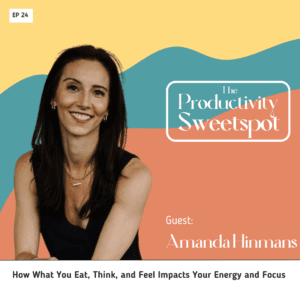
The Productivity Sweetspot ~ Episode 24
How What You Eat, Think, and Feel Impacts Your Energy and Focus
If you’ve ever tried to power through exhaustion with caffeine and willpower, only to crash later, this episode is for you. Productivity isn’t just about managing time—it’s about managing energy. And the key to sustaining energy? Your health.
In this episode, I sit down with Amanda Hinman, a functional health expert, to discuss how your physical well-being directly impacts your productivity.
Amanda shares how to recognize the warning signs your body is sending, the impact of stress, hormone imbalances, and poor nutrition on focus and efficiency, the most common nutrient deficiencies affecting women over 40 (and how to fix them), and simple, stress-free ways to fuel your brain and body for sustained energy.
If you want to feel better, think clearer, and get more done—without burning out—this conversation is a must-listen.
In this episode, we cover…
Quotes from this episode
Transcript
In this episode, we cover…
- The warning signs your body is sending that you shouldn’t ignore
- How stress, hormone imbalances, and poor nutrition drain your focus and efficiency
- The most common nutrient deficiencies affecting women over 40—and how to fix them
- Simple, stress-free ways to fuel your brain and body for sustained energy
Quotes from this episode
“Your body is always communicating with you—when you learn to listen, you can work with your energy instead of pushing against it.”
“Productivity isn’t about doing more; it’s about doing the right things with clarity and ease.”
“When you fuel your body properly, your brain operates at its highest potential, making focus and efficiency feel effortless.”
“Stress and overwhelm don’t have to be the norm—when you create balance in your health, you create balance in your work and life.”
“True productivity comes from a place of alignment, not exhaustion—when you nourish yourself, everything flows more smoothly.”
Transcript
ANNE INTRO
Health and productivity are deeply connected because your energy, focus and efficiency depend on your physical and mental well-being. And I can tell you from personal experience, pushing through exhaustion with caffeine and willpower only works for so long. So how do we work with our bodies and not against them? This is what you will find out in this episode.
And I love this conversation because when you’re exhausted, sluggish or you’re dealing with brain fog, no productivity system or hack will work. Hormonal imbalances, blood sugar spikes, poor gut health or chronic stress can drain your energy, leave you demotivated and make it really difficult to concentrate.
Forget the hustle, ditch the burnout and step into your productivity sweet spot.
This isn’t just another time management podcast. It’s your go-to space for refreshingly real conversations and practical strategies that help you work smarter, not harder. I’m Anne Rajoo, your host and a passionate advocate for peaceful productivity.
Join me as we challenge traditional productivity rules and redefine success on your terms, with time, energy and focus that actually fit your life. Whether you’re an entrepreneur, creative or just someone who’s done with the grind, you’ll find actionable tips, mindset shifts and powerful discussions to help you get more done without the stress. Let’s find your productivity sweet spot.
ANNE
In peaceful productivity I counter the general advice of productivity gurus to really be good at managing your time. While I think it’s important, I think managing our energy is even more important. And you, Amanda, you specialize in helping women heal naturally and improve their energy.
So I’m excited that you’re here. And I want to dive right in with really just getting an understanding what you think, how is energy impacting our productivity?
AMANDA
Absolutely. And I think it’s so powerful to recognize how we’re able to focus and summon our energy as a way to increase our productivity.
And when I think about energy, to me, what that means is really what type of emotional state are we operating from, right? So when we’re operating from that place of overwhelm, or uncertainty, or even apprehension, self doubt, like emotionally, we’re in a place of lower energy capacity. And that’s going to close the doors on synchronicities and creativity and other possibilities being accessible for us to even recognize or to tap into. And yet, when we can simultaneously increase the energy and summon the energy, summon the focus, and be operating or showing up in a place of curiosity, or passion, or even eagerness, that absolutely expands our recognition of it may even be just a conversation that you have with a colleague or somebody that’s a client that you’re speaking with that day, and they happen to mention a name, or, Hey, did you check out this new store that opened up? And you’re like, Oh, that would be a great place for me to do do a talk at, right?
So there’s just greater recognition and greater opportunity when we’re in that place of a higher emotional state, and higher energy output. So I think they I think productivity and energy are absolutely linked. And a lot has to do with what I’m going to be talking about is how accessible is your capacity, your cellular energy, so that you can be more of the time in those positive emotional frames in those positive states, and be even more productive and impactful.
ANNE
I love that. I just had like the last two weeks have been a bit chaotic for me. And so I really recognize that when I was in this chaotic energy, that I just saw so much negativity, instead of my normal positive outlook, I would be like, Oh, this, like this person is annoying me now.
And this is not going right. And so it’s really and that then it felt like it’s just heightened my negative experience because I was going there. So definitely energy is such a big thing.
And I work with clients when it comes to like, what type of work do we do in a certain, like sort of energy level, and so on. But I think it’s just really, we underestimate the impact of the energy, how how our energy impacts us on a daily basis. And especially when we do work, because people, they feel our energy.
And when we feel the energy, my children feel my energy. So there’s so much there. I also wanted to share with you sort of my story that made me recognize where I wasn’t doing really well with my energy.
At some point, I was really pushing really hard. And I know a lot of entrepreneurs do that a lot. They keep pushing because they, you know, they have big ambitions and goals.
And I was simply really ignoring my energy. I had two little kids at that point. They were, one was six, the other one was four, six months and four years.
I just kept working and working and not looking after myself. And then I ended up with this really depleted energy. And like I said, like just two weeks ago, there was chaos and I was negative.
But back then, that was my normal state. That was just like how I would operate from a depleted energy. Eventually, my body was like, hey, Anne, you’re not taking care of me.
And this is not going well. And I know this is what you help women with. So let’s just talk about this sort of like physical manifestation, if you want to call it, of energy and lack of energy and these kind of things.
AMANDA
Exactly. And I can so relate to your story, because that was similar to my story. When I had a health, my first health diagnosis happened in autoimmune condition when I was pregnant with my fourth daughter.
So after many years of being pregnant and nursing and being up with the baby in the middle of the night, and so I too was in the state of chronic depletion. And it was, it became so normal. I actually didn’t even recognize how much it was affecting so many different areas of my life until the body just like you my body’s hormones finally got loud enough that I could no longer avoid it.
So this is one of the beautiful gifts. In fact, I’m happy to share with your listeners if they’re interested in my free hormone health assessment. Because just like you shared just like in my situation, hormones truly are the messenger molecules in the body.
They’re designed to signal to different cells, how to respond, what type of activity to prioritize. And when we experience symptoms, unwanted symptoms, things like weight gain, or headaches, or insomnia, or acne and skin rashes, or, you know, aches and pains in our joints and our muscles and bloating, all of these symptoms are cues and clues. They point to different areas where the hormone balance is skewed.
This hormone assessment that I’m happy to share, it really looks at your symptoms and helps to identify in the top six metabolic hormones. So we’re looking at insulin, we’re looking at thyroid hormone, we’re looking at cortisol, the master stress hormone that people think of, estrogen, testosterone, and progesterone. Those are the kind of I call it the core six that really influence our vitality or lack of vitality in many ways.
And so when we can kind of puzzle piece together, what are the symptoms that my body is highlighting? And that points me in the direction of, oh, wow, like Kathy, a client of mine had really low testosterone, and she just had no energy stamina, she was fatigued in the afternoon, 3pm would hit and she’d be completely wiped out. She also felt like she had no sex drive and no desire. She’s like, I used to feel passion, I used to feel like focus and clarity.
And now I have brain fog. And I’m just kind of like, Oh, don’t have this energy. And so again, very clearly, we can see looking at her body physiologically, her testosterone levels were rock bottom, or another client who had a lot of bloating and weight gain.
And she this is Mariam and she was actually had really tender breasts and would have a lot of headaches. And she was showing signs of estrogen, elevated estrogen, estrogen dominance, elevated estrogen compared to progesterone. And some of the cues and clues were showing that her body was not able to properly detoxify and remove estrogen in a way that was effective, her liver function was sluggish.
This hormone assessment can be a tool to help you gain information of like, where could I understand what’s happening in my body and how to give it some more attention and some more love and support?
ANNE
I love that. And this definitely the whole hormone conversation is becoming more and more relevant for me. I’m getting to that age where things are changing, which is so interesting.
And I’m very conscious about the hormone impact, which is great, because I think many years ago, there was no conversations about these things. And women just went on feeling awful and not knowing what and why and how. And at least now, there are things available to us that we can do.
And I’m wondering, what would you suggest to someone who who comes to you and says, you know, I used to be so creative, I used to work for hours with like high focus. And right now, I just feel super tired, overwhelmed all the time, brain fog, and these kind of things. Where would we start? I mean, assessment? Yes.
But then what would be like practical things that… Practical things…
AMANDA
Absolutely. Well, again, so and this is this is exactly what I, you know, help women with all the time. In fact, my thyroid and hormone solution program is designed with five predictable steps that help women to build health.
It’s actually building your resilience, building your vitality back if it feels like it has become depleted. And the first step is identify the root cause for your unique body. So we’ve talked about starting with the hormone assessment as a baseline place to start to put these puzzle pieces together.
And then we also look at like, again, your health history, perhaps, are you somebody who’s lived in a, you know, an urban environment with a lot of environmental toxins? Well, that may in fact, impact your health and your vitality. There may be some more support there. But we look at what is the root cause for your life in your situation? Step number two is replenish nutrients.
We know that every single cell in the body is dependent upon nutrients to function. You need to put gas in the car in order for the car to go. Same thing.
We need to put nutrients in in order for our liver to be able to detoxify estrogen properly. We need to put nutrients in in order for our bones to be able to create new osteoplasts and create new, strong, healthy bones and keep us strong and engaged. We need to have nutrients to have antioxidants when there is some immune system inflammation that gets kicked off because we’re come in contact with a virus, for example.
Replenishing nutrients is so important. And that’s very broad and very obscure. So I like to give something a little bit more practical and accessible and also sustainable.
Simple. You don’t have to like count and weigh out your food every single day. That’s going to likely not be sustainable for the rest of your life.
But I think of and the simple one hand meal plan approach, which is called PFFV. P stands for protein. So thinking about at a minimum of palm size serving of protein at each meal, three meals a day for most women over 40.
Then the next one is F fiber, fiber rich food. So a scoop, like if you were the scoop, a fiber rich component could be something like black beans or lentils or garbanzo beans or brown rice or quinoa, something that’s whole grains, nuts and seeds has a lot of fiber. That’s going to be a fiber rich component of your nutrient profile.
That second F, PFFV. So that second F is a thumb size serving of healthy omega three fatty acids within each meal. Again, this can be avocados or walnuts or olive oil.
Salmon is a popular one, but things, chia seeds, you know, things that have those healthy anti-inflammatory omega three fatty acids that our cells need to have really good cell membranes that allow nutrients to easily flow into and out of cells. That’s for the F and then the V is vegetables. And I lean into vegetables even more so than fruit.
Fruits are effective too, but they tend to be a higher glucose, higher sugar content and vegetables have a lot of great minerals, a lot of great vitamins and thinking of full fist size at a minimum. Sometimes we want more than that, but at a minute of breakfast, lunch and dinner, a full fist size of veggies, that can be a really great foundational framework. PFFV at my meals.
How do I start to think about when I’m making breakfast for myself? Okay. If I’m making a smoothie, do I have protein in that smoothie? Do I have a full fist or more of veggies? Do I have some fiber component, you know, so that can be a starting point for, for your listeners.
ANNE
I love that.
And I remember those days when, like I said, when I was pushing through and then my health was going downhill. And back then I was literally surviving on coffee, chocolate and cake because I’ve got a sweet tooth. I recognized that I wasn’t having breaks for lunch.
I wouldn’t, I would hardly eat lunch. It was just be another, you know, maybe a protein bar because I was like, Oh, there’s protein in there.
You know, like once I figured out that there are snacks that I can have that are, you know, having these nutrients and I make them regularly now, like I’m really quite focused on, okay, this is going to be a busy week. I have to make sure I have my snacks because I’m just that kind of like person of, I need to, I need to have a snack in between. I know it’s not necessarily the healthiest, but again, being conscious of what do I put in my body? And I think it’s so easy to forget when we feel like we’re so busy with things that we don’t focus on our body, but the body is eventually it’s, it’s our, it’s our ship, it’s our house.
And we need to take care of that because otherwise it starts crumbling and then we can’t function. What I’ve learned recently as well on the whole sugar cycle, like because I have a sweet tooth, it’s the whole crushing afterwards. So I don’t know, maybe you’ve got a little tip there because I think this can impact our productivity as well.
If we’re like filling ourselves with sugary stuff to keep going, we can do some work, but then I don’t know how long the window is, but how soon it crushes and then we feel even worse than before. You have tips around that.
AMANDA
Well, and the interesting thing about glucose sugar, when we have a spike in sugar. So anytime I’ll give you rough numbers. Anytime we consume foods that have more than five grams of sugar per serving, this is in the U S you know, kind of, you can see on the label five grams of sugar per serving that is going to create a hormone cascade where it’s going to signal for insulin to be released from the pancreas to start to gobble up that glucose.
And there’s a whole cascade of events that happen, but that activity on purpose is going to suppress the strength of your immune system for the next four to five hours. So if you think about it, every time I choose an item that has that spike in sugar, not only am I going to get a little peak, a burst of energy, but then that energy is going to likely drop off. My immune strength is going to drop off for, for several hours.
So the risk of, you know, feeling run down or catching a virus or having some other dynamic happen, bacteria gets heightened and many of us go from eating, you know, like you said, coffee or a sugary or caffeinated, you know, breakfast, and then grab a quick snack or something. And then for lunch, we’re going to grab, you know, lots of dressings or lots of, you know, even it’s hidden up oftentimes in our sauces and our dressings and things like that. Even if it is a salad, but you have a lot of sugar added to it.
We go from one meal to the next with this perpetual spike in glucose and diminishment of our immune system strength. And I was in that same boat. And before I didn’t know any better, I didn’t, I hadn’t been educated on the effects of certain food choices.
And like you, I had a sweet tooth because my body was constantly running on fight or flight. So it was wanting to get in some, give me some more nourishment, my cells are like, Hey, give me more. I need more.
So it becomes like this perpetual cycle. And that’s why adding in the protein and adding in the fiber as more sustainability to your energy level, that’s really important for sure.
And another step that I think we’re obviously diving deep in the nutrition component, that is an important piece. The other piece that I think is so valuable, and that’s often missing in the health conversation, when we think about optimizing our energy, improving our focus as our belief system, and what I call like an instep or with my clients, we talk about resetting your thoughts, because we often have these unconscious thoughts about just this is the way that the world is like, I, you know, I don’t have enough time to do all the things that I would like to do, or that I need to get done, that I am not enough. You know, I’m not, I’m not good enough.
I’m not skilled enough. I don’t do it as well as somebody else. Or even things like this won’t, this won’t work for me.
I’ve tried it before we have a lot of narratives and unconscious thoughts and beliefs. And if we don’t start to expose those beliefs and examine them, observe them, first of all, and say, like, what is the, what is the thought pattern? Like, you know, I have so many women who were like, I’ve tried to release weight, I’ve tried it before, I’ve gone on the diets, I’ve done the workouts, maybe I can do it for a couple months, but then it all comes right back. I just it’s not sustainable.
Part of that is recognizing like, well, what are the patterns of thinking that you continuously say to yourself, I don’t have time, I don’t have time to cook and prepare food in my body. Or I don’t have, I don’t have the ability to be productive in, you know, concentrated hours. So I’m working late in this other night, and I’m not getting a, you know, a full night’s sleep.
You know, what are the thought patterns that are really getting in the way of the choices that you’re making day in and day out to serve your body and to take care of your health?
ANNE
What would be one step that you would suggest to someone who’s got some thought patterns that maybe are causing the very problem? How can we break these up?
AMANDA
Yes. So I love this framework of first recognizing your thoughts. And I use personally something that I call a catalyst journal.
So the end of each night, I’ll look back on my day and just pick up one or two situations that created some type of negative emotion, whether it was I was feeling overwhelmed, I was feeling frustrated or irritated, I was feeling disappointed, what was the situation. And then there are three categories that I’d like to lump them into. One is, if it creates some type of sadness, or depression, or disappointment, or even self criticism, some type of, you know, that in the kind of in the field of sadness or sorrow, that is usually pointing to a belief in lack, you believe you don’t have enough, you are not enough, you don’t have the time, you don’t have the resources, some type of not enoughness, right.
And so that’s lack. The other one is some type of anger, frustration, irritation, impatience. If there’s some type of anger, that’s pointing to some belief in attachment, you believe something outside of you is going to bring you contentment or make you happy.
You believe this next client will make you more happy. You believe your child is showing up and behaving in class will make you look like a good parent. And that will make you happy.
You believe if your spouse comes home and brings you a bouquet of flowers, that’s what you need to make you happy. You believe something external that you’re attached to going a certain way, is the source of your fulfillment. So it’s a recognition like where am I giving away my own empowerment.
And then that last category is anxiety. When we feel overwhelmed, when we feel anxious, when we feel scared, when we feel, you know, procrastination is often comes up when we’re feeling overwhelmed. That is some level of control.
You feel that you are in control, and it’s only up to you to mitigate the outcome. And rather than recognizing there’s something much greater than all of us, I have a belief in God, I believe that the world is actually always conspiring to our highest and greatest benefit and prosperity and growth and opportunity. Yet we have to be up, we have to have the energy, we have to be open to see the bigger picture.
And when we’re trying to micromanage and trying to control all the circumstances, that’s when we get into overwhelm, that’s when we get into fear. So the catalyst journal gives us a way to kind of categorize is it lack? Is I can see the pattern? Now, the tool is to recognize like, what is this situation, asking me to love and accept about the way things are right now, the more we can step into surrender, love and accept, and even curiosity, what else could I possibly know or learn from this? Now you’re softening, you’re mitigating that reoccurrence of the pattern. And so that’s the work, I literally do it every day is the catalyst journal of like, okay, what was the situation that either triggered lack, attachment, or control? And how can I learn from it? How can I how can I receive the gift that life has given to me, so that I can now be more tuned into it and actually less reactive in the future.
ANNE
I love that. And this is exactly what sort of happened to me the past two weeks where I went through all three of them. And eventually, you know, took a deep breath or more than one and was like, listen, can’t do anything about it.
Let it go and move on and surrender. I love the framework. This is a great one.
I think that I’m gonna try that out for me. Before we wrap up, is there anything else that you sort of feel like we it’s super important to share and we haven’t touched on yet?
AMANDA
Yes, I’m happy to share. I mean, we touched on a couple of the key little things that you know, that help women to predictably increase their energy, increase their metabolism and feel better.
I’m happy to share my thyroid hormone solution book. It’s a best selling book where it has all those tools that we talked about today and many more, all five steps. So if you want, I can offer information there.
But I think it’s really having a game plan, when you’re just trying to wing it and come up with these things on your own that is less efficient, and it becomes overwhelming. So having a game plan where whether it be the five steps that I’m talking about, or some other framework where you have almost like, okay, here’s my roadmap. Here’s what has been a trajectory that I can put into practice and do it repeatedly and then see how it positively improves my life.
I think having a game plan and surrounding yourself with that support is a huge catalyst to changing your life.
OUTRO
Health isn’t separate from productivity. It’s the foundation of it.
So when your body is depleted, no amount of productivity hacks and tools and tricks and techniques will help. This really is your reminder that giving your body what it needs is essential for true, peaceful productivity. So the more you support your body, the more energy, clarity and focus you will have.
And that means the better you can show up. And you can be more productive, you can be more efficient, you can be more joyful. Everything just really changes in a positive way when you get your foundation right.
So just like health, productivity is not a one size fits all. There’s no real blueprints. It really depends on you and your lifestyle, your body, your stage in your life, your stage in your business.
There’s so many factors. However, what is really powerful is when you understand your productivity type. And for that, I’ve created a really fun quiz or a scorecard that helps you to self-assess and understand what’s your productivity style.
And it gives you personalized action steps so that you don’t have to work harder to be more productive. Those customized tips are really powerful and they are not big things. They are small, subtle changes that you can make.
They are a variety of things. They include mindset, they include techniques and tips, they include different options that you have to play around and understand how can you make shifts to really benefit your productivity style and to tap into your style as a strength. So if you want to find out what your productivity style is, go on my website.
It’s annerajjo.com forward slash quiz. I’ll put the link in the show notes, of course, and do this quick scorecard or quiz and find out what is your productivity style. And don’t forget to come back next week.
Next week is going to be a solo episode and I will talk about the biggest misconceptions about productivity. It’s going to be a juicy episode. You don’t want to miss it because I will share the things that actually work and not just those things that productivity gurus have been telling us.
So come back next week. Anduntil then, stay peacefully productive and I’ll catch you next time.
END
Listen on your platform of choice


View all episodes
Get more of Amanda
Do you struggle with being productive?
Discover where to start when creating business harmony and work-life fulfillment with the Wheel of Peaceful Productivity
Keep In Touch with Anne
Subscribe to her newsletter
Peaceful Productivity Letter
Join hundreds of readers and enjoy three actionable tips on how to make the most of your time.
Thank you!
You have successfully joined our subscriber list.