
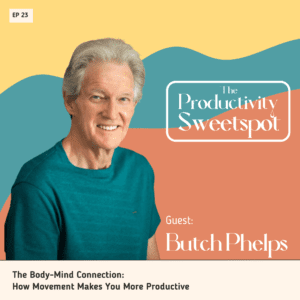
The Productivity Sweetspot ~ Episode 23
The Body-Mind Connection: How Movement Makes You More Productive
Most people think of productivity as a mental game, but what if your body plays just as big a role? Chronic tension, stress, and poor movement habits can drain your energy, making it harder to focus, stay efficient, and perform at your best.
In today’s episode, I’m joined by Butch Phelps, a muscle expert with over 20 years of experience studying how movement affects physical health, mental clarity, and overall productivity.
We’re diving into why energy management is just as important as time management and how simple relaxation techniques can help reduce stress, prevent burnout, and increase productivity.
If you work from home or spend long hours at a desk, this conversation is a must-listen!
In this episode, we cover…
Quotes from this episode
Transcript
In this episode, we cover…
The surprising link between chronic muscle tension and productivity challenges
Why stress and entrepreneurship often go hand in hand—and how to break the cycle
The advantages of energy management in preventing fatigue and improving focus
Simple stretching and relaxation techniques for stress relief and better work-from-home productivity
How to train your body and brain to work together for peak performance
Quotes from this episode
“Most people focus on managing time, but if you don’t manage your energy, you’re still going to feel exhausted and unproductive.”
“When you carry stress in your muscles, it’s like trying to work with a 50-pound weight on your shoulders—it slows everything down, including your focus and efficiency.”
“Small, intentional movements throughout the day can reset your nervous system and keep you from reaching that point of burnout.”
“Relaxation isn’t a reward—it’s a necessity. If you don’t allow your body to recover, you’re setting yourself up for long-term stress and fatigue.”
“When your body is in balance, your mind follows. The better you feel physically, the more clarity and ease you’ll bring to your work.”
Transcript
ANNE RAJOO
Productivity is not just a mental game. The body is much more involved than we might think. And today’s guest, Bucht Phelps is a muscle nerd who has studied the muscles of the human body for more than 20 years, and he is joining me for a conversation that really is a reminder that the same mindset that helps us in Peaceful Productivity, like pacing and mindful actions, applies to physical awareness as well. And so many of us try to push through the discomfort thinking that this is the only way to really achieve results, but Butch will explain that this no pain, no gain mentality is actually working against us.
In this episode, we’ll dive into how we can align our brain and our body so that we can improve our physical well-being, but also our focus and overall productivity.
So if you ever felt like you’re working harder but you’re getting less than this episode, get ready to learn how to stretch, release and move intentionally, and learn a few insights into the body and the muscles that I had no clue about, and so that we together can unlock better productivity in both the body and the mind.
Welcome to the Peaceful Productivity Pod. I’m your host, Anne Rajoo, and together we redefine productivity where peak performance meets happiness.
Most people think productivity is a mental game, but I think the body is much more involved than what we may think, and I’m excited to dive into a conversation today about movement and why physical health is critical in staying productive. My guest today is Butch Phelps. Butch, welcome to the Peaceful Productivity Pod.
BUTCH PHELPS
Thank you, Anne, looking forward to it today.
ANNE RAJOO
Me too. So let’s get right into it. Let’s start by hearing why you think that movement is critical in productivity.
BUTCH PHELPS
Well, you know, like you said in the introduction, I mean, it does have something to do with the mental side, but if the physical side is creating a lot of chronic pain, low back pain, stiff neck pain, between the shoulder blades, it makes it very difficult to think about how you can improve productivity when just walking to the rest of your back can be very painful. And so when you start to incorporate how the brain and the body works together, now what you can do with that is that you can use the body with the brain to free up the tension in the body so you can take out the chronic pain, and now the person that’s working for you, your staff, now has clear thought process to be able to do more at a faster pace.
ANNE RAJOO
I can’t imagine worse things than just like nagging pain that is just there constantly, and it doesn’t go away like it’s torture.
BUTCH PHELPS
Well, it is. And I have clients who come to see me all the time, and they’ve been suffering from, sometimes from six, seven months to three, four years. I can’t even imagine, for three or four years getting up in your knee hurts, or your back hurts, or your neck hurts. I mean, that just starts to overwhelm your thought process, and then all of a sudden trying to do more things in your business to improve your productivity really is detriment by that pain that you’re dealing with every day. So if we can take it and understand that no matter what job they do, a lot of times, people think when we talk about the physical side, we’re talking about people who lift heavy things, or carpenters or logistics people and so forth. But there are a lot of people who sit behind the desk looking at a computer that have neck and neck and shoulder pain and nagging low back pain, and then your knees start to hurt over time. Can be any of those repetitive movements that we do, understanding how to unlock those muscles changes everything.
ANNE RAJOO
Well, when we met, initially, I told you that I’m a mom of young children, and while they’re more independent now, I still remember those days when I had to sit with my little one on my lap, sort of like in this weird lean position, you know, one arm around him so he doesn’t fall down, sort of holding his hand not to touch my laptop trying to work. And every time after I did that, I had such neck and shoulder pain, because obviously that position was absolutely not helpful, but it is what I had to do.
BUTCH PHELPS
Exactly, moms too. I mean, most moms, like two daughters who have three children each, and I’ve watched them as well. And usually when you watch a mom or the child, they’ll have a tendency to hold that child on one hip more than the other. And after about six months to a year, all of a sudden their body becomes a little crooked because it’s so used to holding that child on that and so now you start getting into low back pain, you start getting into hip pain, you start getting into neck and shoulder pain. Moms do it because they just have to do it. They have to take care of the child, and it’s like, so what if we can show moms how to do it better, so that instead of just becoming something that’s going to be detrimental to them, and even in some cases, sure, hopefully not, but you never know. But if we could show them how to do something very simple that would take them probably 10 or 15 minutes a day and stop them. How nice would that be?
ANNE RAJOO
Why don’t we get into some practical things, not just for moms, but in general, like, I know you have got, you’ve got plenty of tools and techniques that you can share. So why don’t we go there now?
BUTCH PHELPS
Okay, so the place always like to start is and when we’re talking about productivity, we’re talking about what we do in our lives. Things I want to talk about is that no matter what you do, once you understand how the body works, how the body moves, now what happens is that you can now go back and fix it very easily. Now, once we understand how the body works and what’s happening there, now stretching back out, release of the muscle tension becomes really easy. Well, again, we can get into simple things. So we’re talking about sitting in front of a computer, for instance, or you’re holding a child, for instance, or you’re driving a car for a living, your arms are going to be out in front of you, which means that the outside chest muscles are going to get tight. The front of your neck is going to get tight over time, what happens is the shoulders start to round. The head starts to lean forward. Now, the head weighs about 10 to 12 pounds. Every inch that head goes forward, it increases the pressure down between the shoulder blades by 10 pounds per inch. And we all know that we’re on a computer. No matter who we are, the longer we’re on that computer, we seem to get closer and closer to the screen, which means that pressure between the shoulder blades are increasing more and more and more now the pain shows up between the shoulder blades. And when you go to someone and say, you know, Mr. Therapist or doc or whatever, I’ve got pain between my shoulder blades here. What’s the first thing they do, they go between the shoulder blades, and they’re trying to stop the pain between the shoulder blades. The problem there is that that’s not what caused the pain between the shoulder blades, the pain between the shoulder blades, it’s the symptom. What caused the pain between the shoulder blades, it’s usually the outside chest muscles in the front of the neck.
So when we think about the human body, we’re balancing front to back, side to side, 100% of the time. And always laugh and tell my clients, think of your body and the shoulders down as a pedestal, balancing your head on top, because if it gets out of balance, you will fall down. So if you’re in a position where you’re doing repetitive things over time, the brain then starts to assume that if you’re in that position with your head leaning forward, getting closer to the computer screen, or you’re holding a child, or you’re driving your car a lot, the brain then starts so soon, that’s your new normal. And so what we’re talking about with the stretch and release technique is teaching you 15 to 20 minutes a day, max.
Teaching you how to create a new normal with your brain through not only a light stretching technique, but also how to allow the brain to let the muscles unlock and let go. Now most people, when they think of stretching, they think of going to the gym and they’re pulling really hard and they hold for long periods of time. That’s not stretching, because both you grab your leg and you’re how many times you see someone lying in the gym, and they’re lying flat, both legs out. They’re going to stretch their hamstring, and then they lift one leg straight up and they grab it with their hands, and they’re pulling with all their might. Okay, so that’s a bicep curl. Your biceps are going to get bigger, but your hamstrings are not. The other point of that is your hamstrings. There’s three of them there. Okay, so between the three hamstrings and the four calf muscles that creates the rotation in your hips so that your hips won’t hurt when you’re rotating like the child or attention to your job or whatever, being able to understand that you got three of those there. Number one, you need to stretch all three of those. Now, when you’re stretching those I always give people a yoga strap with somebody foot long, but you could do it with a rope, but you lay flat on your back, you’d have, if you’re stretching your right hamstring, take your left leg, put the foot flat on the floor, so that the knee is pointing towards the ceiling, so that you take the pelvis out. There’s no bend in the pelvis. So what happens is when those legs are flat, and you lift that leg up, since there’s no bend in the pelvis, and you get to a certain point now you start to lift the other leg is hanging straight down, which is twice as heavy as the one just straight up in the air. So you’re going to tighten up your shoulders and your chest and your biceps.
How many times we taught that our whole lives, professionals all the way down, you see. And so those are things that you can change and do through the technique that allow you to hit all three of those muscles. So that if you’ve been there to push whatever you won’t string hamstrings can rotate well.
Most people, when they think of doing a calf stretch, they drop their heel off of a step. They’ll stand on a slant board. They’ll lean against the wall, but their leg out behind them. And they think, if they stand there for a long period of time, maybe they’ll do a downward dog that they’re stretching their calf muscles. Well, you have four of those. And again, there’s two bones in that lower leg that you have to rotate with. And so at best, what you’re doing is you’re stretching your Achilles tendon at the base, at the back of your heel there, but you got to be able to use that strap and actually rotate that foot to get all four of those place. Now, once you do that, when you’re rotating and so forth, even if you’re playing tennis, are you playing golf, and so forth. Those things now, all of a sudden, free up the hip, free up the low back, and now your body can perform. I don’t care if you 78 years old at a high level.
ANNE RAJOO
I had no idea about the number of what was it the muscle? I know the muscle. I lost the muscle. (Hamstring). I have very tight hamstrings. I had no idea we are three of them. That’s interesting. It’s fascinating, like what you said, in terms of its different spots in the body that actually causing the issue, like you said, the test muscles and the neck muscles, but then we want to go and massage the bag and then it doesn’t help. I mean, my husband often comes with a nice massage and like “thank you”, but I still feel super stiff. But it’s obviously because I’m not getting to the cause. And I’m wondering, while you were saying these little exercises, is it better to do these before? For example, I sit on the desk for like, two hours.
BUTCH PHELPS
I get that all the time. It’s funny, so it doesn’t matter. Doesn’t have to do it before or after. I do my 20 minutes in the morning. I do it for about 15 before I go to bed. And the reason I do it twice a day is number one, when I’m sleeping at night, when you have a dream, or you’re rolling around in bed, you’re tightening or tensing your muscles. So the first thing to keep in mind is that muscles will tense from everything you think, feel and do. So if you feel angry, you feel sad, you feel depressed, or whatever, you’re going to feel very different than if you feel happy, that you feel joyful, what you go in, what state of mind you’re in, can change the intensity of the muscle itself. Then when you look at movement, remember, do it also, or lack of movement. Can do it also. When you look at when to do them, if you get up, you just make it a routine every morning to do basic stretches. So there’s about 125 different stretches that I have in stretch and release technique. That doesn’t mean you have to do them all.
So if you have a job where you’re a truck driver, or you’re you’re sitting behind a desk, or you sit a lot, then what’s going to affect you the most is going to be again, the outside chest muscles, the front of your neck and the front of your sides, the quads. Because if you find yourself getting up in the morning and your back really hurts. Your low back hurts when you stand up in morning time and you realize that you can walk around a little bit and it goes away. That’s not a back problem. That’s that’s a quad problem. Okay, those are the kind of things that based on the job or based on the activities that you’re doing, you can tailor it to fit what it is you do most of the time, and so that then starts to stop the pain without you doing extraneous stretches that you know you’re never going to do a split, probably. So why even bother with that?
But what we’re trying to do is let’s find out how we can live our life without having constant pain every day. Because I’m telling I run into people all the time who’s been in pain for months, and it’s taxing, and, like I said, torture.
ANNE RAJOO
And I think this is a great spot to move over to, sort of the clarity of mind effect that movement has, the ones obviously you remove the Chronicle pain, and the pain is gone. That feels great. But what else is there that you teach your clients, or that you work on with your clients in terms of clarity and focus?
BUTCH PHELPS
Yeah, for sure. So the idea that when I say so, I say Stretch and release, and I wish I could find a different word for stretch, because it has so many connotations that when people think about it. The gym class, you know, but it’s really what so what I use the stretch part of it is I actually use that to put our body in a position. So in other words, as I’m still working on the hamstrings, we’re talking about earlier, as I’m walking up that strap with my hands, my leg is not helping me at all. My hands are walking that leg up, and as my leg is coming up, I wait to feel that initial tension that I feel now the goal is is not to pull twice as hard, because hey, if it feels good here, if I do twice as hard, it’s going to be even better. That’s not the goal. Because if you do that, the brain senses a danger of an injury, and the brain will contract the muscle to stop you on the front side, so you may wind up with low back pain over a period of time of doing that, if you do that, so when you get up to that first level of tension, what you’re doing, for a mental aspect, is that you’re breathing out. You’re only going to hold for about five seconds at a time, and you’re just going to allow the body to relax in that position, and then you’re going to walk it right back down and come back and do it nine more times. Now what you’ll find is that each time you come back up, that leg will come up a little farther each time as you then rotate the foot inward, that puts you to the inside calf, hamstring muscle, and you start to do the same thing again. And then you’ll rotate the foot outward and do the outside and that was going to come slightly across your body. Don’t worry, I have videos of all these things for free on the internet side. It is great. But you’re going to bring that leg across your body so you can get the outside hamstring muscle. And then I always take them back to the original straight up one. And they’re always blown away. I don’t care if they’re 38 or they’re 88 doesn’t seem to matter. With a hip replacement or not, doesn’t seem to matter. They’re like, Oh my god, does that my leg? And I’m like, well, it’s not my leg, you know. But the thing is, is that as you’re able to move their leg, because the mind got out of the way now the body will move.
ANNE RAJOO
What I hear there is really this body-mind connection. And, I mean, I’ll admit that when I do stretching, it’s more like, Okay, let’s get it done. Because, you know, I’ve done my workout yeay. Now, let’s finish it off with stretching, which is, but I don’t use my mind a lot for it. So I think this is what I’m hearing now, and this is what I will probably change. I’m like, really listening to my body there, like when we said the initial little stretch and the feeling, yeah, and I think this is exactly what I want to like bring out into the world with peaceful, productivity, mind, body, altogether, mindfulness, intentionality. And I just realized I haven’t done that with my stretching. So thank you.
BUTCH PHELPS
You’re welcome. We’re never taught that. I mean, we’re taught exactly to feel what you feel. You know, if I keep pulling my harder and harder and harder, I’m fighting with my muscle. If I pull it harder, my muscle will just get in. You’re not fighting with your muscle. You’re fighting with your brain, because the brain is afraid you’re going to hurt yourself. And it’s like, once you can control that part of it, what you’ll find is it’d be very relaxing. I call it. My brain breaks twice a day, and doing it twice a day becomes really easy, because if you do it before you go to bed after all day now, the body is in a more relaxed state. You’ll have less leg cramps in the lower legs. You will have better sleep because the circulation of the blood is moving better because it’s not tight. In other words, when the muscles get tight like that. They can actually reduce blood circulation. They can reduce nerve connectivity here. And so what we want is to get the body in a more relaxed state. Now, when you think about the joints, especially, the muscles cross over those joints, and as they do that, and they get really tight that pushes the joints closer together, which squeezes out the synovial fluid, now, all of a sudden, you’re heading down a path of someday having a hip replacement or a knee replacement somewhere. My thing is, is, what if we can, we can solve that, you know? And it’s like so I’ve had great success with people who have things like plantar fasciitis, where within two to three days you can knock it out, even though they’ve been suffering with it for six months. Because everybody treats the foot, carpal tunnel, everybody treats the wrist. It’s actually in the forearm, and I’ve had great success with that elbow tendonitis. I’ve seen it where you knock it out in 30 minutes to an hour. And here you see people walking around with bands on their arms all the time. But you have to understand how the body moves and how the body works. Now here’s a weird thing that would kind of blow your mind when I was studying muscles in school. My background is in aging sciences and neuromuscular massage, when we started looking at peer-reviewed studies, because some of my professors were saying what you’re talking about, that you’re seeing, I’ve never heard anybody talk about that. You’re kidding. And so we started digging into peer-reviewed studies. Well, based on the studies, depending on who you read, you may have as few as 640 muscles and as many as 700 straight there’s not a real consensus of how many you have. The most common is like 653, if we don’t put the mind part into with the muscle, you cannot get the muscle to release. You have to understand that the muscles are the slave to the mind.
ANNE RAJOO
It’s really a different approach and a different concept than what I’ve ever heard. So this is really intriguing. I’m going to take your videos. I’m definitely think I’m going to need some stretching tonight, because I mentioned today. So when we said light, I like that. So this is a great idea. And before we wrap up, I heard you also say massage, and I think you have something like a self-massage. So maybe this is something you can share and then share where we can find you and the videos and all that good stuff.
BUTCH PHELPS
Absolutely, absolutely. So I do have a self-massage part of it, and I teach my clients how to do that. It’s no different than when you’re doing the stretching part. Most people get a deep tissue massage, and they go see a massage therapist, and they’re grinding and grinding and grinding on them. Well, the ironic thing about that is that, hey, the person laying on the table, they feel good for a short period of time, but what happened by the therapist grinding so hard on them, their brain is contracting the muscle, much like if they were lifting away to failure, which means the muscle fatigue is completely out, and you almost have, like, no control over for a moment. Okay, so you feel good momentarily, but it then it comes back. When I talk to people about self massage, it’s the same concept. It’s like you want to press just hard enough with your hand or with a tennis ball on the backside against the wall. Want to press just hard enough that you can find the sore spot. But the temptation for so many people is, I want to just dig in once I find it. You don’t want to do that. You want to breathe out and allow the pain to let that muscle go, and as it does, it softens up, and it lasts so much longer. Now, the ironic thing I saw earlier is that when you have a therapist digging in, digging in, digging in, most of them wind up messing up their thumbs because they’re working so hard. And many of my therapist friends here, if they do four or five people a day, that’s a lot. And when I say to them, I’ll do eight to 10 people a day, they’re like, blown away. And it’s like, so thing is, it’s a dance. It’s a dance between me and the client.
And same with the videos. Now, the videos you can find on my YouTube channel at The Muscle Repair Shop. In those videos, I’ll talk about certain injuries and so forth that people have, and then I’ll share with you how to do the stretches that you can follow. Now, what blew me away was that I’ve gotten comments from people from all over the world, and they’re just like, oh my gosh, you know that teeth grinding thing that you had? I follow that. And I had this for like, months. All of a sudden, last night was my best night’s sleep. And I’m like, seriously, I’ll hold a video. I was like, Well, I was like, this is a crowd. I’m very grateful that I’m able to help people in that way. I do have my website is www.musclerepairshop.com and I have a weekly newsletter that comes out every Tuesday. And in that newsletter, I’ll really dissect into common ailments that people have, and always have three videos on it to help you go through and learn how to do the stretching itself, and then I’ll do zoom consultations with people if they don’t live in the area, so that we can talk about what’s going on and give them an idea what’s happening with their body. For instance, if you’re dealing with chronic low back pain that’s probably coming from your quad, if you’re dealing with chronic mid back pain is probably coming from your chest muscles. And then sending them videos that they can follow to make that happen. And lastly, I read the book called The stretch and release, and it’s this like a manual to all this. It really dives deep into how this works and why it works. And I’ll have a section on nutrition. I have a section on why traditional treatments often come up short. And then the last three or four chapters of the book, it dives deep into the back the neck and shoulders and legs and so forth. So that’s probably the best way to reach me at this point.
ANNE RAJOO
Wow, incredible. Thank you so much. I’m definitely gonna subscribe to the newsletter. I think I’m really curious about changing that. Yeah, that mindset about the muscle pushing harder, and it’s exactly that the productivity pushing harder doesn’t work. It seems to not work with the muscles either. So thank you so much for the conversation today.
I love that. In essence, this conversation is a reminder that in productivity, it’s not about pushing harder, whether it’s our work or how we actually treat our bodies. And I love Bucha approach that really shifts the narrative from just getting it done to listening and tuning into our body signals, to shift our mindset to towards peaceful productivity and a peaceful approach in the way we do things. And personally, as someone who’s a runner and loves sports, I’ve never given stretching enough attention. And yes, of course, I’ll do a quick stretch after a run and trying to, like I said in the interview, always harder, make the muscles stretch more, make, you know, be more flexible. And yes, I love yoga, and that’s maybe a more gentle approach. But even there, I do. I do push myself. It’s just something that is deeply ingrained in myself, and I did not notice that I do that with my body too. And so I love the things that Bucha brought up here, that we can actually really tune in and work with our muscle against instead of against it. And I think this is so true for many things. In productivity and the way we work, we often try to push and that is a way of working against something that is coming up for us in, you know, in productivity, in the way we work, instead of working with it and being attuned and aligned. So I really enjoyed this conversation, and I hope you did, too. And I would be curious to know what came up for you if you want to have more conversations like these. And I would just love to hear from you and drop me a DM on Instagram. My Instagram handle is @_annerajoo_. I just love connecting with you there.
And before I go, a quick reminder next week, I will be back for a solo episode, and I will walk you through how to do a time audit and why it matters and how it can help you reclaim your time. It’s not always the lack of time, which is easy to blame for, for, you know, for the rush and the feeling of never enough time, but it’s actually the way how we spend the time that we have, and taking a step back and really understanding where your time is going is incredibly powerful. So join me next week, and until then, be peacefully productive, and I’ll catch you next time.
Listen on your platform of choice


View all episodes
Get more of Butch
Do you struggle with being productive?
Discover where to start when creating business harmony and work-life fulfillment with the Wheel of Peaceful Productivity
Keep In Touch with Anne
Subscribe to her newsletter
Peaceful Productivity Letter
Join hundreds of readers and enjoy three actionable tips on how to make the most of your time.
Thank you!
You have successfully joined our subscriber list.