
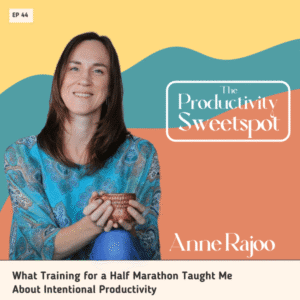
The Productivity Sweet Spot ~ Episode 44
What Training for a Half Marathon Taught Me About Intentional Productivity
Ever thought marathon training could teach you about Peaceful Productivity?
In this solo episode, I’m sharing the unexpected lessons I picked up while preparing for my first half marathon and how they apply way beyond running shoes and finish lines.
From managing setbacks to redefining what “success” really looks like, this journey wasn’t just physical. It became a lesson in sustainable success, discipline with compassion, and trusting yourself to take imperfect, powerful steps forward.
Whether you’re recovering from burnout, shifting your habits, or simply craving a more intentional rhythm in business and life, this episode is a gentle reminder that progress doesn’t have to be perfect, support systems truly matter, and your identity shapes your habits, not the other way around.
If you’ve ever told yourself “I’m not productive enough” or “I just need to try harder,” this reframe is for you.
We’ll talk mindful routines, productivity mindset shifts, and why giving yourself grace might be the most productive move you can make.
Let’s trade hustle for intention. You in?
In this episode, we cover…
Quotes from this episode
Transcript
In this episode, we cover…
- Why productivity doesn’t have to mean perfection
- How I stayed on track without burning out (even when plans changed)
- The mindset shift that helped me stop “trying” and start being
- How identity, not willpower, became my real motivator
Quotes from this episode
“Discipline can look gentle. You don’t have to push harder, you just need to stay aligned.”
“I’m not a professional runner. I had setbacks, I missed training days. And yet, I did it. Peacefully.”
“Progress isn’t linear. Intentional flexibility is a form of discipline.”
“The biggest shift? I stopped trying to become a runner… and just decided to be one.”
“Peaceful productivity isn’t just for work. It’s how we move through life with presence, compassion, and purpose.”
Transcript
INTRO
I didn’t expect to get productivity lessons while dodging hedgehogs at 3.30 a.m. in the morning or whispering come on to myself doing a tech fail mid-half marathon race, but here we are. So in this solo episode, I’m talking about the behind-the-scenes of my recent half-marathon, not just the running part, but everything it taught me about sustainable success, staying grounded when things don’t go to plan, and what it really means to show up with presence and purpose. If you’re feeling like productivity only counts when it looks perfect or polished, I think you will love this little reframe because training for this race reminded me that discipline can look gentle, progress can be flexible, and identity, well, it can change everything.
Welcome to the peaceful productivity pod, where we redefine productivity through a lens of mindfulness and holistic well-being. I’m your host, Anne Rajoo. As a busy mom, entrepreneur, and advocate for a harmonious life, I’ve learned that constant busyness doesn’t equate to true productivity.
Join me here as we explore a diverse range of topics from innovative productivity tools and mindset shifts to creative approaches that help you find your sweet spot, that magical place where peak performance meets happiness. Discover how experts and regular people alike tame their to-do lists, sharpen their focus, find clarity, and maintain a calm, present lifestyle without compromising peace and fulfillment. Set it in, relax, and prepare for actionable insights and practical tips here on the peaceful productivity pod, and leave feeling motivated and confident.
SOLO TRANSCRIPT
So you might be wondering what does running have to do with productivity? I just really wanted to share this different case with you because it definitely has taught me a couple of lessons about productivity and really how I personally can apply peaceful productivity beyond the work I do. And so I have been a runner for many years of my life. I used to be an athlete as a child.
I had the dream to be in the Olympics. Unfortunately, my parents moved. There was no athletics club, and I gave up that dream and I gave up that sport.
But I always loved running and high-intensity sports, and up until I had children. I was running a lot almost every day, sometimes several times a day. I just really enjoyed that, and I always wanted to run a marathon, but I never got around to it, and I think it’s simply because my priorities back then were very different.
I felt like I’ve got plenty of time, and then as I said I had children and I gave up running because it just felt really difficult to make time for that. And so it’s been about 10 years that I did not run. I eventually decided to start running again.
That was I think at the end of last year when now my 10-year-old is into athletics and he loves running and so he wanted to run a trail run here in Mauritius in the mountains. Okay let’s do a little 5k. We can do that together.
I can run with my son. Well he outrun me, of course. And I just fell back in love with running and ever since I have been going for runs more regularly and eventually convinced my friend who is a cyclist to join me and do the half-marathon with me.
And so we have been training together but there have been a few roadblocks along the way and I had to pivot and shift and find different ways of doing things and I think this is a big part of peaceful productivity because not every day is the same, not every season of life is the same and not every project is the same. And so I wanted to share some of the lessons that I’ve learned through the half-marathon and also really just share with you that productivity can be applied to things that are not necessarily related to work or productivity per se. Yes that’s just my little backstory.
Why am I talking about running and productivity here? But basically we decided to run this race in July. So when I’m recording it it’s been a couple of weeks ago. We started training in the beginning of the year which is summer in Mauritius.
It was very hot so we already struggled to find days that were sort of bearable for us to do it. But anyway at 42 years old one doesn’t run the 21 kilometers race just like that. And so we started small.
Started with some 5k races, then went up to 8, still feeling okay about that. 10k started to be a stretch. So we definitely needed to train to get to 21.
I was very proud of my body because surprisingly I felt that muscle memory was still there and probably I’m lucky my body in general is very athletic, very made for running. So I’m a natural what they would say. My friend always said she’s not but she in the end definitely caught up because she’s been running faster than me, and I think if she wasn’t running in front of me for the half marathon I don’t think I would have made it through.
The point here is that I’m not a professional runner. I had setbacks. I missed a lot of training days and I will tell you why.
Yet I did the whole thing peacefully because it was important to me that it felt good. So just for you to take this part away already that when you’re building something, when you’re working on a project in your business, you’re recovering from burnout or you’re trying to reclaim your time somehow, there is something here for you in today’s episode. This is not really about running and you do not have to have any interest in running.
So I’m gonna go through a few points that I felt I took away from the whole process from the beginning of the year working up towards the event early July.
The first point I want to share that is productivity related is that you’ve always got to set yourself up for success and that means you’ve got to have a plan. Planning matters.
So when it comes to work we can use apps, we can use different tools, we can work with people, mentors, coaches, programs.. But we’ve got to have a plan and we have to understand what matters and how do we get from point A to point B. Because you wouldn’t just go along and wing a big launch or a big project. You would make a plan and the same goes for the marathon training.
And so the lesson here really is that we don’t have to do DIY things. There are already tools and systems and people who have done this before us out there. So for my training I would use a running app and I would talk to a friend who’s a very avid runner and who gave me some tips on how to develop a training plan.
So I didn’t just go and be like let me just run for 5k today and maybe tomorrow I go for 10 and then I go for 20. No there was a plan. So that applies to productivity as much as it does for training for a run.
The second part is that we’ve got to stay flexible and compassionate and that’s definitely a big part of my peace framework. Because in my training I got sick. I got sick back in April.
At the end of April quite badly. It was really rough. The whole family got knocked out.
I sort of had the least symptoms and felt the best that week of the sickness. But I was left with a very very persistent cough. I still have the cough.
You probably might have heard it in the last episodes that sometimes I would have a bit of a nasal voice. This cough is still here. So now that is what? 8 weeks? 10 weeks? Almost 12 weeks.
My goodness. This cough is not going away. Initially I pushed through because I was just getting into the swing of things.
I just felt really good with my runs and I was making progress. I could see my speed increasing and I pushed through because I felt okay. Physically I was absolutely fine and the cough didn’t actually bother me when running.
But at some point I got to this moment of my body sort of feeling like it wants to shut down. I just started feeling really cold and shivering and I had to crawl into bed and I couldn’t move. There was no energy left.
That happened a couple of times, and so okay, I guess I will have to stop running. Went to see a doctor. Did the chest x-ray.
Everything fine. It’s just a persistent cough. Not much we can do about it.
Great. But I had to stop training for quite a few weeks, and it really bugged me. It really annoyed me.
It got me quite upset with my body that it would just do this to me at this important moment. Anyway what can I do? Like sometimes you’ve got to deal with things that are outside of your control and it really taught me the lesson again that progress isn’t linear. We have to be flexible and there needs to be some intentionality.
So discipline can look that sometimes we don’t do the thing because there are other reasons and there’s other things that maybe have priority. Like my health had obviously priority in that moment but I was still disciplined. It is about flexibility and compassionate action when we work on our productivity.
Then the third lesson is that we want to build accountability systems. So I had my running buddy. Obviously, she kept me going.
We trained together most of the time, and even if we didn’t train together with that app that we used we could share our runs, and we could cheer each other on and be excited for each other. And then obviously I told my husband about my plans and my boys, who also got very excited for me. So that everybody in the family would understand there is something going on here that takes a bit of priority and maybe a little bit of shifting and shuffling things around.
And so in regards to your productivity we’ve got to have some accountability system and support because that support creates momentum and it’s not about doing everything solo and by ourselves. Having a buddy is incredibly powerful. So that’s lesson number three accountability systems and support partners.
Then lesson number four is we’ve got to honor our energy cycles and our motivation. And I speak about this a lot. It’s clear to me that I perform a lot better in the morning especially physically compared to the evening.
And I trained in the morning. I did try in the evening and I felt that my runs were not as good. It’s about playing around.
It’s about trying things out and seeing what works and what doesn’t work. But then to listen to your body and to your mind and to understand when is your biggest capacity. So you might be the morning person.
You might be an evening person. You might be like my recent productivity audit client. She needs a very slow morning.
She wakes up early but she takes a lot of time to really get into the groove. For me everything is rather fast paced. But yet to understand what’s your energy cycle and when do you function best.
And that’s obviously why I created my productivity style quiz because that’s a big part of your style, your natural rhythm. And if we tap into our productivity style it becomes easier and we can take advantage of our style. We can take advantage of the fact that we work better in the morning or the evening and we can try and create our schedules around these things.
It doesn’t mean that we have to just work at any time of the day and to push through and beat ourselves up when maybe we don’t have enough focus or we feel demotivated. We can design our days and projects around those energy cycles. That’s lesson number four energy cycles and motivation.
Then the fifth lesson is that we’ve got to prioritize and sometimes there are trade-offs. So I used to go to yoga on Wednesday morning and I love yoga. It’s beautiful.
It just really relaxes me and obviously stretches my old bones. It’s not that bad, but you know I was I was just getting into that consistent yoga practice and I could again feel the improvement there. But when I got back into running after the sickness I obviously needed to sort of catch up and so I needed to shift things around and had to skip my yoga practice.
And I definitely felt a bit guilty when I had to tell the teacher that I’m not coming. I was thinking of making up some excuses and then I thought no, hold on, this is my priority. The running is my priority right now and I am proud of that and I will tell her that, currently, I’m training for that half-marathon and until I’ve run the race, I will not be able to come back to yoga.
And so it the productivity lesson there is that really, there are always things happening around us, and sometimes these could be destructions. There can be things that we always have done like this. It’s always like that.
It’s part of our routine. It’s part of our day, week whatever it could be and that’s totally fine. But if there is a specific project or a specific goal that requires some shifting then that could mean that there is a trade-off and that’s okay because it’s got a valid reason and it’s done intentionally.
So the intentional part there is a very important not just skipping the exercise or skipping the food just because oh, I’m so busy I’ve got to finish this deadline. It’s got to have a valid reason and in my case the yoga I had to move for a few weeks so that I could create space and time for the running because also as described in the whole process is as with the yoga as I was doing it more regularly I saw improvements. As with the running as I was doing it more regularly I saw an increase in my speed and increase in my distance and the same with work.
If we do something regularly it becomes sort of easier. We create a process. It goes faster and that is because each little action compounds over time and so that’s important.
But we can only create those compounding effects if we prioritize intentionally.
The last lesson of this whole process is number six the identity shift. So I told myself consistently that I am a runner.
It’s not I am trying to run a half marathon or I’m trying to create this project. I am trying to get better at yoga. I am a runner and that is my identity and that is huge.
That is a huge shift that we can create through simply using these words instead of the trying and the attempt to because this identity that we take on it really is a fuel to stay on course, to stay motivated, to do the things that we said we would do because we are that person. So if you’re trying to create any sort of new habit, if you’re trying to be that peacefully productive person, then call yourself that. Take that on as your identity.
I am a peaceful, productive business owner. I am working in a relaxed and calm way. I am the owner and manager of my time, and so this identity shift is really powerful.
And then I have a couple of little bonus lessons that I just want to sprinkle in here quite quickly. I always speak about baby steps and celebrating wins. So even if we didn’t do the runs that we had planned and we didn’t go along with the running app and the training schedule, my friend and I would always celebrate our longer runs.
We would meet on a Sunday and we would run and then we would have a lovely coffee after the run and we would just really praise ourselves like each other like, you did a good job, the pace was great. We want to celebrate those little micro wins. And of course we don’t want to compare ourselves to someone else who’s been doing this for years or someone else who’s a professional.
Like we we once tried to go with a running group. Neither my friend nor I had ever run with a running group and we were a bit, felt a little bit uncomfortable and they were talking about the speed and the distance they would run and we’re like okay well we are just here to run, we’ll see. A couple of them run off quite fast.
We felt quite positive about the pace we were going, but these other two they were just incredibly fast, and so the worst thing we can do is compare ourselves to those people. I mean if they run several days a week, they’ve been doing this for years, it’s not very productive and beneficial to compare yourself to other people. And then the next little bonus lesson is that the recovery part is part of the game plan.
Rest is productive and I’m gonna link a couple of episodes that I recently recorded on the podcast about the importance of rest because just as in training for a half marathon we have to make sure that we recover our bodies, our brains, our minds and this is productive. And then just a couple of funny stories about the race because the race also didn’t go as planned. It was quite interesting.
The night before race day I went to bed very early because I wanted to make sure I’m well rested. We had to leave at 5 a.m. in the morning to drive down to the south of the island to be in the place where the race is happening. We had to drive for an hour and a half at least.
We got into bed early and I wanted to have a beautiful restful night which didn’t quite happen because my little one had to wake up in the middle of the night and he didn’t want to fall asleep, so that was already a bit of a disruption. And then about 3.30 my dog started barking and he never barks at night really unless there’s something. And I could hear him outside you know going around and bumping into things and pushing his water bowl like the metallic scratching on the stones.
Okay I’ve got to get up I have to check what he’s got there. He had caught a hedgehog. So at 3.30 a.m. in the morning, I found myself collecting this poor little thing and putting it away from the dog at a place where he couldn’t reach it so that my husband could dispose it in the morning.
And I obviously couldn’t go back to sleep. And that really is the lesson there is that we’ve got to build in buffers. I went to bed early.
I’d still got a decent night of sleep. If I had stayed up and watched TV until 10 p.m. I wouldn’t have had enough sleep. In productivity to crossing it over we’ve got to build buffers.
Then we left the meeting point and we drove down and we got to the starting point and I was just connecting my earphones with my phone and selecting my playlist and somehow when I put my phone into my little pouch I must have pressed something and I ended up on some paid Spotify settings. I have the free version. I don’t listen too much to music and it wouldn’t play.
And the race started and I was still fiddling around with my earphones and trying to figure out my playlist and it just wouldn’t happen. It would keep telling me you’ve got to pay. You’ve got to pay.
And I was like oh my god. I was literally feeling frustrated because I thought my I have to run about two hours now without music and I thought I would probably get desperate. But actually it was quite nice because with that I had a very very clear mind when it came to those points where I felt like I want to give up.
I cannot do this anymore and that’s when I started telling myself come on, come on and finally I found myself breathing and telling myself come on in a rhythm. So that was quite sort of a bit meditational and really pushed myself at the end. And then when I got home, my boys were out with their dad, so that I could have a quiet house and could sleep when I got hom,e which was very nice.
And when they came back, they had bought me flowers to congratulate me on my race. So that was just beautiful to see that they had understood that it was important to me. That they had made it possible for me to come home to a quiet home to sleep, to give me time and space, but then also to bring something meaningful.
That was just a really beautiful moment at the end of the race. So before I wrap up, now peaceful productivity isn’t just for work. I think today’s little story showed us that it is part of how we can live, how we move through setbacks, how we hold ourselves through discomfort because we can still choose to show up gently and intentionally.
OUTRO
So here are two ways that you can apply this for yourself today and I would invite you to choose one identity you’re stepping into.
So for example I’m a CEO or I’m someone who honors rest or I am a focused creator and let that really shape your next decision. Take on that identity shift as I said it is very powerful and a very small simple action.
And the second one would be to ask what’s one system or support you’ve been trying to DIY that you could actually outsource or simplify or where you could ask for help. Because again it’s not a solo sport it’s a team sport and having accountability and support are game-changers because we don’t need to push harder we just need to stay aligned with what matters to us.
So I hope you enjoyed this episode and if you did it would be amazing if you would take a screenshot and tag me on Instagram _annerajoo_ or share it with a friend who might need a little bit of a nudge of motivation, and of course, that peaceful kin,d not that push through and push harder kind.
And next week I will be diving into something totally different. I will be joined by Meital Regev and she is a coffee artist and we’re talking about creativity and that is not just for artists. It is a powerful tool for problem-solving, time management and productivity in any business and we dive into how creative thinking and mindful productivity strategies can help you entrepreneurs to work smarter, reduce the overwhelm and build a business that you love.
So subscribe to the podcast that you don’t miss the next episode and I appreciate you. I can’t wait to be back with you here next week and until then stay peacefully productive. I’ll catch you next time.
Listen on your platform of choice


View all episodes
Get more of Charu
Do you struggle with being productive?
Discover where to start when creating business harmony and work-life fulfillment with the Wheel of Peaceful Productivity
Understand Your Unique Productivity Style -And Leverage It for Greater Ease & Focus. Take the Quiz!
Keep In Touch with Anne
Subscribe to her newsletter
Peaceful Productivity Letter
Join hundreds of readers and enjoy three actionable tips on how to make the most of your time.
Thank you!
You have successfully joined our subscriber list.