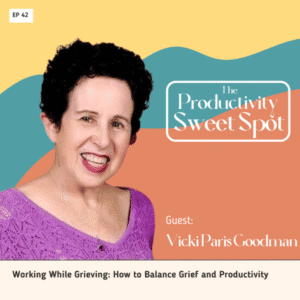
The Productivity Sweet Spot ~ Episode 42
Working While Grieving: How to Balance Grief and Productivity
What does it really look like to keep showing up for your business while navigating loss?
In this deeply human conversation, I’m joined by Vicki Paris Goodman, author of To Sam With Love, to talk about grief and productivity balance, and how we can keep moving forward without guilt when life turns upside down.
Vicki shares her story of losing her husband and finding unexpected optimism after his passing. From rejoining her orchestra to writing a book, she found purpose and meaning after loss while honoring her grief along the way.
We explore why it’s not about “getting over it,” but about allowing yourself to grow while grieving. Whether you’re running a business, leading a team, or simply trying to make it through the day, this episode offers grounded inspiration on working while grieving without losing yourself, how Type A personalities handle loss differently, and finding meaning after loss even when it feels impossible.
Even if you’re not navigating grief, this episode is for anyone facing one of life’s unexpected curveballs that make it hard to stay focused, show up, and keep moving forward, with real lessons in finding balance, purpose, and peace along the way.
In this episode, we cover…
Quotes from this episode
Transcript
In this episode, we cover…
- How to balance grief and productivity without losing yourself
- Moving on from grief while still honoring what was
- How to stay focused and keep moving forward when life throws you off track (grief, loss, or any unexpected curveball)
- Coping with loss as a Type A personality (without burning out)
- Finding meaning and inspiration after loss, even when it feels impossible
Quotes from this episode
“You can grieve and be productive at the same time. It doesn’t have to be one or the other.”
“All adversity is here to teach us something. Even grief.”
“Moving on after loss isn’t betrayal, it’s honoring life’s next chapter.”
“Souls in the afterlife only want what’s most fulfilling for us. There’s no guilt in living fully.”
“You don’t have to cocoon yourself for three months or three years. You can start with just one thing, right away.”
Transcript
INTRO
Grief isn’t something we usually talk about when it comes to productivity, but the truth is, life doesn’t pause when we lose someone we love, and neither does our business. In today’s conversation, I’m joined by Vicky Paris Goodman, who shares her story of navigating loss, rebuilding her life after her husband’s passing, and doing it in a way that is full of hope, growth, and even joy. What struck me most in how Vicky found a way to grieve without shutting down and how she gently rejected the idea that we have to cocoon ourselves or pretend everything is fine.
Instead, she chose a third path. We talk about unexpected optimism, honoring quiet time without getting stuck, and how you can still move forward creatively, slowly, intentionally, when everything feels like it’s changed. If you’ve gone through something hard, and who hasn’t, and wondered how to keep showing up, this conversation is going to speak to your heart.
Welcome to the Peaceful Productivity Pod, where we redefine productivity through a lens of mindfulness and holistic well-being. I’m your host, Anne Rajoo. As a busy mom, entrepreneur, and advocate for a harmonious life, I’ve learned that constant busyness doesn’t equate to true productivity.
Join me here as we explore a diverse range of topics, from innovative productivity tools and mindset shifts, to creative approaches that help you find your sweet spot, that magical place where peak performance meets happiness. Discover how experts and regular people alike tame their to-do lists, sharpen their focus, find clarity, and maintain a calm, present lifestyle without compromising peace and fulfillment. Set it in, relax, and prepare for actionable insights and practical tips here on the Peaceful Productivity Pod, and leave feeling motivated and confident.
TRANSCRIPT
ANNE
My goal on the podcast is to bring diverse voices and aspects of productivity, and so I think it’s important to speak about disrupting events in our life, like a loss or real hardship that can be really difficult to stay productive. So Vicky, you’ve got a very touching personal story, and a very interesting story in terms of dealing with grief and adversity, but not letting it derail you completely, but you found so much positivity in what happened. So just maybe share with us to get into understanding, you know, why are you here? Why are we talking about this topic at all?
VICKI
My wonderful husband Sam passed in 2019 from cancer, two years after we got his terminal diagnosis, and I was very surprised by what happened afterwards.
It actually all started the day he passed. I was raised very secular, and so I didn’t have much of a belief system in anything at the time, and neither does anyone in my family for that matter. On the day Sam passed, I felt like a helping hand was coming from somewhere outside of myself to sort of lead me forward, and I was flooded with optimism.
That was a little unseemly. It just seemed way too soon for that kind of optimism after losing the love of your life. But I thought back on how strong I’d been during our two-year ordeal and how well I took care of Sam, which isn’t really my nature to be a caregiver, how well I took care of him at the end when he needed taking care of. I thought, if good things want to come my way, even this soon after his passing, maybe I should let them, and it was a great decision I made, and that’s how it all started.
And then insights came my way, opportunities to do things that I might not otherwise have done, while Sam was still alive, and serendipitous events, things that let me know that maybe he was still with me, and that’s the start of my story.
ANNE
It’s really interesting because I think when something like that happens, there are certain expectations of the world, how you should handle this and how you should cope. And like you said, soon to feel positive about the event is definitely not something that people would associate with losing someone or a difficult event in your life.
How did that feel to sort of like go out into the world and be positive, but maybe people didn’t receive that very well, I would assume?
VICKI
Well, it’s funny because some people, I remember a couple who were friends of mine, every time I would see them at an event or something for the first year after Sam passed, they would conspicuously sort of lower their energy levels and, you know, look sad in deference to my loss. And I felt I had to do the same thing in return, even though I was happier than that. I felt that when I was around them, I had to kind of diminish everything.
And I was so glad when a year had passed and they kind of stopped doing that I could not worry about it anymore. So that’s one thing that sort of manifested itself, as you suggested. But in general, I was grieving. I was missing Sam, you know, especially in the evening when I tended to be home after whatever I’d been doing.
And I’d think about Sam. But it was interesting how I could have engage in all these activities. Some of them new to me, like I started singing, for example.
I didn’t know I could sing, but some friends said, come to karaoke. And you don’t have to sing. It’s just a great group of people that I think you’ll really enjoy being with.
Well, it turned out I could sing. Now I sing in public sometimes. So I was doing all of these things.
Some of them new to me. I rejoined the orchestra I’d played in before we got Sam’s diagnosis. I play violin in a pops orchestra here.
And so I rejoined the orchestra and I’d have lunch or dinner with a friend. And I was doing all of these things. And then coming home and feeling like it was all meaningless. And I think that was because the person who I’d shared everything with, either I’d do things with Sam or if he wasn’t with me, I could tell him about it when I got home. That option really wasn’t available to me anymore. So, it was kind of a combination of doing all these fun things and then coming home and feeling like it was meaningless.
And I knew I had no control over that aspect. So, I thought, okay, it might be this way for some time. Maybe years.
But since I couldn’t do anything about it, I didn’t worry about it. I just concentrated on doing the fun things, maintaining my relationships, traveling to exotic places that maybe I couldn’t have gone to with Sam. I went to Antarctica.
He didn’t like cold weather vacations. I was doing wonderful things. It amounted to a balance between activities and quiet time.
I needed the quiet time in order to process the loss. Some people will tell you, and they told me, and they were very well-intentioned when they told me to just keep myself as busy as possible so I don’t have time to think or feel. I instinctively knew that was bad advice, however well-intended it was.
I knew I had to process what had happened to my life. There were big changes when the person you share your home with and your life with and who you love so much isn’t physically there anymore. So, that balance was very important and I’m glad it was obvious to me that I needed to do that.
ANNE
What you mentioned there is the important point. I think there’s often this sort of extreme.
Either you cocoon yourself and everything stops and you just, you really struggle to handle what has happened and you really struggle to continue with, let’s say, most of my listeners are business owners. It’s like the business stops, the life stops, and you’re like, oh my god, what can I do? How can I even go on? Or it’s the other one where people dive into the busy work, like you said, like keep busy, don’t think, don’t allow yourself to think about it, you will just feel hurt. It’s the other extreme of overworking and overdoing and I like what you said, it’s the balance of enjoying even new things but still allowing yourself to grieve.
And would you say that the fact of being able to go out and enjoy things and do new things has really helped you with grieving the event?
VICKI
Absolutely. And it’s also occurred to me, well not just occurred to me, I’ve been told by other people who are stuck in grief that they feel guilty about moving on too soon. So some of this, with some people it might be that they really are just so grief-stricken they are stuck and sort of frozen.
Maybe that’s the case with some. I think with others it’s that we have this cultural conditioning that tells us we have to grieve a certain way and everybody interprets it a little differently. Some might think, okay, I need to just kind of cocoon myself, as you put it, Anne, for three months.
Others might say, I have to cocoon myself for three years, you know, whatever the case. I don’t think you have to cocoon yourself at all, not even on day one. I know you and I may differ a little on the belief system here.
I received some insights from God. And remember, I didn’t really believe in anything until all this happened. What changed that for me was someone I spoke to.
It was actually the hospice chaplain. The hospice offered me meetings with their chaplain about once a month for an entire year after Sam passed. And I said, sure.
I had met her and I really liked her and I thought that’ll be helpful. So I did that. And I asked her about the afterlife.
I didn’t necessarily believe in the afterlife, but I asked her about it because suddenly it mattered to me. I wanted to know if Sam was still around, and if so, where he might be. And so she told me some things.
But the best thing she told me was she recommended that I read the story of a secular neurosurgeon who had a near-death experience. And this experience of his was so divinely inspired. He had no way of contracting this infection.
In the first place, he didn’t have a wound of the proper kind that would even allow the infection into his body. And then his colleagues who were taking care of him in the hospital couldn’t get the infection under control. He was definitely going to die.
And if by some miracle he survived, his brain was already destroyed. So he’d be in a vegetative state for the rest of his life. Well, he survives to resume his career, write the book, go on speaking tours, no brain damage whatsoever.
So the whole thing is just so incredible. But I related to him because he also had been secular all of his life until this happened. And he had always poo-pooed the near-death experiences of his patients.
Well, now he’s had one of his own. And I found his story of his near-death experience so compelling and so persuasive that it took me the rest of the way to fully believing in God in an afterlife. So here I am with this brand new belief system.
And I thought,maybe it’ll kind of fade away after a while. Well, it’s been five and a half years now. And I haven’t wavered at all, which was surprising to me and which kind of lends credibility to my story too.
So that’s how I so quickly came from pretty much secular to fully believing in God in an afterlife. And one of the insights that I received while all this was happening was if there’s a loving God and a beautiful beyond words afterlife, and I am finding that most people, not everyone certainly, but most people do have this belief system, then what’s tragic about death? It also means that God has a plan for each one of us. I believe that.
If Sam goes to the afterlife ahead of me, my husband Sam, it only means that he’s in a wonderful place. And I’m left here by God’s plan in order to do more things, learn more, have more experiences, and possibly even to teach others. I don’t see anything tragic about that.
I will join Sam there later. In the meantime, I have these things to do.
ANNE
You have these things to do.
And you said it. I mean, we have different belief systems there, but I do believe there is something there. And I’ll just quickly share my own experience.
So my mother passed away very suddenly and unexpectedly, and she was only 56. And for me, that was a very difficult moment. But what happened for me in that moment was really like this realization that life is short.
I don’t know where she is or whatever, but I took that as my opportunity to really lean into the life that I want to live, to do the things that I enjoy. I have a podcast. I always wanted a podcast.
We spoke initially. I’m an introvert. I struggle with these things.
But I also know that my mom had lots of dreams. And a lot of these dreams were sort of kept for when I retire one day. And unfortunately, she never got to that point.
So I now totally believe that if there’s something there that we enjoy doing, we should do it now. And my mom was a very creative and crafty person. And what happened in that moment for me, I took a lot of her craft things from back in Germany.
So I traveled with empty suitcases, and I brought lots of her stuff back. And I started a craft business here to sell things made of the equipment she had, because I felt so close to her. And I just felt called to do that. And so I do get how this might have felt for you. And just this knowing of like, I’ve got to do these things, and I’ve got to share a message. And if that’s God or whatever it is, it doesn’t really matter.
But I think, you know, like, if we listen to these things inside us, and we trust ourselves, and we can find that path of what you said, the balance of continue doing things that are important, allowing ourselves to grieve, and potentially even grow with the situation. I think this is something that is beautiful about something that is not beautiful at all, losing someone is not beautiful, but the outcome and what we can do with that can be beautiful. So that’s why I wanted to really talk to you, because I think it’s important to share these things that we don’t have to, like you said, we don’t have to cocoon, we don’t have to run away.
We can still do the things that are important, like our listeners, they’ve built businesses for years and years. Well, they still want to continue with their business. And that might require showing up in front of cameras, in front of microphones, and stages, and whatever, and it’s not, doesn’t mean that we’re not allowing these moments into our life. Yeah, I just thought that I wanted to share that, like, I don’t have the belief system, but I do feel there is something that goes really deep with moments like that.
VICKI
Right, a lot of people feel very guilty about moving into the next chapter of life too soon, and it occurred to me that, again, a difference in belief systems, but it occurs to me that if you’re surrounded by, if you’re in a place, the afterlife, where you’re surrounded by a love so powerful that we can’t even begin to comprehend it here on earth, and this is something that many near-death experiences have described, including the neurosurgeons, then souls in the afterlife are perfected, for lack of a better way to put it.
They don’t experience negative emotions, they can’t when they’re surrounded by that kind of love, and when they know all of the knowledge of the universe, because they’re at one with God. So this means there is no anger, there is no jealousy in the afterlife, so people who are grieving need not feel guilty about moving, beginning to move into that next chapter of life, which again is by God’s plan, immediately. They can grieve and be productive at the same time. Their loved one’s soul only wants what’s most fulfilling for them. They don’t want them to, you know, believe that they have to cocoon, you know, for some length of time.
That’s just not something that souls who have the knowledge of the universe at their disposal and this all-encompassing, powerful love would ever feel or believe. There isn’t any reason for that guilt, and there isn’t any reason to sort of artificially postpone moving into the next chapter of life.You can start with one thing.
You can say, I’m going to do this, This is something I’ve always wanted to do, or I’ll just maintain my business and focus on that now and we’ll see what comes later. You can start with something, and you can start it right away.
ANNE
Let’s talk a little bit more about productivity and maybe what, how that looked for you or what you would suggest to people who are going through tough times. And like you said, like pick that one thing, maybe that’s important, or what would come to my mind is a listener who’s got a business, find out what is the sort of the minimum viable, the minimal viable things that you’ve got to do to keep your business alive. But what else would you say is maybe something, I mean, I know you talk a lot about optimism, what could be something they can do to stay optimistic? Or what could they do if they feel really down on a day, but they’ve got a deadline? Anything like that? What practical things you could share?
Well, first of all, I was retired when this happened. So I wasn’t still going to work every day so it’s a little different for me. But I think if you focus on one thing that you really enjoy, you know, not all of us love everything we do about our jobs.
But maybe it’s possible to maybe speak to a supervisor, or if you’re the one who is running the business, you can say, all right, I was working on that project, but maybe since it’s not something I love so much, maybe I can put that aside and do something I’ve always really wanted to do right now and just try and give yourself a break in terms of, of being productive on something you’ll really love doing. Maybe it’s something more creative than that project you were working on, which needs to be done, but maybe it doesn’t need to be done right now. Maybe you can put it aside and do something you really love right now.
That will feed the soul and help with the grief and any other negative feelings you might be having to deal with. And again, remember that death isn’t tragic. In my newfound belief system, it’s not tragic at all.
It’s a cause for celebration if your loved one is going to this fabulous place to be with God. That’s about all I can say to that question, Anne. And, but I hope it’s helpful because I think it’s a pretty powerful way to look at these situations in which some of us just grieve so hard and so long.
ANNE
Yes. I mean, just when you were talking, it came to my mind, you know, right now what’s happening in the world is quite difficult. A lot of people are really struggling.
And so I think even if it’s not the loss, loss of a loved one or something really tragic, but you know, if we focus on the things that we enjoy, so much can change because it is the work that we love and that fills our soul and that makes us feel good.
So if you’re struggling with other things that are not necessarily death, but even in that, I think the message there is true. If you’re struggling with something, focus on the work that you enjoy and that makes you feel good.
Because that is what you initially said, that you were focusing on what you couldn’t control. You couldn’t control the part that wasn’t there,, that you would come home and you feel it was meaningless. You couldn’t control that, but you could control the things that made you feel good.
And I think this is really important. I think that the message of our conversation is that we can’t choose the things that we do and that we are allowed to do. And if we can’t make us feel good, then we don’t have to feel bad or something like that.
It’s our life, it’s what we want to do.
VICKI
I’m kind of a type A personality and any monkey wrench in the works, meaning an inconvenience because something went wrong, that keeps me from getting to the goal as fast as I possibly can.That’s almost intolerable for someone like me.
But one of the insights I had was that adversity, all adversity is coming to us to teach us less. Not just the death of a loved one, but any adversity. I think in my case, the lesson that I am supposed to learn from these experiences is about patience.
Because the one thing I’ve never had is patience. And I’m finally learning patience because I realize that in each thing that happens that gets me so upset, God is trying to teach me a lesson. And so now, if something bad happens, whether it’s trivial or something truly, truly terrible that could be perceived as truly terrible, the thing to do, yes, we have to deal with it.
But the first thing we do now is I have trained myself to say, what’s the lesson in this? And it’s almost always obvious to me what it is. In my case, it’s usually about patience. So I would encourage you all to look at adversity that way. It’s really helped me.
ANNE
I’m glad you shared that. This is definitely something that is really important.
And it’s maybe not always obvious, but I think in hindsight, if I think about different events, there’s, like you said, there’s always a lesson to learn. So thank you for this, Vicky. Just share with us where people can connect with you further if they’re curious about the work you do and the book.
VICKI
Yes, thank you.I have a website where my book is available. It’s Vicky, V-I-C-K-I, Paris, like the city in France, Goodman.com. And my book is To Sam with Love, A Surviving Spouse’s Story of Inspired Grief.
And the book is good. It’s sort of a chronicle of my experience of everything we’ve talked about. So I spend about a third of it talking about Sam’s life and a little of my own and our marriage.
And then the middle portion kind of takes us from diagnosis to his passing. And then the latter third or so is about all these things that happened, the insights and the opportunities that came my way and some serendipitous events that happened that are really fun stories to read about. It’s a very uplifting book, actually.
So the book is available at a discount at VickyParisGoodman.com. I also have three audio episodes for free at VickyParisGoodman.com. Just go to the menu and click on Inspired Grief and it’ll take you to where you can get those audio episodes. And they’re free and they’re important because most of the really powerful insights I had came to me after I wrote the book. It’s kind of the book and the audio episodes are sort of the total package.
And I think they’re so helpful. Get the audio episodes and grab the book. And just one other thing, also available at VickyParisGoodman.com is my brand new book on a completely different subject.
It’s called Speed Bumps and Other Impediments to Life in the Fast Lane. And it’s about the trials of life from the point of view of a Type A personality. And when I say a Type A personality, maybe not everyone knows what that is.
But that’s the really driven, detail-oriented, goal-oriented, impatient personality. I am one. I’m not proud of all the ways I’ve behaved in my life. And so this is a book that Type A’s can relate to and not feel so alone when they’re sometimes a little bit ashamed about the impatience and the way they react to certain things that happen in life. And I also think it’s good for Type B’s, the more relaxed, centered ones among us, who have Type A’s in their life and don’t understand the motivations and behaviors. Like, what was the big deal? Why did she react that way? Sam and I used to. Because he was a Type B.
ANNE
Opposites attract. That’s what they say.
VICKI
I guess so.
ANNE
Well, thank you so much, Vicky. It was a huge pleasure to have you.
Thank you for all the work you’re doing. And all the links will be in the show notes. So have a look at Vicky’s book.
VICKI
Thank you so much for having me, Anne. I really enjoyed our chat.
OUTRO
What I love most about this conversation with Vicky is the reminder that grief and gruff aren’t opposites, that you can feel the loss and still say yes to life. Here are two takeaways that I would love for you to hold on to. First one, balance doesn’t mean 50-50.
It means listening to yourself. Vicky gave herself permission to explore joy again, like picking up singing, rejoining the orchestra or traveling solo. And you can do that, too, in your own way.
And the second part is to link in productivity again, is that there is no right way to grief or no right way to work in situations that are hard and difficult and challenging. When you’re someone who dives into new projects or needs extra quiet time, you’re not doing it wrong. It’s just your own way.
There is no wrong way. And it means that you’ve got to figure out what works for you. And that is so much more important than trying to do what someone else tells you to do or what other people generally do, which very often is the pushing through part, because that means that you just disconnect from yourself even more.
And we don’t want that. So, these are the two points I would love for you to take away from today’s conversation. And, of course, anything else that struck a chord with you.
And if you are in a tough season right now, whether it’s loss, burnout or just general life chaos, here is a gentle invitation for you. Pick one thing this week that feels good. It doesn’t have to be productive, at least not in the traditional sense of productivity.
Rest is productive. So it can be rest, it can be drawing, singing, a long bath, a walk in the forest by the beach or it could be something in work that feels good that you actually enjoy doing your favorite thing, like recording a podcast episode or writing an email or whatever it could be. Pick that one thing and let that be enough. And thank you for tuning in today because you are a special friend to me and I appreciate that you’re here and I want to offer something to you today.
I have created this only for podcast listeners, so this is not available anywhere else. It is my mini productivity audit and it is free. So normally it’s $55, but because you are here listening to the podcast, I want to thank you for being part of this community, for spending your time with me and I want to offer it for free.
So this mini audit is a deep look into what’s draining your energy and what are small tweaks that can bring you into a more peaceful work day. And even though it’s called a mini audit, it’s not actually that small. It’s a part of my larger productivity audit.
That’s why I call it mini, but it’s an intensive assessment and it is personally evaluated by me and I will give you personalized productivity recommendations. So this is not automated or done by AI or some checklist or something. This really is, it’s quite some work that we do together in a very condensed, quick form.
And I think you will love it. And I hope you make use of the offer and the link to your special page where you can book it for free is going to be in the show notes. So don’t miss out on this opportunity.
Get the productivity mini audit with your personalized recommendations and take these first steps towards peaceful productivity. And if you enjoy the podcast, please leave a review. Give it a five star rating.
It lets me know that you’re enjoying these conversations. And obviously it helps the podcast to be seen by other women and entrepreneurs who wish to get out of the grind and hustle into a more peaceful space. And next week I’m diving into the energetics of productivity with my guest Marianne Drew.
We’ll explore how masculine and feminine energy show up in your work, your relationships and how tapping into your feminine energy might be the key to ease, alignment and sustainable success. It’s a juicy one and you don’t want to miss it. So come back next week.
Until then, stay peacefully productive and catch you next time.
Listen on your platform of choice


View all episodes
Get more of Vicki
Do you struggle with being productive?
Discover where to start when creating business harmony and work-life fulfillment with the Wheel of Peaceful Productivity
Understand Your Unique Productivity Style -And Leverage It for Greater Ease & Focus. Take the Quiz!
Keep In Touch with Anne
Subscribe to her newsletter
Peaceful Productivity Letter
Join hundreds of readers and enjoy three actionable tips on how to make the most of your time.
Thank you!
You have successfully joined our subscriber list.