
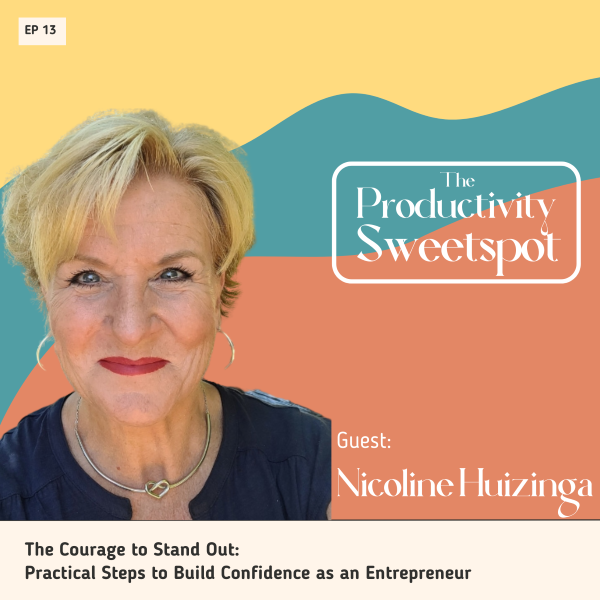
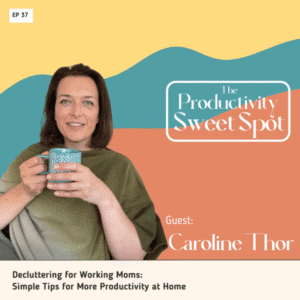
The Productivity Sweet Spot ~ Episode 37
Decluttering for Working Moms: Simple Tips for More Productivity at Home
Let’s be real! Working from home is a gift… until your laundry pile starts whispering louder than your inbox.
In this calming and practical conversation, I’m joined by KonMari-certified organizer and podcast host Caroline Thor, who shares her simple, sustainable approach to decluttering.
This episode isn’t about getting Pinterest-perfect. It’s about creating systems that actually support your life and your focus.
We talk about what happens when physical clutter triggers procrastination, how the mental load affects your productivity, and what to do when you’re overwhelmed and don’t know where to start.
Caroline opens up about navigating ADHD tendencies, parenting teens, and running a business from home and how simplifying her space helped her regain clarity and calm.
Whether you’re the messy genius or the low-key list queen, this conversation will help you feel less behind and more in control.
Because sometimes, the first step to getting unstuck… is just clearing the kitchen table.
In this episode, we cover…
Quotes from this episode
Transcript
In this episode, we cover…
- Why clutter often triggers procrastination (and how to break the loop)
- The mental load working mums carry and how systems can help
- Small shifts that make it easier to focus when you’re working from home
- What to do when you don’t know where to start
Quotes from this episode
“Your space is part of your support system, not just a background, but a tool to help you focus.”
“Procrastination isn’t laziness. It’s strategy. Your brain is just trying to cope the best way it knows how.”
“Mental clutter is just as real as physical clutter — and working mums are carrying way too much of both.”
“It doesn’t need to be perfect. It just needs to work for you and your family.”
“When you simplify your space, you quiet the noise. And suddenly, it’s easier to start.”
Transcript
Let’s be real, working from home really is a gift. Until your laundry, your kids art pile and that rogue sock on the floor start screaming louder than your to-do list. In today’s episode I’m joined by Caroline Thor, a KonMari certified organizer and host of the Living Clutter-Free Forever podcast.
We are digging into the deeper truth behind clutter, how it affects not just your physical space but also your mental load and your ability to actually get things done. If you ever cleaned out a drawer instead of tackling that big project or wondered why your brain feels fuzzy when you’re technically working, this episode is for you. We’ll talk about the science of distraction, how clutter plays into procrastination and how systems, yes even labeled drawers, can be the unexpected key to feeling more in control.
Caroline also shares her personal experience with ADHD tendencies, parenting and running a business and how clearing space created more focus not just for her but for her whole family. So whether you’re the messy genius, I think I could give myself that title, or the Pinterest organized planner, there’s something here that will help you work with your environment instead of against it.
Let’s dive in.
Forget the hustle, ditch the burnout and step into your productivity sweet spot. This isn’t just another time management podcast, it’s your go-to space for refreshingly real conversations and practical strategies that help you work smarter, not harder. I’m Anu Baju, your host and a passionate advocate for peaceful productivity.
Join me as we challenge traditional productivity rules and redefine success on your terms with time, energy and focus that actually fit your life. Whether you’re an entrepreneur, creative or just someone who’s done with the grind, you’ll find actionable tips, mindset shifts and powerful discussions to help you get more done without the stress. Let’s find your productivity sweet spot.
ANNE
So when I talk about peaceful productivity, I often help my clients to sort of declutter their to-do list. But I think Caroline, you talk a little bit more about decluttering your physical space. So the conversation I want to have with you is basically around clutter and how it may affect our productivity.
And obviously that can be physical clutter, but even mental clutter. I think you have a few thoughts maybe around there as well. But let’s start with this physical clutter.
Why does it bother us? Why does it affect us when we want to do work and there’s clutter around us?
CAROLINE
It’s really interesting because it affects different people in different ways. But the general theory is if our space is cluttered, we are going to be distracted by things that are around us rather than being able to focus on what it is that we want to be doing and therefore we will become more unproductive. So if your desk has got piles on it of other things you need to be doing, one, you haven’t got a clear space, but two, you might end up getting distracted by the pile and start looking through that and thinking, oh well maybe I should do that first and not stay focused on exactly what it is you meant to be doing.
In the same way that we get distracted by our phones when we’re sitting at our desk very often. It’s really easy to be distracted by the technology, by our desktop, by notifications on our desktop. Everything around us is working really hard to try and pull us away from what it is we’re meant to be doing. And some people are really good at blocking that noise out, the visual clutter, and other people aren’t. And I’m someone that isn’t. I get very, very distracted very easily.
I have two children with ADHD. I highly suspect that I have as well and I’ve just never been diagnosed because I’m permanently, if I’ve got anything on my desk or if I’ve got notifications on my phone nearby, I’m distracted and looking at them and checking, oh is something, have I got an email, rather than staying focused on what I need to do. So I have learnt that having a completely clear desk with literally only on it what I need, and these days that’s pretty much just my keyboard and a mouse and sorted, having my phone away, actually not even in the room while I want to stay focused on something, and making sure that I don’t have any papers around that are from other projects that I need to be working on so that I can’t get distracted by them.
And that’s basically the theory behind it, that our brains are always looking for a bit of entertainment. What else could I do that’s more fun than this thing that I’m meant to be doing? And that’s the danger.
ANNE
I love that.
And it’s funny because you said it affects different people differently. So I’m more on the other side. I’m pretty good with my clutter.
I’m not perfect. Sometimes I have piles of drawing paper that my boys dropped on my desk and I’m like, oh, what is that? Like, let’s just see. Or I look for a list because I’m a lists person or a notebook person.
So I have different things for different projects. And then sometimes I’ll waste my time and be like, oh, where did I put that one? And I go through my pile of lists and I’m like, oh, I should declutter this. But I’m more of that I can blend things out quite easily, which I suppose is great.
But at the same time I said, I waste time looking for things.
CAROLINE
And my brother, for example, he is incredibly productive, but his office space is utter chaos.
I mean, it looks one of those like artist rooms you walk into where you expect some sort of genius to be sitting there with piles of stuff. And he works really well in that. It actually makes him feel almost safe and like everything’s giving him a big hug and he can focus on what he needs to.
So I think it’s important to recognize your personality. I think the thing for a lot of women, especially, is we are carrying this mental clutter with us, the mental load. Not only are we working on our businesses, but we’re thinking about what kid needs to be where, when, what they need to take with them, what we need to buy for dinner, what we need to prepare for cooking, that the washing needs doing, the cleaning.
So we’ve got all this going around in our heads, as well as all the business stuff. And it does seem to be very much that the woman will hold on to all of that and take responsibility for it. And other people in the family don’t.
So you’re juggling that as well. And that mental clutter, like your calendars, appointments for everyone, all that sort of stuff, that’s something that needs to be looked at really carefully as well, because having systems in place mean that you can literally switch off from all of that when you’re meant to be working, and you will then be more productive. And so many of us work from home.
And then you’ve also got the problem that if your home is disorganized, you’re sitting at your laptop thinking, right, I’m going to work on this project for work. And in the back of your mind, you’re thinking, but I have got a load of washing that needs doing, and the living room’s messy, someone’s coming around this afternoon. And we’re not staying focused on what we need to stay focused on, because of the clutter elsewhere in the home, almost like pulling us.
And I think that’s also something that a lot of people struggle with productivity, especially when they work from home.
ANNE
I agree. It’s definitely, I have a lot of conversations with friends, or even when I work with people in terms of I know I’ve got this deadline.
And I know, I need to do my work. But I also know, I have this to do. And I think, and I’m wondering what your thoughts are. But I mean, the word procrastination comes to mind quite often. I think we can use these things the physical clutter and tidying up and fixing things around the house. Because that’s something that we can do quite easily. I’m using air quotes.
Because maybe the project, the work that we need to do is quite complicated. And so our mind is like, oh, let’s just deal with that. Because I can do it easily and quickly, while this job here that I have to do is complicated.
And I’m wondering if you have any insights around the I don’t know, the science or what that might be that I often feel drawn to let’s fix this little thing here before I work on that complicated project.
CAROLINE
Definitely. My daughter, who’s now 17, actually modelled this beautifully at the weekend. So it’s funny, you should bring it up. She needed to revise for a really important maths exam. And that’s what she should have been focused on at the weekend.
She managed to completely declutter and organise her bedroom. She then cleaned it. She has a balcony outside of her bedroom, she started planting things.
She then baked bread. And I kept saying to her, you’re procrastinating organising, you’re procrastinating cleaning, you’re procrastinating baking, she was doing everything she could to avoid the thing that she needed to do. Because as you quite rightly say, it was going to be hard.
And we do this all the time, because we want this little dopamine hit when we tidy something or organise something, and we open the drawer afterwards, and it looks beautiful, we get like a little reward, we get a little dopamine hit from it. That’s much nicer than having to sit in front of a laptop to really get your brain going and like concentrate for a few hours on something. So we tend to avoid the thing and I always call it this procrastinator, whatever it happens to be, we avoid doing the thing because it’s going to be more painful.
But very often, if we actually just sit down, block out all this visual noise that we have, and get on with it, it doesn’t take us as long as we think it’s going to or it’s not as hard as it’s going to be. And it actually can end up being quite rewarding. And we get the dopamine hit from actually having been able to tick it off our to do list.
So I think we need to look at what our priorities are, and set ourselves goals. I always have two or three major goals for the day, those are the things that have to be done. And sometimes that is something in the house, because if I don’t put the load of washing on, no one’s got any clean underwear the next day, and that is not going to be good.
But very often, it will be a business thing, I have to get this podcast episode recorded today, because I do not want to be a last minute rush again, because that’s going to raise my cortisol levels, and then everything feels stressy. So setting myself goals, things that are my priorities, and I sit down either the night before first thing in the morning, look at my calendar and work out, okay, really, what is my priority. And that’s what I tackle first.
And once that’s out of the way, and they’re done, then I can move on to the smaller items on my to do list that are not so important, it doesn’t matter if they don’t get done that day or not. But it means that my stress levels stay really down the whole time, because I feel in control. And I think we mistake feeling in control very often by organizing our spaces or tidying or doing you know, the jobs, because we want to feel in control of that as well, which is why I’m such a stickler for everyone’s homes should have a system in place and be decluttered and organized to a level that you feel comfortable in and can function in.
And then you can concentrate on the other stuff. Because I really don’t believe and this was my experience, that you can really focus on what you want to when you’ve got these distractions in the background, and you’re feeling out of control with your home or your kids schedules or whatever it happens to be. So I think that’s really, really important.
ANNE
I love that. So let’s talk about those systems. Because you said the level of how it feels good.
So I have an OCD mom in law. And I am the opposite. I’m that chaos person a little bit not crazy.
But my mom always said only the genie masters the chaos. And it’s like my house needs to look like someone lives there, not all clean and tidy. But you know, like just to say that is really different levels.
And I think it’s nothing wrong with either way. But like you, I think systems are incredibly powerful. And I do have a few like sort of home systems to keep things going.
And like, not you can’t really automate them. But they are more like I don’t need to decide about them. Because I know this is how I do it.
And this is when I do it. And I do it every week, every day of the week at the same way. So it’s okay, just get done with it.
But what are your systems? Or what do you tell people when you work with them?
CAROLINE
I think the thing that makes the most difference for people is having a system for papers. Because papers is something that really causes us stress, like when you want to go with the kids to that doctor’s appointment, but you can’t find the piece of paper that you need to take with you, or you can’t find the kids medical book or whatever it is that you need, or as happened to me before I got my life in order 10 years ago and applied the KonMari method in my home, I spent a week looking for our passports before we went on holiday. It was so stressful.
And I didn’t dare tell my husband till two days before we were due to travel, but I still couldn’t find the passports. And he eventually found them because I put them in a safe place. And this is the problem.
We put things in say, but we don’t have a set place. So the first thing I would say is paperwork ordered a system for dealing with it when it comes in, that I think is super important. And I have a fan type folder that opens out like concertina style, it has 12 sections in it.
Each one’s labelled with a month. So if we buy tickets for a concert, or the kids have got a doctor’s appointment in March, it goes into March as soon as I get it. And anyone leaving the house on a day knows that they will have put the papers they need to take with them in the month.So we’ve already got tickets for September in September, and we know they’re there. And we’ll go to that day. And we’ll just go in and get them.
And they’re there. That has been game changing for me. Invitations to kids parties, you know, all this stuff that you then can’t find.
ANNE
Just thinking, yes, these things, that thing. Oh, yes.
CAROLINE
Yes, which house are we meant to be taking them to? Exactly.
ANNE
What time does it start around?
CAROLINE
so that sort of thing. And so the paperwork is a huge game changer.
I think then having systems in place for sort of calendar organisation so that everyone’s on the same page. We do a thing where each Sunday, we sit down, my kids are now older, they’re all teenagers now, and we go through the calendar together for the whole week so that everyone knows what everyone’s doing, and who needs to be where when and it’s not just my responsibility. And that also helps the kids to realise what my schedule looks like, and whether it’s okay to be asking me on a Monday to drive them somewhere or they can see then that when there’s time.
So that’s another thing that works really well. And then having things in place for things like laundry happens on certain days. Mondays is always towels for me.
And then I know Monday morning, I put them in, I put them in the tumble dryer, they get hung back up again. Like I will change, we don’t have a spare set of towels, because otherwise, I wouldn’t put them away. Whereas if no one’s got a towel hanging there, I have to put them back away when they’re dry. And then it’s great. They get it all done. I have a couple of spares in case guests come but otherwise. So having having less stuff in the house to start with helps it to stay organised. And then having everything having a place to go back to. So everyone knows where to find the scissors and the tape when they want to wrap the presents.
And everyone knows where they go back to when they finish.
ANNE
Tell me how do I get my kids to do that, please? Because I have bought, I think, 10 scissors and all have disappeared.
CAROLINE
So it sounds really kindergarten-y but labeling drawers and labeling boxes in drawers, what goes in here is a huge game changer. Because no one can then say, well, I don’t know where it goes. How often do you say, could you put this away? I don’t know where it goes. All the time. And now no one’s got any excuse, because they know where the stuff is. And I’ve like trained them over the years.
At the start, when I first implemented this, it would be a case of like, oh, come on, this needs to go back. Let’s go and do it together. And you support them with it. And eventually, it clicks. And they can do it without needing to remind them or ask them. My kids will still leave stuff lying around.
They will come in from school and leave their stuff in the hallway and walk through, because they’re just they’ve had it. They just need a drink. They need a break.
But they do then go back afterwards and pick their stuff up and put it away, because they know that’s what’s expected of them. And they know where it goes. Whereas if they didn’t know where it goes, it’s very hard to put it away.
So things like that, those systems have been a real game changer for us. And that’s what I suggest with families as well. But having less stuff in the first place makes it so much easier.
It’s very hard to keep on top of a system when there is just too much stuff involved, whether that’s physical stuff or the mental clutter or whatever it happens to be. It’s really hard when it’s just too full of everything to stay on top of it. So really paring everything down, paring your calendar down.
At the start of doing this, I really looked at my schedule and my social commitments and the commitments I’d made to taking part in stuff at schools and all the rest of it. I was just like, no, I’m overstretching myself. I am not giving off my best.
And I paired it right back. And how often I would meet up with friends and things like that. I’m really picky these days about who I choose to spend my time with and hang out with, because my time is precious.
And I will say no to things if I don’t feel like doing it, because at the end of the day, it’s going to make everything else run more smoothly. And that is better for my stress levels.
ANNE
I totally agree.
I’ve had a conversation the other day about kids’ activities. So mine are still little and they want to do all the things. And I’m like I want to give you all the experiences and you try out the taekwondo and the karate and the swimming and whatever.
Like, have a go and see if you like it. But I remember there was a point in time where I was going to different places every single day and sometimes two different places because I have two different boys with different interests. And then at some point I was like, listen, guys, I can’t do it physically.
Like, I’m exhausted driving you around. I’m exhausted, always entertaining one of you while the other one does something because their ages are, they’re four years apart. So oftentimes they can’t do things together.
And I literally had to stop a couple of activities and be like, guys, maybe we can pick it up another time. But right now we have to strip it back a bit. And that was a huge game changer for me.
But let’s bring it back to productivity. And I’m curious, what does like a work day or week look like for you? Do you have certain? I block, for example, certain days where I don’t take meetings necessarily, unless it’s the only day possible. I have a bit of like theme days that I do. Is that something that you do as well?
CAROLINE
I have Mondays is my day where I no one can book me over calendly. It’s like blocked out because I want to start my week, like really being able to sit down and focus on a few things. And I have a meeting with my VA and we get the week set up.
And I can sort of feel in control of things like that for me works really well. I block time in my day to go out and walk my dogs because one they need to go out. But two, it’s better for me to get out and have some exercise as well.
And then in terms of stuff to do with the business, I sort of have things planned out during the week. I actually have a little laminated thing that I have on my desk. And it says on Monday what my jobs are Tuesday, Wednesday, Thursday, so that I know that by the time I’ve got to Thursday, I should have done all the absolute must do’s for the week.
And if there is capacity, I can or something’s happened. I’ve got Friday as a buffer. And it used to be that I was recording my podcast at the weekend that was going to go out on Tuesday because I hadn’t got it done.
And I was writing my weekly email and all this stuff goes out on Tuesday. And I was spending Sunday doing that because I hadn’t got it done. And now Thursday is my cutoff.
Like by Thursday, it’s done, everything’s scheduled. And I can spend Friday doing things that are like things I wouldn’t normally have time to do, like catching up on a course or recording podcast with you or whatever it happens to be.
ANNE
Or meet a friend or do something else.I have that similarly set up. And I think for me, why I love doing this kind of thing and this sort of like planning, envisioning what’s the week going to be, I feel it takes away this whole decision making process on a daily basis of like, oh, what will I tackle today from this 159 items of things I have to do? Which ones am I going to pick? But if I have this sort of laid out for the week, it’s just so much easier.
And it’s again, this whole mental clutter. Like you said, we moms hold so much already. If we can remove a few things from that mental list, it just brings the peace and the peaceful productivity.
CAROLINE
Yes definitely. And the other thing I do as well is on a Sunday, I sit down for like half an hour and I think, okay, what are the three big things I would like to do this week that are going to move the needle in my business and then plan those into my days as well.
So that by the end of the week, I can say I achieved that goal of whatever it happens to be for my business. And that has been a huge game changer for me in terms of me being much more productive, because I’ve thought about it in advance, as you said, and I’m not just ad hoc. Okay, what could I do today? I’m the same as you in that respect.
ANNE
And then there’s less excuses that can crop up because we’re like, no, I’m focused on this and I’m not going to go there, even think about that thing. I love that so much. Well, thank you so much, Carolyn.
It was wonderful talking to you. Share with everybody where they can find you if they want to find out more about the KonMari method, what you do, just tell us where to go.
CAROLINE
The best place is my website at caroline-thor.com. And there is also a link on my website to my podcast as well, Living Clutter-Free Forever, where I give lots of organization tips for busy working moms.
ANNE
Awesome. Thank you so much.
OUTRO
What I love most about this conversation with Caroline is the reminder that clutter, both physical and mental, isn’t just stuff.
It’s often actually a signal, a signal that our brains are craving ease or control, or even a little bit of dopamine hit in a stressful moment. And I think there are two powerful takeaways here that I want to just point out to you again, because your space is part of your support system. So whether it’s that clear desk or a labeled folder, or just knowing where the scissors are gone, those small systems really remove decisions.
And the more little decisions you can remove, the more you prevent decision fatigue. And as a mom, I think we’re making so many decisions in a day already, as well as business owners. There’s always something to decide.
And I think if we can remove some of these small decisions of like, where is something? Should I look over here? Or should I look over there? Or where did I last place that scissors? Or pens. My scissors and pens always get lost. And I know it’s not my fault.
I know it’s those little guys, but I still have to look for them. But yes, I think if we can remove as many decisions as possible, really the unnecessary ones, it helps us to protect our focus. And our focus is just so valuable.
And the second takeaway is that procrastination isn’t necessarily laziness. It’s a strategy.
Because your brain might be choosing to clean the kitchen over the task of writing a sales page because it wants that quick win. It wants to know that this is getting done quickly, efficiently, and sort of in a short instance. And I think Caroline’s insight here is gold.
Tidy tasks give you a dopamine hit. But don’t forget that big thing on your to-do list. But if you can give yourself this sense of progress with a small tidy task and really just get started, and you remove the distractions, the distractions that will creep in when you’re actually supposed to write the sales pitch, the sales presentation, the new offer, when you’re supposed to reach out to that important client, then your brain will want to go to this tidy up situation.
But if you’ve already done it, there’s nothing that your brain can look for as an excuse. So get into the habit of tidy tasks. Tidy that little area over there.
Get done with it. And you remove the distraction. So maybe today I invite you to instead organizing your spice rack, you clear the workspace and you just begin. You begin with one task and one win. And that’s often all that it takes.
And if you’re not sure why you’re constantly busy, but you feel behind, take my productivity style quiz. You will discover your natural strength and you will get a simple personalized strategy to work with the strength and your rhythm instead of against it. Because unfortunately, a lot of us try to push against their natural productivity style.
And if this episode made you think, feel, or even just give you a little breather, I would love for you to share it with a friend or take a screenshot. Tag me on Instagram at _annerajoo_ and I would love to hear that this episode resonated with you.
And coming up next, I will be joined by Vicky Paris Gottman. And we’re diving into a conversation that’s tender and surprising. We’ll talk about how grief and adversity, rather than stopping your productivity, can actually become a powerful part of it.
If you have experienced loss or hardship and found it difficult to show up at work, Vicky’s message will reframe what healing and momentum can really look like. This surely is not the usual productivity conversation, but it’s a wonderful one and one that’s filled with positivity. And I hope I see you back here next week.
And until then, stay peacefully productive and I’ll catch you next time.
Listen on your platform of choice


View all episodes
Get more of Caroline
Do you struggle with being productive?
Discover where to start when creating business harmony and work-life fulfillment with the Wheel of Peaceful Productivity
Understand Your Unique Productivity Style -And Leverage It for Greater Ease & Focus. Take the Quiz!
Keep In Touch with Anne
Subscribe to her newsletter
Peaceful Productivity Letter
Join hundreds of readers and enjoy three actionable tips on how to make the most of your time.
Thank you!
You have successfully joined our subscriber list.