
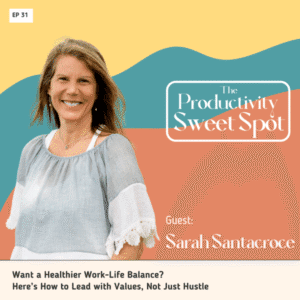
The Productivity Sweet Spot ~ Episode 31
Want a Healthier Work-Life Balance? Here’s How to Lead with Values, Not Just Hustle
What if building a thriving business didn’t require you to sacrifice your peace, your values, or your life outside of work?
In this heartfelt conversation, I’m joined by Sarah Santacroce, author of Business Like We’re Human, to talk about a different way forward—one rooted in compassion, alignment, and a redefinition of what success truly means. Together, we explore what it looks like to lead with values, not just hustle, and how that simple but powerful shift can completely transform your experience of entrepreneurship.
This episode is for the entrepreneur who’s ready to slow down without giving up, to grow without burning out, and to finally create a business that truly supports life on your terms.
Sarah shares her personal story of walking away from a business model that no longer felt right, and what it took to rebuild with intention. We talk about the moment she realized growth didn’t have to come at the cost of her well-being—and how she now supports others in making the same shift. This episode invites you to rethink the “rules” of business and consider how embracing a values-based approach and a human business model can lead to real, sustainable growth—and a healthier work-life balance.
In this episode, we cover…
Quotes from this episode
Transcript
In this episode, we cover…
- Why traditional definitions of success often lead to burnout
- How to shift from pressure to peace without losing momentum
- How to find inner peace in a world wired for overwork
Quotes from this episode
“When I stopped chasing endless growth and started focusing on what truly matters, I noticed the ripple effects. My clients felt it. My community felt it. And I felt it.”
“Recalibrating your business to fit your life isn’t about scaling down—it’s about scaling meaning up.”
“If we don’t first find inner peace, we will always be in this hustle mentality.”
“You have to do that work yourself and find out who you truly are and how you’re wired. That’s when business starts to feel real.”
“Let’s stop feeding the myth that we’re here to keep the economy running. We’re here to create lives and businesses that feel good to live in.”
Transcript
Before recording this conversation, I found myself reflecting on discomfort and how we so often treat it like a red flag. But what if discomfort isn’t a stop sign? What if it’s actually a sign that we are on the right path? I started thinking about the difference between productive and unproductive discomfort. There’s the kind that leads to burnout, pushing too hard, too fast, too long, and then there’s the kind that stretches you gently, expands your capacity, and nudges you forward without breaking you.
And that’s the space where today’s conversation is going to live in. I’m joined by executive coach Fabienne Moore to talk about nervous system regulation, emotional resilience, and what it really means to grow without losing yourself. We will explore the zone of productive discomfort, where transformation happens not through force, but through presence.
Let’s dive in. Forget the hustle, ditch the burnout, and step into your productivity sweet spot. This isn’t just another time management podcast.
It’s your go-to space for refreshingly real conversations and practical strategies that help you work smarter, not harder. I’m Anne Rajoo, your host, and a passionate advocate for peaceful productivity. Join me as we challenge traditional productivity rules and redefine success on your terms, with time, energy, and focus that actually fit your life.
Whether you’re an entrepreneur, creative, or just someone who’s done with the grind, you’ll find actionable tips, mindset shifts, and powerful discussions to help you get more done without the stress. Let’s find your productivity sweet spot.
ANNE
I’m incredibly excited to have you with me today, Sarah, because the work that you’ve been doing has been really inspirational to me and I know to many other people too, and you talk about humane business and humane marketing, but we are here together today to especially talk about healing, recalibrating our relationship with work. I want to just really dive in. What does that mean to you? Why does our relationship to work even matter and why do we need to change it? I assume that’s what we need to do, but start us off there.
SARAH
Thank you for having me and making space for this conversation. I need a lot of space to talk about this because I think it’s just a huge fascination of me right now, and I guess for other people too. Ever since COVID, a lot of things have changed in the workplace. If people are still in companies, there’s talk about the work from home that happened. Now, companies are bringing people back into the workplace, even though there’s huge resistance. All of this in the last five years has really drawn our attention to work.
There’s a lot less willingness to only work. We have all kind of experienced how it could be during COVID to have a better work-life balance, to use that language. Now, we’re just like, well, we won’t put up with everything anymore.
There’s people who had these huge commutes, and they’re like, well, I’m not doing that anymore. We’re going to get into the entrepreneurial work soon, but what I see in the work marketplace is that there’s so many people quitting their jobs right now. Yes, there’s people being let go.
That’s one thing that we see happening, but there’s also a lot of people who are quitting or quiet quitting. They’re still working, but they’re just like, okay, I’m just doing this to pay my bills because they’re like, is this all there is to life? Are we just working bees to make the economy work? I talk about that in the Business Like We’re Human book. It’s essentially the myth that we have created together as humans that we are here to work from eight to five every day and, yes, feed ourselves, but also feed this thing that we call the economy, which is also a myth, really, if you think about it.
It’s like this thing that we have created. When you apply that to entrepreneurs, what I always notice is how much we’ve been conditioned because many of us have been in the corporate world before and then quit with this idea, oh, I’m going to be more free. I have so much more flexibility, and I’m going to be my own boss. Then because of the belief systems that we’ve been trained with, we just find ourselves in the same situation. We feel like, well, we still have to work eight or nine or 10 hours per day because we’re on this hamster wheel and we’re like, yeah, but we got to be successful. We have to put in all this work.
That’s where I feel like, well, that’s where we’re at now. It’s like, well, we need to change our relationship to work. One big topic also is, of course, AI. Well, with the reality of AI, and there’s a new term that I just learned about in a book called stellar world. They’re talking about AL, artificial labor. It’s not just artificial intelligence, but probably eventually what’s going to happen is artificial labor.
So many jobs and work is going to be replaced. That’s why I feel like we need to recalibrate or heal first our relationship to work because we need to, as humans and as business owners, redefine what it means, what work means for us, and how to then adapt our businesses to fit into our lives so that we don’t feel like we’re only defining ourselves by our work or by our business.
ANNE
So how have you done that personally? How have you redefined your business and what does it mean now to you and what’s different from before?
SARAH
It’s not easy. I’ll tell you that because of so much conditioning, right? To feel like, this is who I am and this is what I do. What I’m still working on is just seeing the business part and my life’s work part as part of who I am, as part of what I do, and trying to fit that into my daily routines, but not make it the only thing I do. And so that means finding other things that fill my days and that give me joy. I talk about reconnecting with nature, just being in silence, cooking more, really paying attention to what we eat. I don’t especially like cooking, but I do like paying attention to nutrition.
And so it’s like, well, how can I cook fast but healthy? That’s usually what I do. So just paying attention to the things that do make us human. And of course, having human relationships that are not just ways to get to more business. So I’m not talking about only business relationships, but having moments in our days where we only focus on relationships. You have small kids, so just making that a priority and not feeling guilty. Oh my God, I am not making money right now.
But as you know, because we’ve talked about this before, it’s quite difficult. It’s quite challenging because of all the thoughts that we grew up with that just made us into working bees.
ANNE
Definitely. What comes to my mind is the story of my dad, who always said, some work to live and I live to work. And so when I got into the position that I would start a business, which wasn’t quite by choice, because it was basically COVID forcing me or forcing my hand into it, I was literally like, oh my God, I’m going to be like my dad, working seven days a week, 12 hours a day. Oh my God, no, like it’s literally that what I sort of envisioned.
Obviously, I didn’t necessarily go down that route. But I had this example. And then I often found myself like, being like, how can I make this look different? If this is what I’ve seen and what I’ve grown up with? But I still want to be successful. Like you said, it’s still a business, I’ll have certain vision for it and want to grow. But how can I make this true in reality? It is definitely difficult, as you said. But what it sounded to me like is really this point of like, having your life and having the business part of your life.
And I think there’s a certain saying around it, the exact words don’t come to me, you know, like, fit the business into the life, not the life into the business sort of thing. Is that sort of like?
SARAH
That’s exactly the premise of the business, like we’re human is to find balance and balance is always like, well, do we really want balance? And it can always be balanced. But in a way, probably what’s a better expression is to find harmony. It’s like feeling good in both places, right? So the journey really, what I feel like I’ve been on is this idea of finding inner peace, great with, whatever our life’s work is. But if we don’t first find inner peace, then we will always be in this hustle mentality.
And so in a way, you make peace with yourself, you make peace with, your story, your parents, that’s definitely always what we’ve been told and thank our parents for what they have taught us. But you remember, in the community, I did this kind of meditation about, letting go of those stories and thanking our ancestors for what they have taught us. But then, thanking them and saying, I’m going to do it differently now.
I’m going to step into a world of abundance and not scarcity, where I feel like I have to work all the time. And I think, so this fits really into a bigger paradigm shift, that we kind of see everywhere, people are talking about this. And yet, we don’t really know what to do with that.
Like, what does that mean? But I truly believe that as humans, we need to look at our purpose on this earth in a different way. And no, and not just say, well, my work is my purpose. It’s so much bigger than that.
And if we only look at our ancestors, like the, the one generation, two generations back, then we’re unfortunately only seeing kind of like role models that we don’t want to repeat. But that’s why I’m so fascinated by ancient history and finding our human origins and going way back, like, we just went to visit the pyramids in Egypt, and just going into that energy of the ancients 10,000 years ago, and realizing that different energy they brought to their life. And that it was not only about growth and more possessions and more things, but it was a lot about, yes, the spiritual aspect of life, joy, beauty, all of these things that we just kind of forgotten how important they are.
And so, in a way, that’s the bigger paradigm shift, right? But what I’m trying to do with, I think all of my work started with marketing and selling. And now business, like we’re human, is taking people on this journey and show them while there’s, yes, business is important, but there’s more than that in our lives.
ANNE
I love that. And you already shared this, this conversation that you had in the community, and this like thinking the ancestors, what would be other sort of practical things or practices that you have, or that you share in the book, for example, that we can use to create this? This spaciousness to maybe do something different, and to let go of these beliefs and to try out different things. I think this is what I talk in productivity a lot. It’s like trying things out, see what works for you, because obviously, we all human and everybody is different.
But what are your practices or tools or tricks that you have there?
SARAH
I love how you talk about peaceful productivity. Obviously, that’s such a good match. And I’m so forever grateful that you wrote the the afterword of the book.
So exactly. So the book is basically two thirds of the being that we need to kind of work on. That’s always where my work starts. And so that means like, our mindset, and what I talk about in the book is this Ubuntu heart and mindset. And what that means is, it’s an African term that means being one, having this shared humanity, this idea of, yes, we can be in business. But it’s not about being smarter or more pushy or more manipulative.
It’s doing things together. And that means,they’re gonna, there’s going to be a money exchange. But if we have this Ubuntu heart and mindset, then we all grow, it’s like we rise together, right? And so that that is the being part of the recalibration, if you want. And the second being part is the authentic relationship culture, I call it. So I still, I noticed still that, in the business world, if you look at, the typical online marketing world, it still feels to me like a copy of the corporate world where people put on this mask, and pretend they have to be somebody, be all perfect and have it all together and be this big guru. And it just doesn’t feel good. It doesn’t feel real. It doesn’t feel like, oh, I’m having a real conversation with this person. And so there’s certain things that we can do to make it feel real.
And yes, it starts again with inner peace, so that you actually feel authentic, right? It’s not about the seven steps to be authentic. No, you have to do that work yourself and find out what who you truly are, and how you’re wired and all of that. But then having that, I think that just takes off this huge weight of our shoulders. And just, like, oh, this is me And this is me doing business, like we’re human, because I am human. And yes, I’ll mess things up and all of that.
And then the third practice is the humane business practices. And so that’s probably what you mean. It’s the more tangible things that we can do and, you know, change certain things in there. I talk about, like, similar to you, like, the typical things that help you create more space, like automation and batching and just tapping into partnership with technology, AI, so that we can create a business that, yes, is very human, because we pay a lot of attention to the human side of the business. But the tech and the AI helps us then, streamline, make things more productive, so that we have to spend more time in front of the computer and putting things together.
ANNE
And then not necessarily spending or filling the time that we’re creating with the help of technology and automation with more work, but maybe go and do some other things, like you said, the other parts that are part of you, be it the nature, I don’t know, sports, like I recently really rediscovered my love for sports, which I had sort of paused for many years because I had two children and they were little and I had a business and there was just no time, but now the kids are a little bit bigger and I feel like I can shift my schedule around a little bit more and so I’ve taken up sports again and it just feels like so good. Yes, I could fill this hour with something else in my business, there’s plenty of things to do, but I’m choosing to do something that is also important to me and I think what you do beautifully in the community and that’s what I’ve realized for myself in different ways is this finding people who are aligned so that you see these examples, like not my dad example, working, working, working and not the really competitive business or this big entrepreneur with big following and making millions of dollars or euros or whatever it is, but finding the people who align and even if that means they make less money or they have a less larger following or whatever it is, but I think for me that’s where I’m feeling comfortable and where I’m feeling supported in the sense of like, okay, I can try things differently, I can build my business working less hours than I thought maybe I should or have to, but I think it comes with finding the right people who speak in that way because it just feels so much more reassuring and like, I’m not the odd one here, it’s actually there’s more people who think this way and let’s learn from them and have these conversations, you call them the conversations of change and I think that’s really powerful and that’s something that I really value in my business.
SARAH
I think that’s probably the biggest shift, when you asked initially like, how was that for you going, changing the way you do business, it’s all about the people you surround yourself with and that has taken quite a bit of time because if you are in this environment where it’s all about the guru teaches you and there’s thousands of decibels of people who are just there to learn in isolation often because they feel like they are so inferior to the guru who has it figured all out and who’s just teaching rather than inviting the conversation, then the sovereignty of each human being cannot come up because we feel like we’re just followers, right, and we have to bend ourselves and just apply what the guru is teaching us and that’s actually happening even in like communities where you see they call themselves heart-centered or conscious or whatever, that shift has not really taken place yet completely.
It’s still like that top down kind of attitude and that’s really what I feel like that needs to change as well so that the sovereignty of each being can come out and we can do business like we’re human.
ANNE
I love that part and again, it’s a bit of a personal question but you obviously, you changed your membership. I remember like initially, I think you did this like teaching style but then you changed your membership to a really community-led membership and personally, for me, it’s the first membership that I’m part of where it’s like that, like I’ve seen people trying it but it didn’t necessarily work as well as it does in your membership and I’m wondering what mindset shifts did you go through because I personally would think there might be some fear of like, oh, but then, you know, I might not be seen as the expert and then people might not buy my bigger offers from me because there’s other people who are leading workshops in the community and that kind of thing.
That would be like the first one that would come to my mind if that was me. What did you shift for yourself there?
SARAH
The community was never a place where I taught my programs or my thing. It was always like, let’s do this together and yes, there was always people who join the community, usually they are somewhat familiar with my work so there is that.
Yes, I bring in, you know, the values basically but it was always a community where we always had members then holding the meetups and because I was just so tired of, you know, these other places where I was not seen, A, as a human and B, as someone who has experiences as well. Like it was always just like, no, you’re here to learn instead of you’re here to share and learn from each other and I think it’s like again, it’s just my backstory. I grew up in a small hippie community where that was my everyday thing.
It’s like, no, there was not one person who ran the whole thing. It was all of us, well, we were kids so us a bit less but it was, you know, everybody who had their strengths and their weaknesses and so we just all learned from each other and so that’s the kind of spirit I want in the community and I see it as a separate thing. It does happen that people from the community come into the program but I don’t use it as a funnel.
It’s not the thing, you know, it’s like, oh, emails and then you’re going to be funneled in. I think that kills a community, actually. I just like it has to be voluntarily that people are like I want more and then they will join the program.
ANNE
I think that’s what it probably is. Like for me, it’s like probably what I’ve seen the gurus teach is use a membership or a community as an entry point and then sell to these people and that’s obviously not what you do and I think that’s quite refreshing because obviously that’s what a lot of people try and not to say that’s wrong or whatever. It’s like, I think it’s what we’ve been taught and what we’ve been seeing but then there’s a different way and it’s this, like, what’s your value and I think this is what you do very beautifully. You really embody your values and you bring them into your business wherever it touches and for me, that’s what your work stands for as well. It’s like your human values are reflected everywhere in your business and that’s why I resonate so much with you because that’s how I want to work as well.
I want to really be conscious about my values and feel aligned and I think that makes me happier at work and instead of like, yeah, chasing this, like, oh, you know, like, there’s this next opportunity, this next dollar amount and yes, I could probably go for it and do it, skill-wise but how would I feel about it and that’s something that is really important to me and I’m hoping you with your book, we can change that paradigm shift, like you said.
SARAH
I do think it, you know, it requires a certain level of maturity, maybe that’s the wrong word but it’s just from the members in there, they’re all completely unique human beings who kind of want to stand in those values and that takes a certain, like sovereignty, I guess, and kind of this thinking of I want to do it differently and I don’t want just someone to tell me how to do it so that’s not, that’s what my work is not about. I’m not going to tell you how to do it and other memberships who are doing amazingly well because there’s someone teaching you how to do it and so it’s almost like the members in our community are like, well, I want to come to this community to share and do it in a kind of, like, questioning all our assumptions way so that’s, yeah, that’s beautiful.
ANNE
To have the conversations, I think this is the real deal there is that we are having conversations, personal human conversations and I think this is why I’m there and so I think, like if you want to maybe invite the audience to those conversations if they’re now curious and like, I want to talk to Sarah and I’m going to be there too but what are these conversations of change and how do we get into it.
SARAH
Thank you and so what I’m doing right now with this new book, the Business Like We’re Human book, I basically sat there and thought, well, I’m going to question all our assumptions, all my assumptions around how a book launch should look like because when you go on any of the social medias, well, you just kind of see the same thing, everybody doing the same thing, launching the same way you really recognize the pattern and so I’m like, I’m just so bored of that. I want to do it differently and I also feel like it’s just, it’s not the time for people to just have to read another business book in isolation where, it’s crazy times that we’re in right now, so many people are feeling it and they just don’t have the attention span to just sit down and read a book and so it’s like, well, we need to practice exactly what we’re doing in the humane marketing circle, in the community and have conversations around these topics and that’s why I set it up as conversations for change where, yes, I will basically bring the topics of the conversations and they’re based on the Business Like We’re Human books.
So there’s four conversations, the first one is about waking up, so waking up to, well, what’s going wrong in business and why are we all burned out and all of that and also healing our relationship with work as we discussed and then the second part is re-imagine, so now that we have woken up, let’s re-imagine how we would want our Business Like We’re Human to look like and our life to look like, so we get together and re-imagine our business differently.
The third part is about recalibrating, so what we just discussed, what are the tangible things that we can do to recalibrate our business and find more spaciousness, not to work more but to be more human and do what human beings do and then finally the fourth is about integration and so that’s how I’m launching the book as a fundraiser to help me raise the funds for the self-publishing, I’m self-publishing it but yes, also to create conversations and create community and I’m sharing that with people and I think you put up a link where people can go, it’s at annerajoo.com forward slash fundraiser and you help me share it and you also win because you get a small commission, I just always like to be transparent about that too, right, because basically what we’re doing is we’re partnering, we’re creating something together and, I’m just so grateful for that.
ANNE
Thank you, I’m so grateful for you for the work that you do, your community, those conversations, like I said, I’m joining and obviously I’m really grateful for having the opportunity to write the after work for your book that was like really special so thank you and that’s why the book means a lot to me too and then that’s why I hope the people who are listening are joining these conversations because it’s not just it’s not just another thing, I think it’s really, it’s beautiful so I can only really say from the bottom of my heart that if like if I tell you to go somewhere, this is definitely Sarah’s space, it’s something that you want to discover so thank you so much Sarah for today and for everything else as well.
SARAH
Thank you, I just want to highlight that there are not webinars, right, I think sometimes if people haven’t experienced it they think oh, it’s just another webinar, it’s not a webinar, it’s like you’re going to be on camera, you’re going to be seen and heard and you’re going to be put into breakout rooms and yes, that takes some courage to show up for that but I think that’s exactly what we need right now is to reimagine business differently together so I can’t wait to see you there Anne and everybody else who’s listening. Thank you.
ANNE
Absolutely, thank you so much Sarah.
OUTRO
So here’s what I’m sitting with after this conversation with Sarah. What if business growth didn’t mean more but more meaningful? We are so often told that growth is about going bigger, doing more, having more clients, producing more offers, generating more revenue and while these ambitious goals are wonderful and I really want everyone to have audacious goals and achieve those and create massive visions, it’s beautiful.
However, there is this shadow side that can come with this push and this grind and this doing and that’s burnout and disconnection and even losing the sight why we started our business in the first place. What really struck me in Sarah’s story is how she didn’t burn it all down. I mean, I’ve come to the point where I wanted to burn it all down more than once. It’s been a very close call and I’m glad I didn’t but it somehow felt like it was the only option. But Sarah recalibrated. She made that bold decision to be deeply human, to choose being overdoing and to stop chasing the endless gruff and to start really creating from this place of alignment and spaciousness and clarity and I think that’s beautiful and at the end of the day what she did is she let go of those shoulds that we have internalized so much because we’ve seen a certain way of doing business, a certain way of living and a certain way of success.
But it’s time to let go of that and it’s really a reminder that we can lead from our values. We can give ourselves the permission to do something differently and I really hope this episode has given you that permission to change the way we see success and the way we do business and to create this ripple effect out into the community to focus on meaning instead of noise and achievement and really create this peaceful way of being in our business. I hope this episode spoke to you as much as it did to me and I’d love to invite you again to join Sarah’s Conversations for Change.
It’s the small series that she’s hosting at the beginning of June and it’s to support the book Business Like We’re Human and you can sign up on my website on annerajoo.com forward slash fundraiser and these conversations are really beautiful. They are really going to champion the humane way of working and before you go, next week I’ll be back with a guest episode and we’ll talk about what my guest calls the zone of productive discomfort. So this is where real growth happens not through force and grind of course but through gentle leaning into the edge of our comfort zone with intention and we’ll talk about how we can recognize it and why it’s different from pushing through and burnout and how it can lead to breakthroughs that actually really feel good.
So I hope you will be back next week. I appreciate you for being here and until then stay peacefully productive and I’ll catch you next time.
Listen on your platform of choice


View all episodes
Get more of Sarah
Do you struggle with being productive?
Discover where to start when creating business harmony and work-life fulfillment with the Wheel of Peaceful Productivity
Understand Your Unique Productivity Style -And Leverage It for Greater Ease & Focus. Take the Quiz!
Keep In Touch with Anne
Subscribe to her newsletter
Peaceful Productivity Letter
Join hundreds of readers and enjoy three actionable tips on how to make the most of your time.
Thank you!
You have successfully joined our subscriber list.