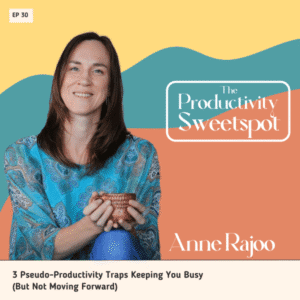
The Productivity Sweet Spot ~ Episode 30
3 Pseudo-Productivity Traps Keeping You Busy (But Not Moving Forward)
Are you constantly working but not actually making meaningful progress?
You might be caught in pseudo-productivity—the kind of busyness that feels productive but quietly pulls you away from your purpose.
In this solo episode, I break down the three most common pseudo-productivity traps that keep entrepreneurs stuck: staying busy without direction, prioritizing low-impact tasks, and getting lost in perfectionism or over-communication. These patterns don’t just waste time—they drain energy and blur the line between action and distraction.
We’ll explore how to shift out of busyness addiction and into intentional, focused work. I’ll share how embracing Deep Work, protecting your mental clarity, and creating more supportive productivity systems can help you reconnect with what actually matters.
This episode is a guide to refining your time management and productivity so you can stop spinning your wheels and build real momentum toward sustainable success.
If you’ve been craving more clarity, creativity, and progress in your day-to-day, this one’s for you.
✨ Curious about outsourcing or ready to get support in your business?
Visit my Boutique Virtual Assistant Agency Virtufully and book a free consultation to explore how we can help you reclaim your time and focus on what matters most.
🎧 Want to go deeper? Check out the Time Audit episode to uncover where your time’s really going—and how to realign your energy with what matters most.
In this episode, we cover…
Quotes from this episode
Transcript
In this episode, we cover…
In this episode, I walk you through the three most common traps I see with clients (and have 100% experienced myself):
- Staying busy instead of being effective
- Letting small projects crowd out big vision work
- Getting caught in over-communication, over-prep, or perfectionism
Quotes from this episode
“Pseudo-productivity is performative busyness—it looks like work, but it doesn’t move you closer to your meaningful goals.”
“If you’re constantly busy but still feel stuck, it’s a sign that you’re prioritizing urgency over importance.”
“Small wins feel satisfying, but if they’re keeping you from the deeper work, they’re just distractions in disguise.”
“Perfectionism is one of the most socially acceptable forms of procrastination—and it’s a trap.”
“True productivity isn’t about doing more; it’s about doing what matters most, with focus and intention.”
Transcript
Being busy is not the same as being productive. Many professionals fill their days with activity, endless meetings, constant emails, and reorganising to-do lists, yet we make little meaningful progress towards our goals. So, today, we’ll explore why we stay busy with small tasks that feel productive and how it actually keeps us from making real progress, and what to do about it.
So busyness has become a batch of honor. One study found that the knowledge workers spend about 39% of their day on their actual job duties. The rest is swallowed up by meetings, emails, and status updates. There’s a report from Grammarly that says 8.5 hours per week are wasted on performative productivity per worker.
So it’s time to be honest about our work habits and take action to work smarter, not harder.
Before I started my business, I worked in a nine to five in a pretty traditional office environment. And at some point before remote work was even a thing, I actually negotiated to work from home a couple of days of the week. And I was the first employee to do that. And let’s day, not everybody was thrilled for me, and there was actually quite a lot of gossip, and the culture in this company wasn’t exactly healthy, but that really is a story for another day. But what stood out for me at that moment was that very often I would, you know, finish my work, warp up, earlier than my official end of the workday, let’s say around 4 / 4.30 pm I would be done and I would sit there until five because that was the official end of the day. Then I would be sort of reorganizing my inbox and poke around some documents and maybe make some tweaks on a marketing campaign. And it really was just busy work, but it felt a lot safer than being the first on to pack up and leave the office before it was even five o’clock and I wasn’t the only one. I remember a colleague who would very often send an email later in the evening and in my opinion, just to really appear more committed. And first thing in the morning, she would walk in and announce that she had sent that email last night, and if I had seen it, because I had already left and I didn’t work that late. “But you know…have you seen it? Make sure you reply.” It was quite interesting. But it was really the whole point that there is, this sense of performative productivity in a lot of offices because we wanna appear committed and dedicated instead of lazy. And so we’ve got these habits that we maybe carry around with us.
And if you are an entrepreneur who listens to this podcast, but like me used to work in a nine-to-five, there might be some habits that we wanna unlearn. And actually, a couple of weeks ago, I recorded an episode with a guest about unlearning corporate. So I’ll link to it in the show notes.
I think this habit of pseudo productivity or performative productivity is one that we just simply need to get rid of. It can’t be that we’re sitting around looking busy and not moving the needle. So I think this is a very important topic and I wanna switch over now to explain what is pseudo productivity really. I already gave you a couple of examples, but it really is that behavior that looks productive, but it doesn’t really contribute a lot of value and it doesn’t really move the needle forward in your work, in your projects and so it’s pretty much an activity without impact. And Cal Newport defines pseudo productivity as “the use of visible activity as the primary means of approximating actual productive effort.”
So many of us get caught up in this trap. Looking busy, constantly being busy, replying to messages. I mean, we’ve got so many communication channels, Slack messages, WhatsApp messages, Facebook messages, Instagram messages, LinkedIn messages. I mean, there’s messages coming our way all day long. Notifications on our phones, emails not to forget, there’s an absolute communication inflation. And it really very often is unnecessary.The amount of communication that we are experiencing is a level that I think has never happened before. And I do believe that these different points of communication and notifications and all these things are really diminishing our productivity and clarity. I think it’s really one of the key enablers of pseudo productivity.
Because we are communicating, it feels like we’re doing something that is important. “I need to respond to that message. I need to reply to this email.” But is the email or the message in the first place, does it make sense? Like is it actually important? Does it create real value? Does it move the needle towards the goal, or is it just something that needs to be thrown around so that we can all look busy and important and effective and productive?
As lot of that is really the core, and so pseudo productivity is very shallow work. We are focusing on those things that can be done quickly – just this message in between or just quickly this Instagram post. It’s this quick and easy task that make you feel like you’ve accomplished something, because the deeer work is a lot harder. It takes a lot more time, but it’s the deeper work that truly drives the results.
And so in Peaceful Productivity, I always tell my clients that it’s not about doing more and accomplishing more. It really is focusing on the work that matters. And so this is countering the whole point of pseudo productivity, which is the opposite of Peaceful Productivity.
But it doesn’t mean I’m immune to it. It doesn’t mean it doesn’t happen. So if you’ve ben listening for a while, you know that I run a boutique virtual assistance agency, and I do see pseudo productivity there sometimes. And for myself and the team that could look like, for examples, redoing some work because there was miscommunication or we are waiting for some reponses or approvals and we can’t continue the work until this approval has been given. Or we work on something because we get excited about it and then later we realize, oh, maybe it’s not the right thing, or maybe it’s not the right time. And that’s really something that happens to me a lot, where I get started because I get so excited or I have a new idea and I feel like, oh, let’s just do this, this feels exciting. Instead of, you know, continuing on some old, maybe a little bit more boring project. But later on then I discard the idea altogether because I realized maybe that’s not the right thing. One of my coaches actually gave this a name, which I loved, and it really stuck with me. She called it the “small project creep.” So I’m very good with that. There is some ideal that feels really interesting and feels really exciting. And so it’s a small project that I can do quickly, easily, and I’m like “Oh let’s just do it.” but at the end of the day, it very often is this sort of productivity that is not moving the needles but makes me look very busy. And it sort of avoids the deepr work that is harder and more difficult.
Let’s now move on to really talking about what could we do to shift away from pseudo productivity to escape from it. I’ve got some reports that I read and picked up some ideas there and also been thinking about clients that I’ve been working with in my Peaceful Productivity Audit. How I help them to really focus on the things that matter.
The four points that I would like to share are:
A shift of focus from visibility. The being seen doing something to shift to focus on the outcome. Like I said, this person in the office needed to make sure that everyone is aware that emails come in late to look committed and to look really busy because she wouldn’t be able to do it during the workday because she has so much work to do. However, this is more about how she presents herself to the outside world. But what matters really is the outcome.
The second point would be; really streamline communication workflows. We’ve got to minimize the number of communication channels and how we are reachable. And one of the things that I always teach is to set limited times during the day when you would be checking emails, when you would be checking your Slack messages or your Instagram, whatever it is. Do that only during specific times of the day, and definitely don’t do it during your peak performance hours, the time when you are the most alter, when you’re the most creative, the most awake. You don’t wanna check emails then. Do it towards the end of the day, or maybe just before lunch when you already a bit of an energy dip, then it’s a good time to do those things.
And the third point; AI is your partner, not your replacement. Use the tools that are available. Automate as much as possible, summarize your meeting notes, create drafts with the help of AI. Get help from AI wherever possible so that you are free for strategic thinking, creative thinking. Those things are really important as an entrepreneur and not those little itty bitty tasks that somehow need to get done because they’re part of the process. There are really powerful AI tools out there. Or if not an AI tool, then obviously a VA who can support you. We’ve got to stop doing all the things ourselves so that we can really focus on those needle movers.
And then the last one would be; invest in outcome oriented tools. And that’s something I notice a lot with my VA client. They very often have very bloated tech stack. They have so many systems, and I think it’s quite natural and understandable because when you start our as an entrepreneur, you start at some point with something and you realize you’ve got a need for some tool, be it an email sending provider, be it a website, be it some payment system. You need these things and so you start with a tool and often at the beginning, you might be bootstrapping it and budget is an issue, so you find something that is low cost, but then, a year down the line, you realize, oh, its not good enough anymore. I need a different tool. And so you sort of add in another tool that you hope will do one task or another. And very often they overlap in some areas, but then this other tool doesn’t do this thing and the other tool doesn’t do that thing. And so you end up with a lot of tools and there is really this tech overload. And I think in part AI has increased that a lot as well because with AI there are so many new tools that are available and you can really spend your day researching what’s the next best AI tool that I can use, that can help me save time.
But then we forget the time that we actually spend on the research. So, yes, there tools and just tech stuff can also be pseudo productivity. It can really make you look like you’re very busy, finding hat right tool, implementing that right tool. But you don’t often need more tools. You might actually want reduce the number of tools that you’re using.
So these are the four things that I think are really essential to escape pseudo productivity. So really shifting away from the visibility of the looking busy to the actual outcome, streamlining your communication, introducing AI as your partner and investing really in outcome oriented tools and getting out of your tech overload.
And I want to talk to you as well about common cause of pseudo productivity, because it’s, I think, not something that we do very intentionally. And like I said, when I was working in corporate, it really was this going with he team. I think when you work in a company and the majority of people stays late, because that’s sort of what everyone does, you feel like the black sheep to leave on time. And so it really is this thing that happens because we see other people being productive, looking productive, and we end up in this trap where there is the illusion of busyness and this illusion of productivity, and it really is often this cultural pressure of being busy. Like, how are you, oh, I’m so busy. If we are not busy means we are lazy. And that’s like sort of the thing that we want to avoid because we don’t wat other people think we are lazy. We want them to think we are busy and successful. We want to be seen as busy. And so we walk around the world telling everybody how busy we are.
And again this whole culture that probably came with Covid of being always on, always on Zoom, always on messenger to make sure we are replying and all the overflow of messages. It’s just expected that we are available, but that is mostly busy work. It is not real productivity.
And I mentioned this episode that I recorded with my guest about unlearning corporate. We talk about this a little bit there, so if you want to continue that conversation, I’ll drop the link in the show notes.And then right now, this might be the biggest reason for pseudo productivity, it’s the fear for our job security. We want to be visible, productive. We want to be seen as the doer, as the committed worker bee. I think it’s natural that we want to do everything possible to be seen as that valuable team member. And so we keep ourselves busy because we don’t want to risk losing our job and the current economic uncertainty.
The other part is this dopamine hit and this instant gratification we get from a task done, a message sent, an email replied to and an Instagram post made. It feels good. You’ve actually done something. You can tick it off your to-do list. It really is sort of seducing you into prioritizing these little easy tasks instead of the hard work that needs to get done because this bus work provides you the short time satisfaction, whereas the meaningful work is often harder, takes longer and reward might not be visible straight way, and it requires your discipline.
And then procrastination can often be disguised as busy work. Like I said we get into the easy work and finish off that quick task because the harder work is more difficult or maybe it is more uncomfortable because it is work that we haven’t done before and so we’re avoiding it. We are trying not to get to it because we are too busy with other things. Too busy to really get into this project, and so busy work could also mean procrastination.
And then perfectionism. Perfectionism is another one this is like, let’s just make sure all the details are correct, everything is tweaked to perfection and again, it’s not always moving the needle. So we are avoiding the real work. We feel that we are productive because we are perfecting a presentation, or we’re tweaking this sales page again and you’ve done something for the day, but the outcome is not there. And that’s the problem.
This is actually something that I recognize often with the Over Optimizer as a productivity style. And I have this productivity style quiz that help you to identify if maybe you are an Over Optimizer. But it’s really this tendency that you might have, that you want to use the latest app, the latest tech to improve thing. You want to rearrange your Trello board to that it looks clean and tidy, or you go into your Google Drive and like switch around folders, which, you know, sometimes have their place. I’m not saying you should never, ever tidy up your Google Drive. I definitely have to do that at some point. But it could be really this trap of pseudo productivity to avoid the real work.
And then there is a lack of clear priorities or goals. This is also something that I notice with my clients often. Yes, doing those little things, being lost in the weeks of your business, being busy with the trivial task, because there is actually really not a lot of clarity on what is my priority, what is my goal? What do I need to get done to achieve these goals? And so everything always feels urgent and important, and there is little sense of how to distinguish. If that’s you, if you feel that maybe you are lost in the weeks, it could be useful to revisit your goals and priorities, and I’m happy to do that with you. You can always book a complimentary session with me where we can look at this together and where we can have an idea about what could be the next priorities and what could be that goal what you’re working towards so that you’re not stuck in pseudo productivity.
And I already spoke about it, the last point would be the digital distractions. All these messages, these notifications, these apps that constantly want our attention. Everybody in this work wants our attention and our attention span has been becoming shorter and shorter with the years. Because of that mobile phone that we constantly have with us. But we get interrupted all the time and that really forces us into this reactive mode. Oh, a notification -reply. Oh message her, quick. Okay. But it fragments our focus and we cannot, we cannot allow that. We’ve got to make sure that we clear these distractions.
So these are the reasons that I think are most common for why we end up in this pseudo productivity trap.
And I already said that I’m not immune to this. It does happen. I would love to just share some examples with you. So I learned from my very first VA client to hold really effective meetings. She was so good at this. She would only have these sort of catch up meetings at a specific day of the week and we would always have an agenda prior to the meeting and there will always be a summary. Back then I would need to do the summary, now we’ve got AI to do that. And she was so good with keeping time, so we would have a little chat to, you know, to be humanly connected, but none of these meetings every overrun, even if we had some complicated project that we would be working on. She was just incredible with timekeeping and her boundaries.
And then, constant email and messaging obsession. I’m repeating myself here, but I want to share this little story that when I started my business, I had an out-of-office that said something along the lines of “Thank you for your email. Just not that I’m checking my emails only between 10:00 am and 12:00 pm and that I will respond to you in that timeframe.” And my husband sent me an email and he was shocked when he received my out-of-office. I remember this conversation of like, you will not succeed in business if you don’t reply to your emails immediately and constantly. And he is really one of those people who would reply to emails at like weird times, and we often have discussions about it because I just don’t do that. I never done that, even in corporate, and I will not in my business answer messages late at night unless it’s a really urgent matter. but in the line of business that I’m in, most of the things are not life threating and incredibly urgent.
So we can have boundaries and timeframes for checking and responding to messages because we don’t need to be obsessed and don’t ned to be constant on. And that leads me to the next point that I often still struggle with, and this my productivity style. I’m definitely a Multitasker. I move fast. I can get things done quickly. I’m efficient, but I also often multitask, and I’m sure you’ve heard that multitasking is a myth. We cannot actually multitask. Our brain is not really equipped for it. Every time we tackle a new task and we switch from one task to another, we lose focus. It can take up to 20 minutes for your brain to refocus. And so multitasking is definitely not something that I would recommend for anyone and so I always try really hard to structure my workday and my work week with specific days for specific things. So I’ve got my CEO day, I’ve got my Finance Friday, and I try to have my client meetings batched together during only specific times and on specific days so that my days don’t get fragmented because I’m already multitasking so much. So I’ll try to really create these pockets of time where I can focus on specific things and this is also something that I love suggesting to my clients ii they’re similar to me – multitasking and always working on a lot of different things. I have a tiny task list. It’s my little running list of things that at some point I’ve got to do, they don’t need to get done today or tomorrow. They are small little tasks that I can do in 10, 15, 20 minutes, but they are really tasks that are not urgent or important enough to interrupt my focus and to take me away from the really important things. So I put them on a list because I don’t want to forget that I have to do those, but I also want to be able to pick and choose them intentionally rather than a tiny task stealing my focus and running my day and feeling like I’m scattered all the time without actually getting anywhere properly.
And then the whole idea of low-impact tasks versus the needle movers. So we often have a tendency to wanting to do it all, especially as a solo entrepreneur who grows to a certain level where we started out bootstrapping our business, you know, learning how to create our own website, we’re writing our own content, we create our own graphics because there’s Canva that has beautiful templates and that makes it really easy for anyone to create something pretty. And it becomes harder and harder to delegate. And so when I decided to move away from being a solo freelance VA and bringing on team members into creating an agency, I really had to learn how to delegate and to let go of the idea I can do it all. Because a lot of the things that I now delegate to the team are not necessarily my zone of genius. So the team is really good at it, but I might not be that good at it. And I really value my time and so I see the delegation as an investment. It’s not a cost for my business, and I hope that my clients also don’t see it as a cost to have support from a VA, but an investment in buying back their time. Because time is such a valuable resource and it is also very much tied to energy. And so if we have time and energy, we can focus on the things that really matter.
So yes, these are little experiences that I’ve had with pseudo productivity and wated to share with you today.
And before we wrap up, I want to get into a couple more strategies that we can use to get out from pseudo productivity and be really productive. And these are practical strategies, but also some mindset shifts, and I’ve probably touched on a couple of them already, but I think it’s important to sort of summarize those before we wrap up this episode.
So we want to prioritize ruthlessly. We really want to identify the high-impact tasks and focus on those first and not all tasks are equal. And if we consider the pareto principle, which is 20% of the task, will create 80% of the impact. So we want to focus on the 20% because they create 80% impact. We don’t want to focus on the other 80% that are not very important. So this often means that we’ve got to say no, we’ve got to say no to things. We’ve got to delegate low-value activities so that you can concentrate on the important ones.
Then we want to set clear goals and outcomes. Make sure you know what success looks like for your day, for your week, for your project. Clear goals really guard you against getting lost in busy work. If you know exactly what you’re working towards and what success looks like,
you’re more likely to identify the busy work that is trying to distract you, and then we want a time block for deeper work. I describe that for you that I’ve got CEO days and finance Fridays and batch my client calls, because we need this uninterrupted time so that you can do the most important work. Treat this deep work block as a non-negotiable. It’s an appointment that needs to get into your schedule. It needs to be blocked off so that other people cannot hijack your schedule, and it should be at least 60 to 90 minutes long, because that’s really the ideal time for your brain to focus and to accomplish something that has a real value.
And then we want to limit and optimize our meetings. I told you about that first VA client who was really good at it. So we want to have these boundaries about the time. We want to have agendas. And we don’t have to have a one-hour meeting just because Zoom has the option to drop down and select one hour. We can have a 20-minute meeting. We can have a 35-minute meeting. Not every meeting needs to be one hour, just because this is what like sort of standardized. And in the corporate world, we can have a 15-minute meeting if we are really clear and focused on what needs to be discussed, and then we want to batch and schedule our communication. I told you already, I had this out of office that I only reply to events between 10 and 12. So we can choose times of the day that we actually open our inbox, that we actually reply to Slack messages. Of course, unless there is an occasion where there is a big project, there’s an important deadline or something, you know, something went pear-shaped and need to be fixed, then obviously we need to check our messages and respond. But in general, we would want to do that specific window. And we can do that by setting expectations. We can tell the team I only check my messages between so and so hours, or like that out-of-office. We can tell people so that they don’t that they don’t wonder. Oh, she’s not replying. So, oh well, she said in her message that, yeah, she only checks on it. Okay, all right, I can live with that. It’s it’s our business, it’s our time, it’s our schedule. We’ve got the power to put these things in place.
And then we want to minimize these digital instructions. We really want to take control of those pings and pop-ups, and we want to make sure that we turn off notifications and email alerts and social media pings when we’re doing this deep work. You can have these Do Not Disturb modes or apps that block these distracting websites. And it really helps, because it is so tempting, it is so tempting to look at your phone, even if you put it upside down. There are studies that show that we’re still checking the phone so many times, and these statistics say that we check our phone approximately 205 times per day, so that equates to nearly once every five minutes doing our waking hours. I mean, wow, this is just so much time that we spend on checking our phone, and it can cause a 20% drop in productivity we need to make phone doesn’t hijack our productivity.
And then another study to really embrace the good enough mindset and move on, that “done is better than perfect.” I think we often spend too much time trying to create something really incredible when our good enough is perfect. So we can, we can embrace that. We can move on to the next, more important task.
So then the Over Optimizer I already mentioned. It’s a productivity style that you can discover in my productivity style quiz. And really it’s this over-optimizing of the tech of the process of the sales page and the constant tweaking and improving and finding the next best AI tool, while a simple system often is the most powerful system, and so you don’t want to spend your time over optimizing. Then we want to delegate and automate low-value work as much as possible. Like I said, I had to learn this when I moved from a solo VA to an agency model, and I’m happy to have a free consultation with you if you’re considering to delegate and automate. We can have
a chat how that could look like. The Agency website is virtufully.com, and when you scroll down on the home page, there is a button to book a free consultation, and I’m happy to support you in finding ways to delegate understanding. What are those low-value tasks that could be dedicated or even create automations for you.
And then we want to track our results, not just the effort. As I said initially, we don’t want to look busy and like show our commitment through effort. We really want to focus on the result, on the outcome, and we want to track those outcomes over the hours spent on actually getting there. And this can be with the team, but this can also be a self-reflection exercise, where you get really honest with yourself, and then we want to have boundaries and we want to recharge, because it often is a very overlooked aspect of productivity. And sort of productive people often work longer hours. It’s, you know, like I said, I was finished at four, 4:30. I would stay in the office until five or even longer, because even leaving at five was too early, because, oh, wow, she leaves on time. She’s not very busy. So yeah, so the productive people work longer hours, and that can lead to burnout, obviously. So we want to take breaks. We want to disconnect after our working hours and have good boundaries around our working hours.
And then last point that I want to share today is that we want to continuously reflect and improve, because no one is immune. So the productivity often creeps up, just like “small project creep” I love that name. It creeps up. Sometimes we don’t recognize it and we’re fully in it. And so I would always recommend to do a time audit to understand, really, where is your time going and where are you spending then it would be good inside the productive activities, and you will find a time audit template on my website, on my home annerajoo.com and I would really invite you, if you haven’t done a time audit, to do that. There’s also a full episode where I explain how to do a time audit, so I will link it in the show notes. But it’s definitely something that if you think you have some pseudo productivity going on for you. It’s something that you want to have a look at.
Okay, so again, busy doesn’t equal successful. Focus on your purposeful work rather than the busy work. It is okay to say no, and we value effectiveness over effort, and we want to embrace quality and sustainability.
So I hope this episode was interesting and helped you recognize some of these pseudo productive tasks that you might be involved with. And I just want to invite you again to take my productivity style quiz that will help you to understand where you are more prone to pseudo productivity, because I think some of the productivity styles would be the perfect victim of pseudo productivity, whereas other styles maybe not so much. So if you’re wondering what is your productivity style, you can find the quiz on my website. Again. It’s an annerajoo.com/quiz and it takes just a few minutes and you get some fun recommendations and tips how to work with the strength of your productivity style and how to really tap into these positive aspects of how you’re working and identifying what could be causing some friction in your productivity, because it is part of your productivity style.
And next week I will be back with a really inspiring conversation that I know you will love. My friend Sarah Santacroce will be with me and we will talk about Humane Business, which really is the antidote to this whole hustle mentality. We will dive into what it means to heal our relationship to work, and how we can recalibrate so that work fits our life and not the other way around. Come back next week. I know you will love the conversation. And I can’t wait to be back in your earbuds. And until then, stay peacefully productive. See you next time.
Listen on your platform of choice


View all episodes
Get more of Charu
Do you struggle with being productive?
Discover where to start when creating business harmony and work-life fulfillment with the Wheel of Peaceful Productivity
Understand Your Unique Productivity Style -And Leverage It for Greater Ease & Focus. Take the Quiz!
Keep In Touch with Anne
Subscribe to her newsletter
Peaceful Productivity Letter
Join hundreds of readers and enjoy three actionable tips on how to make the most of your time.
Thank you!
You have successfully joined our subscriber list.