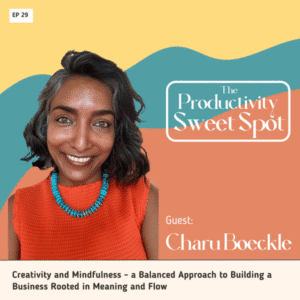
The Productivity Sweet Spot ~ Episode 29
Creativity and Mindfulness - a Balanced Approach to Building a Business Rooted in Meaning and Flow
What if the secrets to happiness in business aren’t found in doing more—but in reconnecting with what lights you up?
In this episode, I sit down with Charu, a creative entrepreneur and jewelry designer, to explore how honoring your intuition, cultivating mental clarity, and embracing creativity can completely transform the way you work. We talk about finding your purpose, letting go of hustle-driven strategies, and building a business that supports your flow state, not your burnout.
Charu shares her journey from corporate life to crafting a soul-aligned business, and how mindfulness and intention have helped her create joyful work—without sacrificing growth or structure. Whether you’re an artist or not, this conversation is a reminder that creativity belongs in your business… and that your attention is your most valuable resource.
If you’re seeking work-life balance as an entrepreneur and want to infuse more productivity, creativity, and meaning into your day, this episode is for you.
In this episode, we cover…
Quotes from this episode
Transcript
In this episode, we cover…
- Releasing the “shoulds” of how business is supposed to look
- Finding your purpose by reconnecting with joy, flow, and creativity
- The power of mental clarity in a noisy world
- Why attention is your most sacred resource
- And how your business can become a space for expression, not just execution
Quotes from this episode
“We’re all creators. When we forget that, we start living on autopilot instead of with intention.”
“Productivity used to mean ticking boxes. Now it means feeling aligned with how I’m spending my energy.”
“If your energy is off, it doesn’t matter how perfect the plan is—you’ll still feel stuck.”
“Anchoring into my highest frequency isn’t a luxury—it’s how I create work that actually matters.”
“Stillness is where the clarity comes. That’s when the next step shows itself—without force.”
Transcript
ANNE
Charu, so you had this big shift from a very structured corporate career to your incredible high fashion career and then an intuitive and creative business, so I’m curious to know a little bit more about that shift and that story, obviously, but also what you maybe have learned along the way about your productivity and I think especially your flow while you’re creating your beautiful pieces, so yeah, bring us into your world and what’s your story?
CHARU
Well, it is a crazy story, now that I look back at it, and it started in like 2007, that’s when I graduated from masters in business, and you know I had always been a creative child growing up, but I grew up in India and the mode of thinking in that country sometimes can be very related to profession and getting professional degrees over pursuing art and design and when I was growing up, of course my parents were very, very supportive of whatever I wanted to do, but I didn’t get into the colleges that I really wanted to get into, and so I made a mental note of like, hmm, that means that it’s not for me, and I went a completely different way and I pursued all my other degrees and got a masters in business and I thought life is set, and I thought I landed a big job with a financial institution in India and I had financial independence, everything for the first time, and I really thought I had made it until it came to the everyday aspects of going to this job and really getting into the banking world, and I was good at it, but I really felt like I was dying inside, that a part of me was just craving creativity, color, fashion, dressing up, expressing yourself, and a financial institution is the very opposite of all of that, and so it was a big, dark reminder that I had, that something was not aligned, and of course I was there for like three years and I did my best, I was actually doing really well because that’s just the person I am.
I give it my best, and it gives you results, but I was so unhappy that it made me look for how can I satiate this part of myself, and that was the beginning of the pursuit of design again in my life, and this time I just did it, I think when you start looking for creative solutions to problems, life helps you, and so a course came along, and it was like on the weekend, and I could just do it after my banking job, and I just got into it, and it was jewelry design, and I did it, and I loved it, like it became the high point of my week, and that’s where it started, and within a year or two of just pursuing this as something to just satisfy myself, it became this bigger and bigger calling to actually pursue this, do this for work every day, and at this time I was all into this job, but decided to quit cold turkey, apply to this school in New York which was really famous for jewelry design, and I already had a master’s, so I wanted a shorter program, and I was like I’m gonna apply to this one place, and if I get in then that’s my sign, and I got in, and yeah, and you know it was based on a portfolio, so I really felt like if they saw talent in me, then there was something there, I’m not the only one who believes in myself, and I got in, and despite the odds of securing a US visa at the time of having only this one school, and quitting a very safe, very financially beneficial career, and my family thinking I was completely nuts for doing so, and basically starting from cratch, I just was like I want to experience what life is like when you do what you love at work every day, and then I came to New York, and that was the start of a really hard fight, but a really worthy fight to create a career in fashion, and honestly looking back one thing led to another, so hard work led to making fantastic relationships with professors which led to being introduced to people in the industry for internships, really proving yourself there led to one thing, to the other, to jobs, to opportunities, and here we are.
ANNE
Here we are, and now you are creating beautiful pieces of jewellery, and I think we just spoke before we got on, it’s this channeling that you do that makes your jewellery very unique, so it’s not just for the piece itself, but I know, because we’ve connected a while ago, because I’m a passionate creator, maybe not quite the artist, but it’s my hobby, and it’s my love and my passion, but you’ve got this very special way, so yeah, maybe you share a little bit more about why do you create the jewellery you do, and I know you do that in a very mindful way, so let’s combine this whole topic of mindfulness, and I know you meditate and you’ve got lots of things there that I think influence your jewellery creation, just share a little bit more about that.
CHARU
I’d love too.
So I guess I think of it this way. I think before 2020, I was just a really trained jewelry designer who had a career in fashion, worked with big labels. I knew how to I was trained to sort of reveal beauty. And then when 2020 came and I went through a really heartbreaking divorce with my then husband,it sort of brought me to the field of meditation. And at that time, that became a tool that really supported me in a really isolated world, because COVID was on full bloom at the time, and so was the breakdown of this marriage. And I guess when things don’t work for you at all, and you get into something that even works a little bit, it really becomes your lifeline. And I really like, because of the perfect storm of it being a really isolating time of intense heartbreak, of everything that you really know to have worked for you, when it all falls down and you’re like, I don’t know who I am, I don’t know what matters.
I don’t know what my path is. I think you start asking the deeper questions, and so did I. And for me, meditation, spirituality, getting into Dr Joe Dispenza, his work, really changed me, personally, and it also changed my view of what creativity is, and going from somebody who was a designer trained in jewelry to somebody who experienced this whole other side to them, that is very difficult to put In words, but it is very much a felt experience. And so my meditative experiences really showed me that there is, like I was using my creativity, like 10% but there is this other 90% that is outside, and it comes from the field, or God, or whatever you may call it. And if you really pay attention to it, it’s right there, and it flows right into you. And that was the start of me wanting to create my current jewelry line, which I call divine Amuletto.
When Amuleto is a Spanish word for Amulets, and I call it divine amuleto, and it is basically
jewelry that is really created to connect you back to your high frequency state, a state that you touch during meditation, a state that you feel when you set an intention, when you say a prayer, because I really feel like what happens when you meditate or you do any mindful practice, is that you do it with eyes closed. You do it sincerely. You feel the feelings and when you open your eyes, you get absorbed in the world and you forget you forget that intention, you forget the feeling, you forget it. And that happened to me a lot, and I used my jewelry to sort of get myself back to that state.
And for me, that has created so much change in changing my habits, changing, breaking some of the patterns in my mind that were really like blocks for me, very limiting blocks,
and it was really easy, because you have this constant reminder. And the great thing about jewelry is that you’re wearing it. It’s always on you, and so that was really my intention to create Amuletto because I wanted people to have a constant companion with them that reminds them of what’s possible, what was the intention that you had, that you began with and to reconnect and of course, when I got into the whole research on gemstones and wire crystals the way they are, you really begin to understand why crystals are used in tech. It’s not just because they are just cool materials. It’s because they can hold energy. They can hold the frequency of your intention. They can hold data. So if they can hold the data that the chip needs, they can also hold the data that my intention is.
ANNE
I didn’t really, I never thought about it that way. So that’s super interesting. I love that cool. Well, okay, where do we go next? I think obviously the audience of my podcast, they are not necessarily artists, creators. They might just not be creative, or even associate, like, identify as creative, but like I said, like for me, it’s a passion, and I do think that creativity is part of being productive, either the, the, you know, the artistic expression of creativity, or what you mentioned, even the creative problem solving, thinking and like, I love creativity. I’m looking at like I’ve got a big jar standing here that I’m covering in macrame at the moment. And for me, it’s often this thing that I do, because, you know, when I move my hands and when I, like, get off my laptop, I can feel how this act of doing something with my hands changes my mind. It clears my mind. It removes all these thoughts. But also it helps me when, like, let’s say I’m we probably all know that we work on the project and it’s quite intense, and we’ve got a good chunk of focus time done and when I in the midst of it, but I feel my brain gets fried at some point.
So quite often I go to my little creative project, and I have, like, a lot of them just started and lying around, but it really helps me to switch off and to just refresh. And so I don’t know if that’s something that you experience, or if you have a practice around it, I don’t know what do you feel about this conversation of like, how does it feel productive? Or, how does it tie into productivity?
CHARU
So that is amazing Before I answer your question, I want to ask you a question, which is that when you go to that jar that you’re sort of working with, right? What happens? Why do you think? Because it sounds like you have a change in state, in your own state when you get in there.
ANNE
Yes, It relaxes. I think because the macrame is so repetitive
CHARU
Yes. But so this is really important, and I think this is what I’m figuring out from my own process as well, that our attention is our biggest resource, right? It is the most important, and we really undervalue it, and when we give our attention to like you just macrame the jar, what you’re doing is, just by giving it your attention, you’re actually making it a secret object.
And because when you’re when you’re giving it your attention. You’re feeling relaxed. Feeling is energy. It’s energetic. It has a frequency, and energy travels. So you’re basically transferring your relaxed energy to the energetic field of this object, and it sustains it. Now what happens is, you go about, do your stuff during your day, and when you go back, you’re now in the field of that energetic object that you have basically grown like a plant.
And now there is a new transference, a new now the object is impacting you. It’s the same with plants, right? Like you grow a plant and it grows and grows and grows. And every time you go to it, there is a feeling. There is you feel like, Huh, you grew.
It’s the same with objects, and it was, It’s beautiful, because that’s the power of your attention and that I think is so important when it comes to any creative act, even if you’re solving a small problem at home in a creative way, it’s like your attention and how you’re feeling around that object or that iIssue is what is most important.
And I find it to be an empowering place, because you can create many such sacred objects in your home or spaces where you go and feel energized, but I think just understanding why something is becoming sacred is because you’re transferring your energy to it, and then it is giving it back to you when you’re in need.
And that’s kind of like, what, too beautiful.
ANNE
I never thought of that that way, but it’s exactly that. Yeah. I mean, it’s just such a beautiful practice to create something and to to see it grow. But yes, it definitely has a lot of feeling and energy with it.
And I think this is exactly what I’m trying to say to people when I talk about creativity and productivity, even if you have no artistic talent as such, but there’s still something that you can create, even if it’s growing the plants you know, like this, it can still be a creative app.
CHARU
Immensely creative. Actually, I think I used to be a plant killer, but really, I have really,
I’ve really changed. I’ve really, like, figured out, like, of course, you need to know, like, what the plant actually needs, like, how much sun, how much water, extremely important. But also how you care for them. For me, how I care for them has really changed. I used to look at them as just plants before, but now I see them as living beings, and I’m like, Well, what does this living being actually need? And you know now when you see the latest in consciousness studies, they’re saying plants are actually like highly conscious and very communicative and very intelligent.
ANNE
That’s why people talk to them so and those plants grow beautifully. When people talk to their plants.
I hear, I don’t know, I haven’t spoken to my plants.
CHARU
But if you apply the energetic lens, right? So anything we say is sound, sound is energetic. Words are energetic. So if we are delivering that sound to something, of course, now there’s going to be a give and take. It’s going to receive it, because the plant is energetic too, and if it’s something positive, it’s going to have a positive effect. I feel like, if you put this energetic lens on everything, you start to really see what a alive world we are living in.
But we feel like, Oh, my God, what could possibly be in this in this plant or in this object, but it’s actually all conscious.
ANNE
I love that. This is so interesting. Like I said, never thought about it this way. Okay, well, I’m curious. So obviously, you are a creator and a creative person, and I’m wondering, how do you sort of balance your work in terms of your business, and maybe some more sort of admin things that you need to get done, or maybe some more, you know, strategic things. And how do you balance that with creativity? Or maybe, what have you learned from creativity that you take over into the other side of the business, tasks that you still have to do as a business owner.
CHARU
That’s a great question. I’m still learning. So in my experience, I think everything is a fine balance between your intuitive side and your analytical side, your intuitive side that just knows stuff before anything happens. Or it just knows, like sometimes we just say, Well, I just knew it. That’s your intuition, and it really is, if you really pay attention to it, becomes like an uninvited guest, a very good guest, because it just says like things to you while you’re not even asking the question. And it’s really powerful, because those insights are very sharp, very short and very to the point and no stories attached to them. So there is that aspect, and I have a lot of that when I design the pieces and I tune into that, because I think that there is a lot more information that your creative aspect, that your intuitive aspect takes into account before it delivers the information to you, and that information may not be available to your senses yet. So in a way, that’s very holistic information. And then, you know, for a lot of the other stuff, of course, we need our analytical mind and I use it all to really plan. I think for planning, I really go full force with my analytical, really strategic aspect. It’s hard to create a balance, though, because you don’t know when you’re becoming too dreamy eyed, if you’re going too much into the intuitive side, or when you’re getting micromanaging with yourself, when you’re planning too much and not allowing that room, I’m I just think it’s like, I don’t know. It’s like swimming in a really fast river. You’re just like, figuring it out as you’re doing it. and I think it’s I just let it my current practice is to let both these sides guide me, but to keep checking in whether I am dominant, in one because if I am dominant, well if I’m not taking enough action, and I’m just understanding and just being like, I know this, right?
Like, suppose my intuition tells me something about, oh my God, this is gonna happen 20 steps later. And if I’m giving too much energy to that, and I have stopped taking any action now, because I’m already like, oh my god, this is gonna happen. So then I that has become dominant. So then I just stop and I reassess and just do the next best thing in the moment,
or if I get very micromanaging, which has happened to me a lot as I built this business last year, I got very analytical about a lot of things, and it really builds frustration very fast in me, the analytical part of me is very dominant, so that’s my tell. Now, if I’m feeling a lot of frustration in myself, then I’m probably not tuned in with the side of me that will say, you know, everything in its own time, divine timing. Relax and, you know, let the right answer come to you. Because the analytical side, I think, gets very like, well, I need to know right now.
ANNE
It tends to be the louder side, isn’t it? Because that’s what we’ve learned. I mean, you described it with, you know, being brought up in India and, you know, being very education focused, and then you had this big job. I mean, all these, like, all these years, you probably learn to focus more on the analytical mind. And me too. Like, same story for me. And so it’s like, usually the voice that’s louder and the intuitive voice is quieter. And I mean, you obviously have practice to lean into it. I think I’m probably sort of still at the beginning of that journey, you know, to really be become more intuitive, but I find it really powerful and interesting.
I can definitely feel like how my analytical brain always is, the more the louder one and the intuitive one is, the quieter voice. And like, I have to be intentional to allow the other one to speak. But I loved how you explained that you know, like when you feel frustration,
there are telltale signs, and if you pay attention, you can see them and you can find them.
So thank you for sharing. So before we wrap up, I’m wondering, is there maybe something else, and any sort of myth that maybe someone has around creativity, or, you know, mindfulness and creativity, anything that you feel like could be really insightful to share before we wrap up.
CHARU
Well, the one I hear a lot is people often feeling like they have to be an artist, or they have to be someone qualified to be creative. But I think that’s the biggest myth, because we are born creative. We are all creatives, and just intending to your garden.
You are creative in making a meal from scratch in a time crunch for people you love highly creative, because the very act of bringing something that does not exist into existence is creativity. And so everybody is creative.
Love it. Absolutely, this is what I’m this is why I’ve talked about creativity on a productivity podcast, because I do think everybody has something creative, creative inside of them, even if it’s not the traditional artistic sense.
thank you so much for sharing. Well, where do people connect with you? What’s the best place to find Divine Amuleto And to find you?
CHARU
Well, Divine Amuleto is a website and an Instagram page that I am happily and easily available on. I also have my own podcast called your Colorful Path, and it’s colorful because it’s me. So you can find it. I love Instagram. You can find me on Instagram at your colorful path with Charu and at Divine Amuleto and please, please send me a message. Tell me anything that resonated, or send me a message or a question for any crystal that you’re interested in.
ANNE
Oh yes, definitely do that. And yeah, just check out Charlie’s work. It’s just so beautiful. Thank you so much for being with me today, of course, thank you.
Listen on your platform of choice


View all episodes
Get more of Charu
Do you struggle with being productive?
Discover where to start when creating business harmony and work-life fulfillment with the Wheel of Peaceful Productivity
Understand Your Unique Productivity Style -And Leverage It for Greater Ease & Focus. Take the Quiz!
Keep In Touch with Anne
Subscribe to her newsletter
Peaceful Productivity Letter
Join hundreds of readers and enjoy three actionable tips on how to make the most of your time.
Thank you!
You have successfully joined our subscriber list.