The Productivity Sweets Sot ~ Episode 28
How to Crush Big Projects and Still Be Present for Your Family
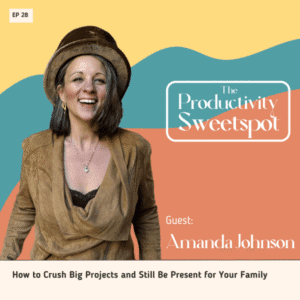
Is it possible to write a book under a tight deadline and still protect your peace, health, and relationships? In this inspiring conversation, Amanda Johnson shares exactly how she did it — finishing a full manuscript in just three weeks while running a business, caring for her family, and staying aligned with her values.
Amanda’s story is a masterclass in time management and productivity under pressure. From restructuring her daily routines to carving out intentional space for Deep Work, she shows how you can make big creative leaps without slipping into burnout. You’ll also learn how she involved her family in the process, created emotional support systems, and used focused sprints to replace long workdays — proving it’s possible to cut hours at work while still meeting huge goals.
If you’ve got a big project on your plate — a book, a launch, or an idea you’re finally ready to finish — this episode will help you do it in a way that’s aligned, sustainable, and deeply human.
In this episode, we cover…
Quotes from this episode
Transcript
In this episode, we cover…
- How to manage big projects under tight timelines
- Rethinking hustle culture for creative work
- Why daily structure matters more than long hours
- What “productive kidnapping” and family collaboration look like in real life
- How to stay focused without sacrificing your health or your relationships
Quotes from this episode
“Big projects don’t have to be overwhelming if you approach them with intention and a plan.”
“You’ve done hard things before. Go back and find the evidence—and build that into the new project.”
“Sometimes when you’re pushing and pushing, we’re not allowing that part of ourselves to get to answers by itself. We jam it up.”
“I created a special shopping trip before I left, so my family could look forward to my time away too. They felt like part of the achievement.”
“I knew how I worked best, and I structured everything—from food to space to family asks—so I could show up fully without burning out.”
Transcript
Big projects, tight deadlines, the pressure to get everything done right now. Sounds familiar, doesn’t it? But what if you didn’t have to sacrifice your peace or your relationships to meet those big goals? Well, that’s exactly what we’ll be talking about today, because here’s the thing. Ambitious seasons don’t have to turn you into someone your loved ones barely recognize.
You can finish what matters and still be present for dinner. You can stretch towards that deadline without snapping at the people you care about most. Today’s guest, Amanda Johnson,managed to write an entire book in just three weeks while keeping her relationships and daily life intact.
Yes, you heard that right. Three weeks. If you’ve got a big project on your plate or one coming up, this episode is for you.
Also, you might be thinking, if you’ve been listening to me for a while, that peaceful productivity sounds really nice, but you are going to launch something big next week, next month, next quarter, and it’s going to be an intense work period. Well, I’ll challenge you. Keep listening because it is possible and Amanda will share how.
But before we dive into the conversation, I want to remind you to check out my new quiz. It’s a quick way to identify your biggest productivity bottleneck and get simple action steps to improve it. And if you’re ready to take control of your productivity, this quiz is waiting for you in the show notes.
But now let’s jump in and hear from Amanda how she stayed peaceful and productive while writing her book in just three weeks and how we can all implement these strategies for our big projects.
Forget the hustle, ditch the burnout and step into your productivity sweet spot. This isn’t just another time management podcast.
It’s your go to space for refreshingly real conversations and practical strategies that help you work smarter, not harder. I’m Anne Rajoo, your host and a passionate advocate for peaceful productivity. Join me as we challenge traditional productivity rules and redefine success on your terms with time, energy and focus that actually fit your life. Whether you’re an entrepreneur, creative or just someone who’s done with the grind, you’ll find actionable tips, mindset shifts and powerful discussions to help you get more done without the stress. Let’s find your productivity sweet spot.
ANNE
Finding peaceful productivity in a normal day, week or month is one thing. But what happens when you throw in a huge project into the mix like a launch or writing a book? And like in your case, Amanda, writing a book in just three weeks, how did you get it done without actually losing your sanity in the process?
AMANDA
Yeah, well, I should say, I did try to give myself a good six months lead time for that. And I, I created it wasn’t just a book, it was going to be a launch, a three day event where I was going to help other people achieve their dreams over the weekend after we launched the bestseller. And so,but you know, as life happens, right, our best laid plans, I got an email from a client who said that he had been given 30 days, he was fighting cancer.
And they’d given him 30 days and said, you know, he told me, I don’t know, I can’t leave this planet with this book still inside of me, will you help me? And so I shoved my projects to the side. I worked with him. It was one of the most productive, insane times in my business to up till that date and then, finished his book.
And then I was grieving him because that was a transformational process to be running alongside him, at the end of his life. And then, then the holidays. And so I looked up on December 27th and I started counting the days and I thought, Oh my Lord, I have three weeks.
So, I sat my family down and I said, you know, I’m committed to this. Like people are coming to an event. This thing has to be done. And it means that I have to have a good product in three weeks to get it through the rest of the publishing process. And I don’t want you all to hate me. And so, or the project when it’s done, right? Cause this is a very important part.
I mean, this is something I’ve been dreaming about doing for six years. So, I asked them what they needed, you know, what do you need? Because I’m going to be like all of my attention is going to be on this. Here’s what I need. There’s a whole bunch of stuff around the house that I would take my time. And if you guys could do this while I’m busy with this, I would be so grateful. Laundry dishes, picking things up, right? Like I made the list. Oh sure. We can help with that. Fantastic.
Okay. So then I’m going to have longer hours. That’s what this is going to look like. And then I needed to be out of the house in order to write. I don’t write books at home. It’s not as productive as you’d imagine. And so I had to tell them like, this is what it’s going to look like. And what do you need in the process? And so my husband said I would like a little chunk of time every night, you know, updates on what’s happening at home and what happened for you and some date nights and like once a week. And then my son who was nine at the time, he said, I want to go to Disneyland once a week.
ANNE
That sounds like a very smart nine year old.
AMANDA
I mean, and I didn’t know how smart he was because, you know, at first I thought, Ooh, like a whole day away from this project. Cause I mean, three weeks, I was planning on writing every single day to get this thing done. But, he must’ve intuitively known that I would need that day to come up for air, and get away from the project and just kind of let everything process and fall away and get reorganized in me at a deeper level. So that when I went back, I was refueled, you know, all of that, family fun and connection that I absolutely needed.
And that’s what, and the remarkable thing about it was that, you know, they did everything that they said they would do. I did what I said I would do. I got the thing done.And at the launch, they came and listening to them, watching their posture. I realized that the unexpected gift in all of it was that they owned my achievement as much as I did. Like I gave them the opportunity to be part of something really big and really cool.
And they felt like they had played a significant part in it. And so that was really special. I didn’t expect that part.
ANNE
When we initially met, I love the story of like bringing in your family. And I’ve always tried to do something similar with my boys. It’s not always been successful, but I must say, because I kept on it, I feel like they now have a much better understanding of when things are really important for me. They will sort of step up and they will sort of say things like, Oh, mommy, but I know you need to do this work. I’ll let you do this work. And I’ll wait for you.
And you know, like, they never said anything like that in the first few years. So it’s beautiful to witness. And I think I love the part where you said that they own part of the success, because I feel sometimes it’s so difficult when they watch you as the family of like working really hard.
And especially children, when you work at home, they feel like you work all the time. You never have time for me while my husband is at the office and he comes back home. And I’m like, well, I’m not I’m working less than your dad. But you know, like it’s this perception. So I like that a lot. But yeah, I mean, obviously, you had different plans.
So first of all, you had to reshuffle everything that must must have been quite stressful. Then going through the writing process with your client and this emotional load. Then it was Christmas and New Year and all these things. It must have still been quite difficult. What did you do for yourself besides, you know, family fun outings and stuff to help you sort of maintaining balance if there was balance in process? I’m not sure.
AMANDA
Well, you know, I’ve been helping other people write their books for a few years by this point. And I knew that there were some really key ingredients. So of course, structure for the for the project is really important. And I had that I had a really strong outline. I knew exactly where the stories were going to be and how it was going to move between all the chapters. But also, you know, there’s the the environmental structure.
So like I said, I decided not to do any of the writing at home. At the time, I had a little office at the retreat center where I was facilitating all of my retreats with these individuals. And so I went over there and I created I knew how important you know, I had to I had to live what I was preaching.
Because everyone was watching to like my community was still together and they were watching me do this. And so, I had a beautiful yoga den down the street. And so I had my yoga practice, there was an amazing labyrinth at the retreat center that I was at. And so I had my spiritual practice in there a way of like, going in and setting my frequency for the day for the writing all of my intentions. And also, I had people around me who not necessarily in the space, but people who knew what I was doing, and knew that I was going to likely run into one of those hard old stories. And so they had made themselves available by phone, like just give me a call if you need to, talk through anything processed or anything.
And so that was beautiful, to have the people who are going to be able to pick up the phone, I only needed it a few times. But man, I was super grateful when it happened when you picked up the phone.
And so those structures, the home structure, the environmental, the physical structures, I knew I needed. Again, at that retreat center, they took great care of all of the meals. And so I had everything, I just had it all set up so that I really could just focus on that project and really take care of myself in the process. Nature, movement, those sorts of things were really key.
ANNE
It sounds like really anticipating your needs, like just being realistic of like, what do I really need to make this happen? And then looking into the future and really thinking it through? What do I need? Who do I need it? When do I need it? And what could that look like? And I love that. I think this is really powerful. Because I think I mean, I’m quite good with planning and putting project plans together. But I came to points where I’m like, I’m really taking along my project plan. But then I have this inner voice of like, so you need to make sure you hit the next deadline so you don’t fall behind.
So you don’t have time to go for yoga and go for this and that. Do you have these things? Or what do you tell your clients when they are like, within the stressful deadline, but they physically or mentally need a break?
AMANDA
I always tell them to take the break. You know, I learned when I was in high school and college, I had the opportunity to work with my dad for a while. And he was someone who had studied psychocybernetics. And the idea of that theunconscious mind is always it’s goal seeking. So when you set a goal for yourself, it’s already trying to get to the answer.
And sometimes when we are pushing and pushing and pushing, we’re not allowing that part of ourselves to get to answers by itself, we jam it up. And so that’s often what I find is that when people are really pushing on something and for like, they’ve done it 100 million times before, why wouldn’t they be able to do it right now? Well, there’s something going on inside that needs space, it needs to take a breath. And however they find that breath, some of them are nature people and have to go take walks and or runs, I’ve had people who were writing through big traumatic abuse stories, and they created a ritual for themselves where instead of going back into hanging out with their beautiful family that they’d created after the abuse story was over, they would take a run, and they would just run a few miles and then come home.
And that was their way of kind of leaving it all out there and not bringing that material home. So and then of course, we’re story junkies over here. So we have a map actually, of all of our favorite stories that we suggest to people, like, maybe you just need to get some ice cream or some popcorn and get on the couch and watch this movie, because it’ll do that, right, it’ll distract the conscious mind, it’ll help to create some empathy.
And, frankly, a lot of these stories have a lot of the answers that we’re looking for, if we’re looking for them.
ANNE
I love that. And what came to my mind was then when we want to force creativity, it tends to not come.
AMANDA
I know, I kind of know how I create, right, I think part of it is really understanding yourself, and how you operate the best. So for me, I am never going to be one of these people who can do creative work for an hour or two every morning, on a book project, like I need to have three weeks or a month, where that is my primary focus, even though I may be spending one or two hours a day keeping business moving along, working with clients, those sorts of things. But I just know how I work, I know that I work with public deadlines, one of my old coaches used to give me a hard time and say, that’s because you’re a people pleaser, and you shouldn’t be feeding that.
And I thought, well, until I get over that, I’m going to use it. Because if I tell someone that I’m going to have a book done, guess what is going to happen hell or high water, that thing is going to get done. And finding that balance, figuring out, so many of the people who step into this space, and I’m sure yours have already achieved some great things, hard things, big projects.
And so I think that, we can fool ourselves into thinking, this is something big and new and different. Is it just different? And maybe there’s some new skill that you need to learn? Or maybe there’s, maybe there’s a little bit of a learning curve, but you basically know how to achieve a thing. So just go back and figure out how you’ve done all of the other things and then figure and then build that into the new project.
ANNE
(NEW PART ADDED HERE (no transcript at the moment)
Unfortunately, I had some tech trouble here. And my part didn’t record. So I went on to ask Amanda about her family, how she prioritized caregiving, doing this intense work season.
AMANDA
Well, I did make a lot of decisions when my son was young, there were certain, not only did I have a toddler, but I was also taking care of an ailing grandmother. So parent, caregiver, entrepreneur, wow, right, trying to sort out that schedule and the chaos that can happen all of the time. So, adaptability, but also, one of the things that I knew was that he was watching me.
And that I was modeling something like dreams matter. When you have an inspiration for something, it’s important to go after them. And so sharing that with him at the beginning, like I did with the book, but not just I’m going to go do this thing, and I have to do it.
But here’s why, here’s how it’s going to take everything that I’ve learned across all of my career and put it into a book. So it’s like medicine for other people. Isn’t that great? Yeah, that is really cool, right? And really helping them to understand the why, what, what is it that’s making you jump out of bed and, and make all of these kind of odd decisions in our culture.
And then, to your point about the guilt, yes, that happens all the time, right? You miss out on important moments and those sorts of things. But I also learned when I was in a facilitator training program, which was my first time having to leave for good chunks of time, like full days, like my first time taking a full day or an overnight event. And so sometimes I would take them with me and have them be in a hotel room so that I could go hang out with them in between the events.
But sometimes I was just gone for a weekend. And what I realized was that I could also plan to figure out ways to bless them and have them even look forward to those times. So for instance, I would always do a special shopping trip before I left, right? So normally we eat all of these things and they’re used to this.
Well, when mom goes away, right, she gets us all of our favorite snacks and the things that we don’t get all of the time. And then I would write love notes, and so I would put those in different places or ask my husband to leave them out in the morning or little somethings that didn’t take a lot of time to prepare. But meant, it was that feeling like, I’m thinking about you, I’m away, I’m doing something else, but you’re, I’m with you, and you’re with me sort of an experience.
And then I found, with when I was starting to do my retreats, and I would have those big, three, five, seven, now seven day events, I would watch them just have so much fun without me, to the point where I’d be like, Hey, what happened while I was gone? I didn’t get as many calls or texts, like what was happening? And, right. so it’s also that time, like, I really realized that was a really important piece for my husband and my son, those times away were really good for them. Because, I don’t know if it’s true for you, but the little boys always seem to be a little bit more attached to the moms early on.
And so when she’s not around, guess what, like, it’s time to build those relationships and find those activities. And they would have their TV shows that they knew I didn’t like, they would watch those while I was gone or go to this park that was their favorite. So finding ways to kind of build that.
And it was just part of my preparation, moving into any of those big projects or any of those events, I would just make that part of, it’s on my checklist, I’m going to the store for these things, and I’m gonna get all of this ready
NEW PART B TO BE ADDED (no transcript at the moment)
Again the tech played up and my part didn’t record. I was curious to go deeper and understand how Amanda involved her family, how she got their buy in to support her and I shard who often when my boys are at home, I give them “work”. My 10 year old loves Canva and creates logos and banners and we even worked on a website for his online drum school that he wants to start. I love that I’m raising a future entrepreneur! So Amanda shared her own lovely story.
AMANDA
Exactly, and I think there are ways to bring, perhaps not for everyone, but I think there might be ways to bring them in, and start to ask questions. I mean, I remember one day I on my way to working it in three weeks, I had sat down with my coach. And we had talked about a bestseller camp. And so I’d said, Okay, if people buy one book, they’ll get this if they buy five books, they’ll get this sort of content, and I was scheduled, I was tearing it up until I got to 20. And then I started to feel like I was going to hyperventilate. And I was like, okay, 20 is like the max I can ask people, right? It was it was a big ask for me.
And so I leave my coaching session with her to go pick him up at school. And asked him, how his day was, he asked me how my day was, what’d you do today? Did you work on the book? Well, no, I worked on the strategy, I met with Ursula, and I told him about it. And so I explained everything to him, because he had obviously shown me he was a little entrepreneur, by the time he was like three or four, he was gaming the Montessori marketplace, like nobody’s business.
I mean, he knew his target market, he knew exactly what they wanted. It was hilarious. And so I would strike up these conversations. And so I told him, I said, Yeah, she can you believe she told me that I should ask people to purchase 20 bucks? And he said, Why not 50? I almost had to pull the car over on the side of the street. Why not 50? And I said, Erin, who would buy 50 copies of my book? And he said, organizations that work with a ton of moms that have 50 moms, he said, and then, but you know, you’re gonna have to give them something like really, really pricey for that. Maybe, maybe you could he gave me my whole business plan, I made an extra $20,000 in the next month, because of this conversation.
What if you just gave them a discount to one of your big events, when you’re your retreats? I put it out there the next day, people purchase 50 books, I hit bestseller, I had new clients. And so I think if we can find ways to strike up conversations and say, even if they don’t understand our industry, if we can create, like a generalized question around it, like, what would you do if you were in a situation where you’re working on a project, and it just feels really hard? Like, how do you deal with that? And then you’re not only bringing them in, but you’re also cultivating critical thinking, you’re helping them to develop all of their own skills for resilience. So I just think that we have this kind of crazy way of keeping everything separate in our families, that they don’t really know about our marriage, except what they see, they don’t really know about our work, except what we tell them.
And like, what if it was a whole team, who understood, like, we all have different superpowers, we all look at the world differently, we could all add something of value to a beautiful vision, if we’re talking about it. Few years later, I think it was a few years later, he heard me telling that story. And he said, you really, you did that? Why didn’t I get a cut? And I thought, oh, now he’s my business partner.
ANNE
This is such a fun story. I love it. My 10 year old already promised me that he would be my video editor one day.
And we already discussed the rates. And he was very adamant that even though I’m his mom, he won’t be able to offer me a very big discount because of the quality he will be producing. I mean, the confidence.
Incredible. I love it. I had to learn this for years. And he’s already got it. Okay, lovely. Thank you.
This was a really wonderful conversation. I enjoyed it deeply. And I’m really grateful for your time, Amanda.
So now let’s just share where people can find you and how they can connect with you.
AMANDA
So saved by story dot house is the company. It’s a writing and publishing house where we help people who are trying to get messages into the world from inspiration impact. And so if people have questions about the writing process or what kind of structures or how they can save their own stories while they’re working on stories for the world, if they go to saved by story dot house forward slash foreshadows, that’s F O R E shadows. There’s a whole bunch of different free things that they can take a peek in and just start getting started on the adventure.
Such a powerful conversation today with Amanda.
We talked about how big projects don’t have to be overwhelming if you approach them with intention and a plan. We spoke about involving your family in the process or creating temporary bubbles for your deep work. And Amanda shared so many actionable tips for making these projects more manageable. And I hope you took lots of ideas away. And I think for me personally, the main productivity takeaway of this episode is that that sort of referred or reminded me of a episode I listened on Cal Newport’s podcast. He’s the author of Deep Work and Slow Productivity.
Definitely two books that I love and that I can only highly recommend. But he shared this metaphor of someone swimming in the sea. And you know, I live in Mauritius, a small island. I’m right next to the ocean and I love the water. So that really resonates with me in any case. But he talks about this idea that you can be swimming with nice, strong strokes.
And I’m actually moving my hands here while I’m recording, even though I’m recording without video. But you get that, like nice, strong strokes so that you get closer to the shore instead of drowning. So when you prepare and you have a plan, when you approach big projects, you are able to swim through this busy, ambitious period with tight deadlines.
You’re able to make these strokes and you’re able to get towards your goal. So you are not going to drown in all the different tasks because of the clarity and the ease that your plan can create for you. So I’m a big planner. I love plans. I especially love project plans. And it’s, I think, one of my superpowers.
And I know it doesn’t come easy to everybody, but I just really encourage you, if you have a big project that you’re working on, create that plan. Even if you feel uncomfortable with listing all the tasks, it might feel overwhelming because it’s a long list of things that need to get done. Or if you’re more that, you know, bigger picture, throwing in just a couple of milestones and, oh, I’ll get this done somehow.
I can only tell you that if you have a big project and you don’t break it down in really small, little tasks, it will always feel overwhelming. It will always feel challenging to keep on track because either your day is too short to actually accomplish these big projects. And I remember my productivity audit client, Lara, was like that.
She would put a big project on her to-do list and it wouldn’t get done. So it would always be carried over to the next day and the next day and the next day. And she was getting really frustrated and demotivated with that feeling of, I will never be able to accomplish this project.
So breaking it down in baby steps is super powerful. And it doesn’t have to be elaborate, a simple sheet of paper, an Excel file, a Google sheet. All of these things are amazing.
As long as you sit down and you really think about what are the tasks that need to be done, in what order do they need to be done, ideally highlight the things that are key milestones and that sort of need to happen for everything to move on. Add some deadlines. I know deadlines are not always a thing for everybody.
Recently, I had Lisa on the productivity audit and she asked me, but I don’t have anybody looking from the outside, like these are internal deadlines. She’s doing a repositioning of her business. How should I put deadlines and how can I come up with these deadlines? I think deadlines are important, even if they are internal.
It’s just something that keeps us motivated, that adds that little bit of pressure. And at the same time, I said to Lisa, listen, still tune into your energy, still see how life is and how the rest of your work flows. And if you don’t actually have anyone waiting for something, if you don’t have anyone who’s expecting a delivery of something, it’s also OK to move the deadline.
It’s your deadline. I’ve done that when I launched a podcast. I’ve done that a few times when I launched a podcast, but I just didn’t feel right to push just for the sake of a deadline.
But I still had a deadline because I still needed to know what do I work towards.
And even when you break down your projects in smaller tasks, you sort of have to get a feeling of like, how long will that take me? And does it even make sense? Is that even achievable if I want to launch something in a month time, but I have 500 things to do? Is it even achievable? So yes, project plan, because that will help you to stay afloat and not drown in your big project and not turn into that really stressed, very unlikable person. And that’s for me, the essence of the conversation. And that’s what I would love for you to take away as well.
And if you need help with planning, like I said, it’s one of my superpowers, always available to you to chat, just connect with me on LinkedIn. The LinkedIn handle, sorry, LinkedIn, I was posting on LinkedIn earlier, Instagram is _annerajoo_. And also, if you’re curious, I’ve got this new productivity style quiz, which is fun, but it’s also really interesting and powerful because it identifies your unique productivity style.
And it will give you personalized tips and resources to really lean into the strength of your productivity style and to make the best of it. So that is on my website, annerajoo.com, and the link will be in the show notes. And of course, come back next week.
It’s going to be fun. It’s one of my favorite topics, creativity in connection with productivity. I’ve got a really wonderful guest on the podcast, and we will be talking about your energy, high frequency and anchoring your highest state.
So this is going to be, yeah, a little bit of a different angle, but I think it’s going to be awesome and I can’t wait to bring it to you. And I hope you’re coming back next week. And until then, stay peacefully productive and I’ll see you next time.
Listen on your platform of choice


View all episodes
Get more of Amanda
Do you struggle with being productive?
Discover where to start when creating business harmony and work-life fulfillment with the Wheel of Peaceful Productivity
Understand Your Unique Productivity Style -And Leverage It for Greater Ease & Focus. Take the Quiz!
Keep In Touch with Anne
Subscribe to her newsletter
Peaceful Productivity Letter
Join hundreds of readers and enjoy three actionable tips on how to make the most of your time.
Thank you!
You have successfully joined our subscriber list.