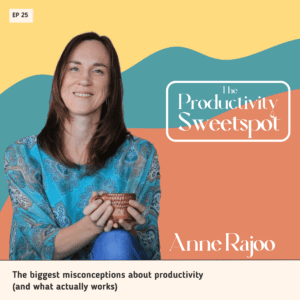
The Productivity Sweet Spot ~ Episode 25
The Biggest Misconceptions About Productivity And What Actually Works
Feeling burned out and stuck in hustle mode, even though you’re doing all the right things? You’re not alone — especially if you’re a mom and entrepreneur trying to build a business without losing yourself in the process.
In this episode, I sit down to talk about what it really takes to improve productivity as a female entrepreneur — and spoiler alert: it’s not about doing more.
If you’ve ever believed that hustle equals success, this episode is your wake-up call. Burnout isn’t just “part of the process!”
Let’s flip the script on traditional productivity advice. You’ll hear why time hacks and rigid time blocks don’t actually work for most women — especially moms — and what actually moves the needle when you’re juggling business and real life. I get real about mom burnout, how it creeps in silently, and why it’s one of the biggest threats to your motivation and creativity.
I share my personal experience with burnout recovery, including the moment I realized I was building a business that didn’t fit my life — and how I turned it around. Instead of pushing through with more discipline, I rebuilt my rhythm using energy management, not time blocks or hustle routines.
You’ll walk away with a clearer picture of what female entrepreneur productivity looks like when you choose peace over pressure — and why that shift is essential for long-term success and sustainability.
Whether you’re in the thick of burnout or just want to work smarter without burning out later, this episode is your permission slip to ditch the hustle and step into a more sustainable, fulfilling way to show up for your business — and yourself.
In this episode, we cover…
Quotes from this episode
Transcript
In this episode, we cover…
- I get real about my own burnout and how it showed up without warning
- Why traditional time management often fails female entrepreneurs
- The surprising thing that helped me rebuild my business without losing my mind
- And how energy management — not hustle — is the key to sustainable growth
Quotes from this episode
“Productivity isn’t about doing more—it’s about doing what matters most.”
“The systems that used to work completely fell apart when I became a mom—I had to find a new way that honored both my ambition and my energy.”
“Willpower is overrated. What actually helps is rest, energy management, and systems that support you—not punish you.”
“You don’t need to eliminate every distraction to be productive—some distractions are necessary for creativity and joy.”
“Peaceful Productivity is about progress without pressure, success without sacrifice.”
Transcript
Traditional productivity advice tells us to hustle harder, wake up at 5 a.m. and squeeze every ounce of efficiency out of our day. But what if these outdated approaches are actually sabotaging our progress? So in today’s episode we’re busting the biggest productivity myth and explore what actually works, especially if you want to be productive without the burnout. Forget the hustle, ditch the burnout and step into your productivity sweet spot.
This isn’t just another time management podcast, it’s your go-to space for refreshingly real conversations and practical strategies that help you work smarter, not harder. I’m Anne Rajjo, your host and a passionate advocate for peaceful productivity. Join me as we challenge traditional productivity rules and redefine success on your terms, with time, energy and focus that actually fit your life.
Whether you’re n entrepreneur, creative or just someone who’s done with the grind, you’ll find actionable tips, mindset shifts and powerful discussions to help you get more done without the stress. Let’s find your productivity sweet spot. Before we dive into today’s productivity myth, I want to share a bit about why I became so passionate about peaceful productivity.
Because for a long time my approach to productivity was anything but peaceful. So my dad used to say, some work to live and I live to work. And so that has been deeply ingrained in me.
And I remember for many years we wouldn’t even go on a family holiday because my dad was always working. I would of course visit grandparents and we would go for little trips. But my first real family vacation was when I was 16 years old.
Until then my dad was always working seven days a week, many hours in a day and it was just what he loved. As a young child I was raised to be independent and with that spirit that if you work hard you can achieve anything. For years I really followed that traditional advice of long to-do lists, waking up early, maximizing my time, taking off all my to-do’s, pushing through even when I was exhausted and very often I was feeling guilty for not working.
When I would get sick or by the time I had children and I wasn’t able to work every living minute of my day and I had to take breaks, I felt guilty. And I thought that being productive meant that I was constantly doing something. And instead of feeling accomplished, because I was obviously working really hard, but instead of feeling accomplished I felt burned out, frustrated, never done and never enough.
There was always more and I always felt I was behind or I wasn’t getting where I was supposed to get. Because I was working so hard, things should be working, there should be an outcome visible or tangible. But it often didn’t feel that way.
But everything changed when I became a mom. Because suddenly my time and my energy wasn’t just mine anymore. I had to manage different things, different needs for, you know, the needs of my children but also different physical needs for myself and my old productivity strategies that until then worked quite okay.
They didn’t work anymore. They just didn’t work anymore. And I fell apart.
I really lost my way. I didn’t honor my body. I felt I didn’t honor my ambitions.
I felt I wasn’t doing well at all, while it probably looked still pretty good on the outside. On the inside it just felt quite horrible. I just didn’t feel myself.
I was unhappy with what I was doing and how I was doing it. And obviously I was exhausted. I was just shattered every single day of my life.
So what I needed then was peaceful productivity. And so I started questioning that hustle mentality that I had. This, you know, constantly grinding and never stopping and not allowing myself to take breaks and to even admit that it was really difficult to manage work and a young family and that sometimes I wasn’t able to do this on my own.
And so I really looked into what I really wanted, what worked for me, like what things was I really good at and so on. So all the things that I talk about in peaceful productivity, I started looking at those and I started understanding that the old paradigm of working hard and that will bring you success is not true in many cases. At least not in the holistic and sustainable way that I see work and productivity and life, because it’s a marathon.
It’s not a sprint. We’re here for many, many years. And so while maybe grinding works in a specific season of our life, you know, I do believe young people, they have to put some grind and effort in there.
But my listeners are mostly not very young anymore. So I think in our phase of our life or in the space that we’re in, we’re looking for peace, for time freedom, and for enjoyment and not hustle and grind. So that’s how peaceful productivity was born.
It was really born from my personal experience. And I’m really passionate about sharing it because I understood as well that I’m not the only one who has been working in these unsustainable ways and who didn’t achieve the success they thought they would be achieving. Or we achieve success, but we just don’t feel good about it.
So that’s where peaceful productivity has its place. And before I get into busting these myths, these traditional productivity norms, I want to share with you about my brand new quiz that I’ve created. So it’s the Peaceful Productivity Scorecard, and it really helps you to understand what’s your productivity style, what’s uniquely your way of working and being productive, and how can you leverage that style and make it your strength.
Or maybe tap into some of the other styles to complement your personal style and to have a more holistic and well-rounded approach to productivity and work. And so the quiz or assessment will help you to understand that, and it gives you tailored, specific to your style, tips and mindset shifts and techniques that you can apply to feel greater sense of peacefulness in your productivity. So I invite you to take the quiz.
It’s on my website, anradu.com forward slash quiz. I’ll put the link in the show notes and find out what is your unique productivity style. And now let’s get into those productivity myths that I want to bust with you.
So I already said it, a lot of us believe that productivity is about doing more. Well, the truth is, it’s not about doing more. It’s about doing what matters.
So my PEACE framework emphasizes this because the P stands for prioritizing with purpose. So instead of chasing endless to-do lists, we want to pick the things that have purpose, the task that move the needle in our business or in our life, and we want to focus on that. So I know that a lot of us try to really cramp as many to-dos in the day as they can.
And I had a client who was really good at making lists and ticking them off, but she came to me frustrated because there was always something that stayed on that list. She never managed to tick off all the things on her to-do list. And we finally got to the point where she understood that she would put large projects on her list, and obviously they were too large for her to accomplish in the time that she had available on that day.
So she started breaking them into smaller, bite-sized pieces and put those on her to-do list, and she would be able to take those off. And she felt so much more accomplished and less frustrated because if we have too many things that we’re not able to do in a day, it only leaves us frustrated and leaves us feeling we’re behind and we’re never done. So doing more is not necessarily working.
We want to focus on what matters. The second myth is that success comes from rigid routines and working harder. Podcast episode with Renée Fick, and we talked about our energy cycles and obviously women and their menstrual cycle functions in on average 28-day cycles, while men have a daily rhythm.
And we have been ignoring that in productivity. Our world is set up to follow this 24-hour rhythm, but our bodies are set up to follow a 28-day cycle. So there is a discrepancy somewhere.
And often this leads to burnout or inconsistency, because we speak about this in the episode and I will share it in the show notes. Not every day feels the same. Some days we’re crushing it and we’re so productive and so creative.
And the next day, nothing seems to be working. And that really is because of the cycle that we experience. And even if we don’t experience a menstrual cycle, the world still functions in cycles and seasons, summer, winter, spring, autumn.
And nature doesn’t just work every single day. We harvest during a specific period, we seed, we try and replenish the soil. All of that is happening.
So just really following rigid routines, because that’s what we think we should be doing so that we are having 24 hours used efficiently, is not always working. So the third myth is that if you’re not productive, you just need to be more disciplined. So discipline is an interesting topic.
I am very disciplined. I think my parents raised me to be that way. My dad, like I said, lives to work.
And so he is incredibly disciplined. He was in the army as well. I think this is partly contributed to that.
But really, I think willpower is overrated. What really helps us is energy management, rest and setting up systems that support us. So in my framework, the E in PEACE stands for energy management and really allowing time for rest and reflection because we keep going.
We are on a grind and we just do the same thing that we’ve done yesterday and the day before and the month before and so on. We don’t stop to think about it and we don’t stop to really reflect on, is this actually working for me? Mostly when we stop, it’s because we’re forced to stop. We get sick, we have a major life event happening, we really feel burned out and we cannot be proactive anymore.
But we don’t want to get to that point. We want to be strategic about our breaks and rest periods so that we can balance, that we can be focused without being exhausted all the time. So the fourth myth is that perfect systems will fix everything.
Well, I’m a systems person. I love systems. They are really powerful.
But systems are not the sole solution. So if you are not aligned with your strength, with the rest that you need, the cycle, the powering through, the rigid routines, all the elements that I speak about in PEACE for productivity, we can create systems for everything in there. But if we don’t have this compassion for ourselves, we can get stuck in systems.
We can get stuck in really trying to fine tune the systems that we have. And this is actually one of the productivity styles that I have identified in the quiz, because there’s a lot of people who are really good with their systems, but it’s not what makes them really incredibly productive if you take a holistic view. So again, if you want to check out your productivity style, do the assessment.
It’s on my website, annerajjo.com forward slash quiz, and find out what’s your productivity style. Maybe you are that systems person. But then I invite you to have a broader look at other things that could be powerful for you to be productive.
And the last productivity myth is that productivity means eliminating distractions completely. But actually, some distractions are good and necessary. And while I’m really, really encouraging everyone to plan focus time in their days, and I always advocate for apps that block out other notifications and applications like social media on your desktop or on your phone, setting limited times, you know, to be able to scroll on Instagram or to have different settings on your phone that don’t allow you to do that during the time that you’re supposed to be working.
And, you know, putting the phone away from your desk so that you can’t just grab it and have a look. I love all these things, and these are really valid tips and are really powerful when you schedule focus time. But at the same time, we all know that life happens.
Not every day is the same. I already spoke about it in terms of energy management. Not every day feels the same.
And so the last E in the PEACE framework stands for Enjoy the Journey. Because when we are trying to be productive, not every day is the same. The things that work for me might not work for you.
The things that work for you might not work for me. And so we shouldn’t restrict ourselves to really narrow it down to these hacks and tips that we have been taught by productivity gurus. Peaceful productivity is the holistic view and really the sustainable approach to productivity.
And so we’ve got to enjoy the journey. All right, so let’s quickly talk about what actually works instead. Just to summarize, we really want to align our work with our energy and not just the clock or the calendar.
And we want to focus on fewer but more meaningfultasks. So those things that really matter. We want to build systems that support us, but we don’t expect that the system will solve everything for us.
And we want to allow for rest and reflection as part of being productive and not just to break away from it, to get away from it. We want to integrate rest and reflection into our days. And then compassion over perfection, because progress matters more than doing it right.
So as long as we keep doing, as long as we keep trying, we are on the right path. It will not be perfect. And even if we think it’s perfect, life happens and things are changing.
So compassion over perfection. All right, that is it for today. I hope you enjoyed this episode.
I would like to invite you to leave a review or a rating on any of the podcast apps that you are listening to this, because it is really helpful for me as a podcaster to have the podcast shown to other people who are interested in peaceful productivity. And I mentioned the Peaceful Productivity Scorecard already, my new quiz. When you take the quiz, send me a message on Instagram, share with me what your results was.
I would be really curious. And the quiz is on my website, annerajjo.com forward slash quiz. I’ll put the link in the show notes.
I would love for you to take the assessment and let me know. And of course, next week I’ll be back. And that’s another episode with a guest.
Monica Mangelson comes on and we talk about routines, but actually in a way that really works for us. We specifically talk about morning routines. And I told you Robin Sharma wrote the 5 a.m. Club in Mauritius, but this is not necessarily what we’re talking about.
The hint that I want to give you here is intuition. We’ll talk about morning routines and routines in general that really work for you. So come back next week.
Tune in and I can’t wait to see you again. Until then, be peacefully productive and I’ll catch you next time.
Listen on your platform of choice


View all episodes
Get more of Maddison
Do you struggle with being productive?
Discover where to start when creating business harmony and work-life fulfillment with the Wheel of Peaceful Productivity
Understand Your Unique Productivity Style -And Leverage It for Greater Ease & Focus. Take the Quiz!
Keep In Touch with Anne
Subscribe to her newsletter
Peaceful Productivity Letter
Join hundreds of readers and enjoy three actionable tips on how to make the most of your time.
Thank you!
You have successfully joined our subscriber list.