

The Productivity Sweet Spot ~ Episode 81
Stop Avoiding Feedback: The Key to Productive Teams and Self-Growth
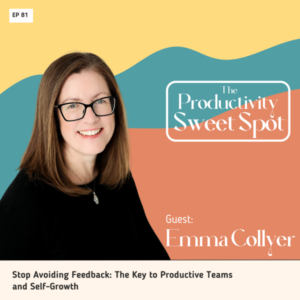
What if the one thing holding back your productivity, your team, and your personal growth wasn’t your to-do list, but your relationship with feedback?
In this episode of The Productivity Sweet Spot, I’m joined by executive coach Emma Collyer to explore one of the most overlooked productive habits in entrepreneurship: how to give and receive feedback in a way that actually builds trust, supports work life integration, and creates real momentum.
We dive into why feedback triggers fear and nervous system responses — even when we know logically it’s just information — and how that self-awareness is the first step toward changing how you receive it. Emma shares a powerful reframe: feedback is not a verdict on who you are. It’s data. And when you learn to treat it that way, it becomes one of the most sustainable tools for growth in your business and your life.
This conversation is packed with actionable insights for anyone who wants to protect their energy in difficult conversations. Emma breaks down what actually happens when we’re receiving feedback we don’t want to hear, why we only remember the critical piece and forget the positive, and how to contain the narrative so you stop catastrophising and start integrating.
We also talk about entrepreneurship and productivity through the lens of team communication — why psychological safety and a regular culture of micro-feedback outperforms the dreaded annual review — and how a 5-to-1 ratio of positive to constructive feedback can transform how a team functions. And yes, we debunk the sandwich method.
Whether you’re leading a team, working with collaborators, or simply navigating feedback in everyday relationships, this episode gives you a grounded, compassionate framework to make feedback feel less threatening and far more useful.
In this episode, we cover…
Quotes from this episode
Transcript
In this episode, we cover…
- Why feedback triggers your nervous system — even when you know it’s just information
- How to “contain the narrative” so you stop catastrophising mid-conversation
- The 5-to-1 ratio that high-performing teams actually operate by
- Why the sandwich method is kind of dead — and what to do instead
- What happens when you avoid giving feedback (hint: it’s worse than you think)
Quotes from this episode
“Feedback isn’t a verdict on who you are — it’s information. And information, we can work with.”
“We often only remember the one critical piece and forget all the positive that came with it.”
“You’re not preventing conflict by avoiding the conversation — you’re preventing that person from growing.”
“Trust is what makes feedback land. And feedback, done well, is what deepens trust.”
“Contain the narrative: what is this feedback about — and what is it not about?”
Transcript
The Productivity Sweet Spot Podcast
Episode: Feedback, Trust & Sustainable Teams with Emma Collyer
—
Expert
What if the thing holding back your productivity isn’t your tools or your schedule — it’s the feedback culture in your business? In this episode, Anne Rajoo speaks with executive coach Emma Collyer about why feedback triggers fear, how to give and receive it with clarity and kindness, and why building a genuine feedback culture is one of the most actionable insights you can apply for sustainable business growth. They explore the mindset shift needed to stop seeing feedback as a threat and start treating it as information — a quiet but powerful form of nervous system regulation and work life integration. If you want to protect your energy in relationships at work, build real trust in your team, and develop productive habits that keep communication flowing, this episode is a must-listen.
—
TRANSCRIPT
—
Anne: Emma, I’m so happy to have you on the podcast. I want to start the conversation with something I think a lot of people relate to — when they hear the word feedback, they immediately feel some sort of tension or discomfort. Why do you think that is? And what are we getting wrong about feedback that you can hopefully help us reverse today?
—
Emma: Thank you — it’s great to be here. I think the word itself triggers a lot of people. I was recently speaking with a group around this, and often the anxiety comes from the assumption that feedback is going to be negative — something we won’t want to hear, because it’s about us or something we did.
Even just anticipating that conversation creates anxiety. People get nervous, sometimes panicked: what is this conversation going to be? We build stories in our minds. Talking to some people, it’s like — oh, I’m going to get fired or something’s going wrong. Always lots of negative narratives that we tell ourselves.
And that prevents us from fully embracing what can actually be really helpful information. Because most of the time, feedback is about helping us grow, learn, and improve. If we stop listening — if we block what the person is sharing with us — we’re preventing ourselves from growing. I think that’s the piece we often forget.
—
Anne: Yes — and the word that stood out for me there was information. To treat it as a piece of information: no judgment attached, no value judgment of good or bad. It’s something we first of all want to hear, and then we can decide what we’re going to do with it.
Logically it makes total sense. But when you started talking, I immediately went back to memories of being called into a manager’s office for feedback, or asking for a pay rise and having all these arguments prepared — and then receiving feedback that countered them. I have very real visual memories of leaving those meetings all sweaty, thinking oh my god, that was awful — and looking back, it wasn’t that awful at all. The feeling and the memory just stays with you.
So is it fear that’s the main thing driving all of this?
—
Emma: I think often it is. Fear that I’m not doing a good job, fear that my boss isn’t happy with me. We build this up before the conversation even starts. And then because we’re in that kind of panic or anxiety mode — because we’ve created a story or narrative that isn’t even true — we believe it. So when the person is actually providing the feedback, we’re not really fully listening. We’ve almost blocked the receiving.
—
Anne: And do we hear what we think we’re going to hear? Like — sometimes I have the feeling we might be listening for the specific thing we expect, and then we catch that particular piece and filter everything else out.
—
Emma: Definitely — that can absolutely happen. And I think what we also often find is that when someone provides a mix of positive and constructive feedback, all we take away is the constructive piece. We forget the positive entirely. We just fixate on the small thing we needed to change or improve — we can’t let it go, and it sticks with us.
—
Anne: Yes, absolutely. But at the end of the day, this is a conversation around productivity — so how can feedback actually lead to productivity? Do you have a story or example where feedback genuinely made a difference?
—
Emma: A broad example: I’ve been brought into an organisation over the last year because they recognised that feedback was a block in how people were communicating with each other — and that was holding back team performance. I started working with various groups within that organisation, and what they’ve shared with me after about twelve months of work is a real shift. People are now open to conversations, genuinely accepting of feedback — but also confident in providing feedback, which is often the harder challenge.
And as a result, people are working more effectively together. That communication barrier has come down. Performance has improved. If you’re doing that at scale across an organisation, it’s significant. And even if you’re doing it just for yourself — managing your own approach — it’s going to have an impact on the people around you.
—
Anne: I love that. And I’m curious — for each side of the equation, what’s your number one tip? One for the person receiving feedback, and one for the person giving it?
—
Emma: Condensing it down to one — for giving feedback, I always talk about identifying the key message you want to get across. Sometimes we overwhelm people with too much, and it’s really hard for them to take away what we’re actually trying to communicate. So just focus on one thing, and be really clear and kind with your words. It will land. The person won’t walk away confused — which is something that happens a lot.
For receiving feedback, I talk about containing the narrative. Ask yourself: what is this feedback about, and what is it not about? The feedback might be about improving a report or a presentation — it’s not about your performance over the last twelve months. Separating those out can really change how we experience receiving feedback.
—
Anne: I love that. And I know you talk about feedback as a way of working — not just a once-a-year sit-down session. How can we create an environment where feedback happens regularly and naturally, without it feeling like okay, let’s organise a meeting and now I’m going to give you feedback?
—
Emma: There are lots of ways. Small check-in meetings — or even just informal moments. Not even using the word feedback necessarily; just saying: I’d like to share some thoughts on what you’ve been working on.
And we often forget about the ratio of positive to constructive feedback. Research shows we need at least five pieces of positive feedback to every one piece of constructive feedback for a team to be performing at a high level. The more we can drop in those positive recognitions — naturally, casually — the more it enhances the whole environment. So it’s really about finding opportunities to say something positive. And then if there is something to address, we do that in the same spirit.
—
Anne: That’s powerful. And I keep thinking of the feedback sandwich — you know, positive, constructive, positive again. Is that still a thing?
—
Emma: It was a big thing a few years ago, but less so now — because people see through it. They’re kind of waiting for the bad news in the middle. What I talk about now is either being direct, or — if you want a softer landing — leading with your positive intention or acknowledging the effort someone has put in before you get to the feedback. That lands much better.
An example: “I really appreciate your efforts on this project — there are just a couple of things we need to adjust to make it even better, which are X, Y, and Z.” You’re acknowledging the person, acknowledging what they’ve accomplished, and then providing the feedback. Not strategic packaging — just genuine acknowledgment.
—
Anne: Yes. Not too calculated about how you wrap the delivery. And what about when someone really struggles to receive feedback in a constructive way? When it gets emotional or difficult?
—
Emma: If someone is upset or having a strong emotional response, you can always say: “Let’s take five minutes and come back to this,” or “Let’s come back to this later today — give you some time to digest what we’ve talked about.” Or even the next day. Sometimes people just need a little space to absorb what’s been shared before they can have a proper conversation. I’d always advise building in that space if you can.
—
Anne: Makes sense. And I’m curious — do you have a personal favourite piece of feedback you’ve received yourself?
—
Emma: One that stuck with me — not necessarily my favourite, but the one that stayed — was from a manager at a time when I was probably taking on too much and saying yes to everything. We had a very frank conversation, and he basically said: “You’re almost running yourself into the ground here — you need to stop.” But he did it with kindness and support. He did it in private, the timing was right — and it stuck. Reflecting on it now, that’s exactly the kind of feedback I want to give others: supportive, but clear. This isn’t working. This isn’t the right direction.
—
Anne: That really resonates. It reminds me of friendship too — you expect your closest friend to give you honest, calling-out feedback. And it doesn’t feel like here’s a list of what I’m doing wrong — it’s the intention behind it. When the intention is right, it lands completely differently.
—
Emma: Absolutely. And as you were talking, the word trust came up for me. We need trust in order to give feedback well — but also, giving feedback builds that trust even further. It often strengthens a relationship, if it’s done well. And coming back to productivity: when you trust your team, when communication is open, when feedback flows naturally — that’s when things work much more smoothly, with far less friction. There really is a direct link between feedback culture and productivity, even if you don’t immediately think of them together.
—
Anne: Anything you’d want to leave the listener with before we wrap up?
—
Emma: One thing I talk about often: don’t be afraid to give feedback. We hesitate because we’re worried about hurting someone’s feelings or damaging the relationship. But try looking at it through this lens — if you don’t give the feedback, you’re actually preventing that person from growing and developing. That reframe puts a different spin on it.
So if you feel yourself hesitating or avoiding, you can practise, you can think about how to approach it — but don’t not do it. Because it will hold that person back.
—
Anne: So true. I can think of situations in my own business early on where I let things slide — and by the time I finally addressed it, the trust had already eroded through all the small things that had accumulated. Looking back, I should have spoken up earlier, every single time. If we want to stay in relationship with someone — at work or outside of work — feedback matters. Otherwise it snowballs to a point where… well, the snowball explodes.
[Note: light banter here about “sandwiches and snowballs” — you may want to trim or keep depending on tone of the episode.]
—
Emma: Ha — I’ll blame the beach and the sunshine for any unusual metaphors today!
—
Anne: I love it. Emma, thank you so much for coming on and for this conversation. Where can people find you and learn more about your work?
—
Emma: Two places. I have free resources at NeedMoreTrust.com — more on feedback and how to approach it. And my website is aspireexecutivecoaching.com — that’s the best way to get in touch with me.
—
Anne: Perfect — everything will be linked in the show notes. Emma, thank you so much for being here. Great conversation.
Listen on your platform of choice


View all episodes


Get more of Emma
Do you struggle with being productive?
Discover where to start when creating business harmony and work-life fulfillment with the Wheel of Peaceful Productivity
Understand Your Unique Productivity Style -And Leverage It for Greater Ease & Focus. Take the Quiz!
Keep In Touch with Anne
Subscribe to her newsletter
Peaceful Productivity Letter
Join hundreds of readers and enjoy three actionable tips on how to make the most of your time.
Thank you!
You have successfully joined our subscriber list.