
The Productivity Sweet Spot ~ Episode 32
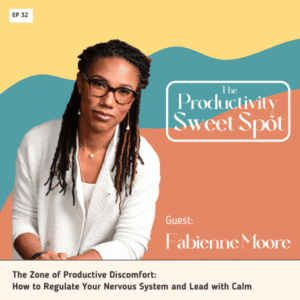
The Zone of Productive Discomfort: How to Regulate Your Nervous System and Lead with Calm
What if the key to sustainable business growth wasn’t pushing harder—but learning how to stay grounded in the uncomfortable moments that actually spark growth?
In this episode, I’m joined by executive coach and leadership mentor Fabienne Moore to explore what we call the Zone of Productive Discomfort—the space between staying safe and burning out, where real transformation happens. We unpack how to tell the difference between healthy discomfort that fuels growth… and nervous system dysregulation that leads to shutdown, overwhelm, or overworking.
You’ll learn how to calm down your nervous system, recognize the signs of dysregulation, and tap into nervous system regulation exercises that build true resilience at work. We also talk about why high-achievers often miss the signals their bodies are sending—and how to slow down to go faster in a way that actually increases your clarity, impact, and peace of mind.
If you’ve ever felt stuck in the tension between ambition and exhaustion, this conversation will help you reconnect to your body’s wisdom, embrace discomfort without tipping into burnout, and lead yourself and your business from a place of calm strength.
Because growth is uncomfortable—but it shouldn’t cost your well-being.
In this episode, we cover…
Quotes from this episode
Transcript
In this episode, we cover…
- What the body is really telling you when you feel overwhelmed or foggy
- Why “slowing down to go faster” is more than a cliché—it’s a nervous system strategy
- How to recognize your own patterns and regulate in real time
- What resilience at work looks like (and what it doesn’t)
Quotes from this episode
“What makes the discomfort productive is the fact that it is paced and attuned and resourced.”
“Our pace can become a habitual pattern in our nervous system. Whether sustainable or comfortable, it becomes familiar.”
“We can’t bypass discomfort. We have to go through it.”
“Slowing down feels disorienting not because it’s wrong, but because it’s unfamiliar.”
“There’s a lot of energy bound up in not talking about things. When we acknowledge them, that energy gets unleashed—and we can use it to move toward purpose.”
Transcript
INTRO:
What does it really mean to build a business that supports your life? Not the other way around. I’m joined by Sarah Santacroce, author of the book Business Like We’re Human and we talk about redefining success, making space for inner peace and shifting from hustle to values-based approach to grow our business. Today’s conversation is really an invitation to slow down, not to do less, but to do what matters more.
This episode is for you if you’re longing for more peace, purpose and humanity in business.
Forget the hustle, ditch the burnout and step into your productivity sweet spot. This isn’t just another time management podcast.
It’s your go-to space for refreshingly real conversations and practical strategies that help you work smarter, not harder. I’m Anne Rajoo, your host and a passionate advocate for peaceful productivity. Join me as we challenge traditional productivity rules and redefine success on your terms with time, energy and focus that actually fit your life.
Whether you’re an entrepreneur, creative or just someone who’s done with the grind, you’ll find actionable tips, mindset shifts and powerful discussions to help you get more done without the stress. Let’s find your productivity sweet spot.
ANNE
Fabienne, I’m excited to have you here today and I think I’m really curious because when I initially connected with you, something stood out for me. You had on your website this term of the zone of productive discomfort and I really wanted to dive into that with you today and I’m wondering really what do you mean by that productive discomfort? Tell me more about it.
FABIENNE
Well first of all thank you for having me in and second of all thank you for asking that question. I think it’s probably one of my favorite questions and what it refers to is the fact that all of the things that we want, all of the things that we long for, all of the things that we’re yearning for, they’re typically outside of our comfort zone.
Like about 10-15 years ago in my group of, actually my acrobatics community, this beautiful meme was circulating and there was a dark black background with a picture in white that said your comfort zone and then on the outside of that where the magic happens. And so my jam as a coach, my commitment to the executives and leaders who I work with is I’m gonna be their guide and accompany them into that place of discomfort in a manner that is productive, that is in service of their growth, their development, their full flowering as humans who happen to lead other humans. But we can’t, we can’t bypass it, we can’t sneak under it, we can’t go around it, we have to go through it.
ANNE
I love that and I think this is what intrigued me exactly. It’s this obviously this word productive because that is my jam. But I do totally agree that discomfort, like outside, like within the discomfort, this is where the magic happens. But I agree it should be productive because my philosophy always is like if we push too hard, it’s not necessarily working. And I mean, there’s so many examples in my life that I had where I really pushed the discomfort really like, oh, this needs to happen, like white knuckling, pushing through and it has to happen.
And it wouldn’t, it wouldn’t because it was too much pushing. So I love this combination. And maybe we can talk about that a little bit more how that really practically looks like. What do you mean when you say the discomfort could be productive? Maybe dive into that a little bit more.
FABIENNE
So I actually want to respond to the first part of what you said, because you’ve reflected back and given me an opportunity to name the other really important part of this, which is what makes the discomfort productive is the fact that it is paced and attuned and resourced. So I’ve done a lot of work on embodied emotional intelligence and interpersonal dynamics with horses.
I had the opportunity to study polybagel theory with Deb Dana last year. And so that framework of recognizing where my comfort zone? Where’s my window of tolerance and of like, again, healthy stress? And then when am I outside of my window and no longer capable of learning? And so the art of the zone of productive discomfort is being in that window of tolerance where we are stretched and can still recover, as opposed to pushing white knuckling, stretching ourselves. If you think of the classic scientific definition of stress, it’s when you pull that spring past the point where it can come back to its original shape.
We have deformed it, and we have stripped it of its resilience. So feeling and calibrating and resourcing. And frequently, in the day to day of my practice, that looks like inviting people to slow way, way, way down. And notice what’s actually happening for me right now. What’s actually coming up for me right now? Not what do I want to say? Not what do I think is the right answer to give my coach? What is real for me in this moment right now? And with the support of that coach, how do I come into relationship with it?
ANNE
I love that. And when you describe that, it really rings very true for me, because I think, initially, when I came up with Peaceful Productivity, there was a lot of discomfort around slowing down, because I’m, I’m a doer.
I’m an achiever. I’m, you know, I’m the first person who pushes and obviously I attract clients who have this very similar trade and experience. And I can see for them, the slowing down causes a lot of discomfort, because it’s not something they’re used to.
And you just described it so beautifully. And it’s exactly what we need to do. And this is very funny. And I’m wondering, if you have a client who is that high achiever, and I’m sure you have plenty of them because of the executives you work with. How do you help them to slow down when it’s so uncomfortable?
FABIENNE
I think the moving fast I’ve seen comes from two general categories and any one individual can have reasons from both categories. The first category is, our pace can become a habitual pattern in our nervous system. And whether sustainable or actually comfortable, it becomes familiar.
And so that’s where our system is used to being that’s the gear we’re used to moving in. And so it can be disorienting to be invited to move in a different gear. This comes up a lot in my work, because as you know, I work with a lot of physician executives, and that process of clinical training is all about go, go, go, work a minimum of 60 hours per week, like you’re working 36 hour shifts with patients.
And so that becomes the pattern in the body and the nervous system can, it always remembers, but it can mostly forget that there is that capacity to slow down. So sometimes that looks like literally just like sitting with people and like, okay, like, let’s just sit for a few minutes and notice what happens. Okay, so it’s feeling fluttery. It’s feeling fidgety. Can that be okay? Can we sit with the flutter? And see what might be on the other side of that, right? So it’s sometimes literally surfing the waves of activity in your nervous system, and learning how to do that.
ANNE
I can relate to that.
FABIENNE
And I want to come back to that. But first, I want to also offer the second category, which is, we are also and I use that we literally moving quickly, so that we can avoid the thing that we believe needs avoiding.
ANNE
Yes, tell me more about that.
FABIENNE
So this is still in process, but I’ve been playing with this notion of like introducing myself as an elephant whisperer, because the elephants in the room, whether it’s your room, or the team’s room, I did a session last, last spring for a pair of teams within an organization, the sales team and the delivery team. And the whole goal of the session was to get the maps of the world that those two humans were carrying around out onto the table at the same time, so that we can actually see what we’re talking about the stories we’re telling ourselves about each other, and reconcile that so that we can move forward.
And one of them said at the end, she was like, Wow, she was like, I don’t know, I hope that we are really able to benefit from this. But what I do know is that we have said we have shared things with each other in this room that have never actually been spoken aloud before. And so by pausing and actually giving ourselves permission to name those things, giving ourselves permission to acknowledge the elephant we actually like, there’s a lot of energy bound up in not talking about things, towing around things.
And so when we acknowledge them, and again, come into relationship with them, that energy just gets like, unleashed. And then we can actually use it to move towards purpose
ANNE
I love that
FABIENNE
But you know, it’s either we don’t have experience navigating discomfort, or we don’t have skills for navigating conflict effectively. And so we’re frequently making the kind of rational choice to just keep avoiding the thing. You have to move quicker and quicker and quicker to avoid it.
ANNE
Exactly, exactly. No, it just really like today, I had an email from a client who was describing something that was going on for her. And I think it was exactly that, like she has this pattern of jumping around, she called it, jumping around from one task to the next, because there was something uncomfortable that she was supposed to do. But it’s just, because she works alone, she doesn’t have anyone like a team member to talk to. But it was just, exactly, she was avoiding the thing that needed to get done. And her pattern there is to jump to the next thing and find something else. And escape the discomfort, obviously. And she was quite aware of it.
But I think by emailing me about it, it was what you just described, like she gave herself permission to speak out loud, I responded to it. And she was already like on the path of like doing the things she needed to do. But she needed someone to have this conversation with.
And I think this is super powerful. And what else came to mind? Sorry you want to say something, go on.
FABIENNE
And the other thing that’s really beautiful there is she saw herself and then she also resourced herself by reaching out for support. And even she hadn’t even received the support from you yet, right? You hadn’t replied. But just knowing I’m not alone in this. That gave her the resources she needed to tackle it
ANNE
Exactly. Let’s go there.
I love the point of resourcing, because this is definitely something that I see with my clients a lot, and that I, for myself, experienced a lot, that when I started resourcing myself, and that could be through a coach, or through having conversations, or putting boundaries in place and tools like resources, obviously, can be so many different things. But what are resources or like, what’s your take there? What are you working with clients when it comes to resourcing them?
FABIENNE
So a couple of things, I will, if a client if we’re working on a specific issue, so actually, I’m working with someone right now, who is navigating some, some really severe burnout. And so we’ve took a while to even get to the conversation about resourcing.
And right now, I’m noticing that this person is really stuck in a binary of like, well, it’s either a week in Tahiti or nothing. And I can’t take any time off. So it’s nothing. Yes, I’m actually not really exaggerating by much. So the first part of the converse, well, the first part of the conversation was to get to resourcing. The second part of the conversation was to at least start to create some awareness of that’s a thought pattern.
And that’s a story. And we all do it, right? It’s either my ultimate dream, glam squad vacation, or nothing, I have no resources at all, right? And whatever that ultimate is for you and to invite her to then start to think about what like, there’s this whole rich spectrum in between the two ends of that binary.
And what does it look like to explore that? Is it? I don’t know, is it VR headsets? And so you can give your mind the experience of being at the beach? Is it going to a nearby lake? Is it taking an Epsom salt bath? Because what your body really needs is to be held in the salty water, right? There’s so many, there’s so many parts of spending a week in Tahiti that if we give ourselves permission, to start to unpack it, things that are accessible. So one of the tools that I use, that exploration is, it’s a list, I use a list that was adapted from the Center for Nonviolent Communication of Human Needs. And I walk folks through a reflective exercise.
And the first passes, which of these needs feel more important to you, which of these needs feel less important to you. And then we go back through the list of more important on the second round, which of these needs are currently being met, which aren’t being met? And then where is it complicated? Like maybe kind of sorta depending upon the phase of the moon. And then we get to have a conversation about those unmet needs, which are significant, which warrant a plan and addressing and what does that plan look like? And these can be tangible things, they can be intangible things.
What I am always at great pains to do in that conversation is to invite folks to think beyond some of the, what like stereotypical images of through the list of…
So the first round of the reflection is moving through the list of needs and sorting them into more important to me, less important to me. And then the second round is going through the things in the more important pile and sorting them into three categories, needs that are met, needs that are not being met, and then it’s complicated things that are sort of in the middle. And so then the third round becomes a reflection on what can be done to ensure the sustainability of the met needs? And what do they want to prioritize in the unmet needs and the complicated pile? And what does it look like to actually, to actually then connect to those resources? And of course, these can be tangible things, they can also be intangible things like relationship and emotional support.
So I find it really powerful. And I, what I particularly love about the exercise is that it invites people to get clear on their unique set of needs. I mean, there are some universal basic needs that we all have as humans.
And if you followif you believe Maslow got it right, there are some that extends beyond our physiology as mammals. And I do believe that there are, like for each one of us, there’s a unique expression of that constellation of needs. And that actually, paradoxically has felt more and more important over the past few years, as there’s been this broader cultural conversation about self care, which I think is wonderful, and also potentially constraining, because it’s creating this sense of like, oh, like, these 10 things that I saw on a list somewhere, this is what self care means, which may not necessarily be what that person needs in a given moment.
Like I had an example recently, I’m a trained yoga instructor, I’m intermittently practicing yogi these days. And like so many of us dealing with lots of strong emotions coming up around the uncertainty in the world. And I had instinctively, maybe even reflexively turned towards asana and like, very soothing yin breathing practices as a way of really with the best of intentions, wanting to resource and support myself, and they weren’t really helping.
And then I don’t know what happened. But one day, I was just like, maybe I want to kickbox. And so I found this 20 minute kickboxing video on YouTube, and I jabbed and I kicked and I sweated and I hollered and I was like, yes, this is what I need.
Right? So for me in that moment, self care did not look like soothing myself, it looked like moving through the intensity that was already present in my system. Ourselves permission for it to be personal and unique, and maybe even counterintuitive.
ANNE
Absolutely.
And I love that so much. Because one part of what I work for with my clients in terms of peaceful productivity, is that I always add this sort of creativity element. And I always tell them this doesn’t mean you’ve got to be an artist.
And it doesn’t mean anything like crafty or whatever. But creativity in terms of like, finding the resources and testing and playing with them and having an open mind to see, okay, what’s coming up for me and what feels right in that moment. And maybe it’s the yoga and maybe it’s the kickboxing, or maybe it’s something completely different.
And when you said that this is what it came to me like, exactly, we’ve got to be creative, we’ve got to find out what’s happening, under the surface, and then find the right tool and resource to support us in it. So I really, really enjoyed that. Thank you so much.
And then the other thing before we wrap up with that I wanted to come back with, you said that sort of in the beginning of the conversation, when you talked about the spring, and that we, the stress, and then we overstretch it, and it doesn’t come back into its original shape. But then I think it, I’m wondering what your thoughts are around, how do we know sort of when is the capacity of the spring? Because obviously, if we want to be in our discomfort in the productive discomfort zone, there is a little bit of pushing there, because we’re growing and we’re stretching, but then we don’t want to overstretch. So how do we know what’s the magical spot there?
FABIENNE
Well, I wish I could. So I think I can offer some principles, because the answer is going to be different for every person just based on their nature, their constitution, their life experience. But generally speaking, it is that window of tolerance, right? And that’s a term from neurobiology. So that is where there is, like on a physiologic level, there is some activation in the system.
And I would say to put it most simply, like, you still have your wits about you So it’s that moment, my dear friend Margaret calls it when your body is like gearing up to be awesome, right? You might get a little warm, you might feel your heart accelerate, and that heartbeat strengthen a little bit, maybe a little butterflies in the tummy. And you’re still present to all of that activation that’s happening in your body.
Right? If you find yourself up in the ceiling, if you find that you’ve retreated to a quiet room deep inside, well, then you’ve gone too far. And I think for a lot of us as adults, it is use the verb explore, which I think is perfect. It’s an exploration. And there’s maybe some trial and error to understand what is my personal zone? And what does it look like for me to play in that? And what how do I care for myself when I’ve accidentally overstretched and bring myself back into that zone where I can be functional, and it’s a healthy challenge.
ANNE
Love it. Perfect. Well, before we wrap up, is there anything else that you think we haven’t spoken about when it comes to the zone of productive discomfort? Anything that is super important to mention?
FABIENNE
I think I will just make one final plug for it. It is where the juice is. So I encourage people to find ways and support and resources to create some of that friction, some of that productive discomfort for themselves. I have never seen it not yield something valuable.
ANNE
Like you said, it’s where the magic happens. I can only confirm that in so many ways in my experience and in the journey. And it’s really where things happen with the juices. I love that so much.
Thank you. Well, if people are curious about you, and want to dive more into what you do, and discover the work, where should they go?
FABIENNE
They can find me on my website, it is www.fabiennemoore.com. And there’s more information there about how I work with folks as a coach. And there’s also the opportunity to schedule a 30 minute meet and greet conversation with me.
ANNE
Awesome. Thank you. The link will be obviously in the show notes and it was a real pleasure to speak to you. I was looking forward to this conversation and it did not disappoint. I really loved it. Thank you so much, Fabienne.
FABIENNE
Thank you for having me on. It was a pleasure.
OUTRO
I hope you enjoyed this conversation as much as I did. I loved how Fabian highlighted how discomfort can be productive, not overwhelming, by meeting it with safety, support, and self-awareness. We now know that there’s a difference between stretching and overextending, and how our nervous system plays a crucial role in determining whether discomfort becomes growth or burnout.
But what does that actually mean or look like in our day-to-day life? So I wanted to share three gentle ways you can start practicing productive discomfort right now.
One, try something new every day. It doesn’t have to be big. Maybe it’s sending that pitch email that has been sitting in your draft folder, or recording that podcast episode without over-editing it, or even taking a cold shower. Discomfort builds capacity one small step at a time.
Number two, seek challenges instead of avoiding them. Ask yourself, what am I resisting here right now? And what might be possible if I moved forward with intention? You will be surprised what could be possible.
Third, use discomfort as feedback, not failure. If something feels hard, it doesn’t necessarily mean you’re doing it wrong. It means you might be growing. And the key is to stay with that discomfort, not to push through it blindly.
So as always, I love to tie back my topics to peaceful productivity.
And if you’re constantly operating in overdrive, the idea of slowing down to go faster might feel counter-intuitive. But this is your invitation to pause, regulate your nervous system, and move forward from a place of grounded focus. Try building in one moment each day where you notice the discomfort, without running from it or without pushing through it blindly, by building the awareness.
Because awareness alone is a powerful shift. And because productivity at its core isn’t about speed. It’s about intention, presence, and capacity.
All these things that expand when we learn to be okay with discomfort. So thank you so much for tuning in today and for listening to the podcast. I appreciate you. And as always, I will appreciate it if you share the episode with a friend who might be navigating a period of growth or is craving more peace in her productivity. Because sometimes the right conversation at the right time makes all the difference. And if you haven’t yet, take my productivity style quiz to discover how you work best, so that you can grow sustainably in a way that actually feels good.
The quiz is on my website annerajoo.com forward slash quiz, and I will of course link it in the episode notes. And before you go, let me tell you about next week. We will sort of continue this exploration of the theme of nervous system awareness and regulation with my guest, Emily Rose Dallare, who will help us unpack how urgency might be sabotaging our growth.
We’ll talk about how self-awareness, capacity, and compassionate leadership help us move from reactive hustle into peaceful productivity. I can’t wait to share that conversation with you. And until then, take a deep breath, be kind to yourself, and stay peacefully productive.
I’ll catch you next time.
Listen on your platform of choice


View all episodes
Get more of Fabienne
Do you struggle with being productive?
Discover where to start when creating business harmony and work-life fulfillment with the Wheel of Peaceful Productivity
Understand Your Unique Productivity Style -And Leverage It for Greater Ease & Focus. Take the Quiz!
Keep In Touch with Anne
Subscribe to her newsletter
Peaceful Productivity Letter
Join hundreds of readers and enjoy three actionable tips on how to make the most of your time.
Thank you!
You have successfully joined our subscriber list.