“You didn’t run out of time today. You ran out of the thing time was supposed to create: space to think.”
“When you’re overwhelmed, the instinct isn’t to slow down — it’s to tighten your grip. It feels like control. It’s actually debt.”
“A rough decision made once beats a good decision remade five times.”
“What looks like waste on paper — the lighter week, the unscheduled hour — isn’t inefficiency. It’s what makes the next stretch of work possible.”
“If you’ve tried every productivity hack and you’re still exhausted, that’s not proof you’re undisciplined. It might be proof the system was never designed for how you actually work.”
Expert
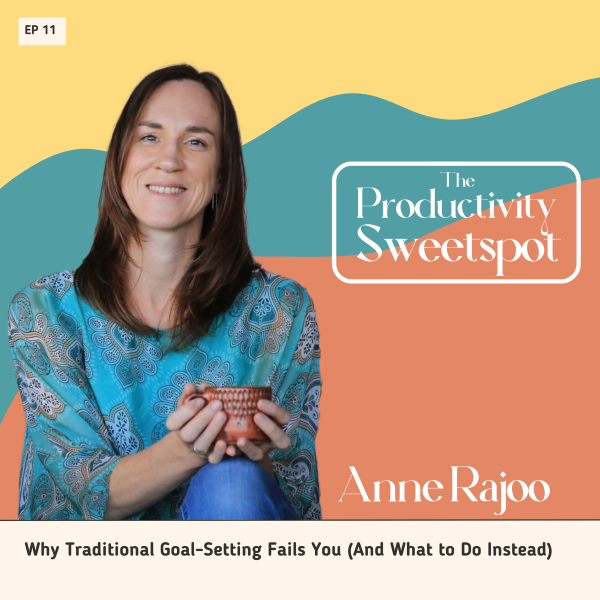
Why do you still feel behind even on the days you clear your whole list? In this solo episode, Anne Rajoo makes the case that chronic exhaustion isn’t a discipline problem — it’s a work design problem. Drawing on her paper The Attention Recession, Anne unpacks pseudo-productivity, the Busy Loop, and the three types of work debt (coordination, decision, and recovery) that quietly compound until you’re running on empty. If you’ve tried every trick to protect your energy and reduce work stress and you’re still tired, this conversation on entrepreneurship and productivity offers a different way to think about professional capacity, personal energy management, and how to create productive systems that actually hold you. Because burnout recovery doesn’t start with doing more — it starts with redesigning how work happens.
Transcript
Anne Rajoo: You cleared your inbox by 10am. Client calls, done. Content posted. Invoices sent. By 6pm, everything on today’s list had a line through it.
And yet at 9pm, you’re sitting there wondering why your business doesn’t feel any further ahead.
That’s not a time management problem. You didn’t run out of time today. You ran out of the thing time was supposed to create: space to think.
That’s the thought I want to leave you with today. What if the problem was never that you needed to be more disciplined? What if we’ve spent years treating what is actually a work design problem as a personal productivity problem?
Over the last few months, I’ve been writing a paper called The Attention Recession. It started as something I thought would be a short article, and somehow turned into forty-plus pages.
As I kept writing, I realised the same pattern was showing up everywhere — in organisations, in small businesses, in my own work. We keep trying to fix people, when what really needs redesigning is the way work happens.
So today, I want to explore that idea with you. Because once you see it, it’s very difficult to unsee.
For years, when a client came to me exhausted, I started where most of us start: tighter time-blocking, better boundaries, a cleaner morning routine. It helped — for about three weeks.
Then I’d watch the same person, six months later, back in the exact same hole. Not because they’d stopped trying. Because I was handing them tools to survive a system that was never built for how they actually work.
That’s when the question changed for me. Not “how do I get better at this?” but “what does this business actually demand of me — and is that demand sustainable?”
Here’s what I mean. Most productivity advice is built on three false assumptions. That you’re the main variable — fix yourself, and your output improves. That your business is stable — it’ll settle once you catch up. And that problems are isolated — fix the one thing, and the rest holds. None of that is true for a growing business.
Then there’s what I call pseudo-productivity — the visibility trap. Replying fast, staying available, looking busy: all of that gets rewarded, by clients, and by your own nervous system. Even though the real value — the strategic thinking, the decision that saves you six months — is invisible, and it’s the easiest thing to skip. It’s the use of visible activity as a stand-in for actual productive effort, and it creates incentives for performing busyness instead of producing meaningful output.
That feeds directly into what I call the Busy Loop: a self-reinforcing pattern where overload creates responses — working faster, cutting recovery, staying constantly responsive — that temporarily keep up appearances while deepening your energy debt.
When you’re overwhelmed, the instinct isn’t to slow down. It’s to tighten your grip. Answer faster. Say yes more. Cut recovery. It feels like control. It’s actually debt.
And work debt has three flavours. Coordination debt — the systems you never wrote down, so every handoff costs you energy. Decision debt — the things you keep circling back to that quietly drain your attention. And recovery debt — the rest you skipped that you’re still paying for.
It compounds like financial debt. Debt grows when unpaid interest gets added to your original balance — and in the next cycle, you’re charged interest on that new, larger total. Essentially, it becomes interest on interest, and the debt grows exponentially.
So here’s the reframe. What looks like “waste” on paper — the lighter week, the unscheduled hour, the pause between projects — isn’t inefficiency. It’s the thing that makes the next stretch of work possible.
I want to leave you with two reflection prompts. Where are you solving a clarity problem — not knowing what actually matters this week — with a capacity solution, like working longer or adding another tool? And what’s one piece of recovery you cut because it didn’t look productive — and what is it actually costing you to keep going without it?
Here’s what I hope you take from this. If you’ve tried every productivity hack and you’re still exhausted, that’s not proof you’re undisciplined. It might be proof the system you’re operating in was never designed for how you actually work — and that’s fixable, but not with more willpower.
Two things kept coming up as I wrote this paper, and they translate directly to running your own business.
First — decision debt. Pick one decision you keep circling back to: a pricing question, whether to bring someone on, how you structure your week. Every time you revisit it without deciding, it costs you energy, even when you’re not thinking about it. This week, just decide. A rough decision made once beats a good decision remade five times.
Second — protect one piece of recovery on purpose. Not because you’ve earned it. Because it’s the thing that lets next week’s version of you think clearly. Block it before the week fills in around it.
If you want to go deeper into everything I unpacked today — the Busy Loop, work debt, the full research — it’s all in the paper, The Attention Recession, at annerajoo.com/attention-recession.
And if this one made you rethink your to-do list, send it to a friend who’s also running on empty — or screenshot it and tag me on Instagram, @_annerajoo_, or connect with me on LinkedIn.
Next week, I’m joined by Kate Kurziej, and we’re getting into something that trips up almost every entrepreneur I know: capacity. It’s a topic I’m deepening for my own work with founders and teams, because “I don’t have enough time” is rarely actually about time.
Kate has this idea of an optimal capacity percentage that completely reframes how you should be filling your week, and why more hours almost never fixes the overwhelm. We also get into how her own understanding of capacity shifted through different seasons of life, including motherhood, and how to actually tell the difference between what’s important and what just feels urgent.
If you’ve ever looked at a calendar that seems “fine” on paper and still felt like you were drowning, this one’s for you.
I’m Anne Rajoo, and this is The Productivity Sweet Spot. I’ll catch you next time — and until then, stay peacefully productive.