

The Productivity Sweet Spot ~ Episode 91
Your Best Day Starts the Night Before: Sleep, Energy & Productivity
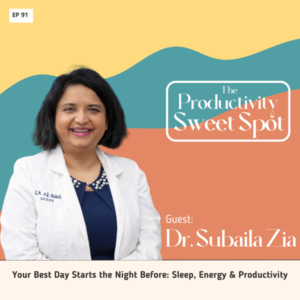
What if the secret to protecting your energy, boosting focus, and finally reducing work stress wasn’t another productivity hack, but a better night’s sleep? In this episode, I sit down with sleep physician and Telemedora founder Dr. Subaila Zia to talk about why sleep is the most overlooked lever for sustainable energy in work, and why so many working moms are running on empty without realising sleep is the missing piece.
Dr. Subaila explains why we spend up to a third of our lives sleeping, and why that’s a good thing: sleep clears toxins from the brain, sharpens memory and creativity, stabilises mood, repairs the body overnight, and even helps regulate weight and heart health. She walks through the most common reasons sleep falls apart, from sleep apnea and restless leg syndrome to nutritional deficiencies, poor sleep hygiene, and “orthosomnia,” the very modern anxiety of chasing a perfect sleep score on a tracker.
For working mom tips that actually fit real life, Subaila shares practical, low-cost strategies: a consistent sleep and wake time, a wind-down routine of at least 30 minutes, a dedicated “worry time” set hours before bed so your to-do list doesn’t follow you into the sheets, and the ideal bedroom temperature for deeper rest. We also get into the very real experience of interrupted nights with kids, why “sleep divorce” is becoming more common, and how Subaila is using AI to speed up sleep diagnostics and personalise care.
If you’ve been powering through exhaustion and calling it normal, this conversation is your permission slip to make sleep a priority again.
In this episode, we cover…
Quotes from this episode
Transcript
In this episode, we cover…
- Why sleep is your best-kept productivity secret
- The real reasons behind insomnia, sleep apnea, and restless nights
- Practical, low-cost sleep hygiene tips for busy working moms
- Why “sleep divorce” might save your relationship, not end it
- How AI is changing the future of sleep care
Quotes from this episode
“Your best performance starts the night before. If you want to have a great day, fix your sleep.”
“Sleep is nature’s gift to us as a performance booster — those who wield it as their superpower tend to be more successful in personal and professional lives.”
“The preparation for a good night’s sleep starts during the day, just like the preparation for a good day starts the night before.”
“Nobody gets helped by an individual who is so sleep deprived that they cannot function.”
“We are not here to be perfect. We are here to be practical.”
Transcript
Excerpt
What if fixing your sleep was the fastest way to protect your energy, boost focus, and reduce work stress? In this episode, Anne Rajoo talks with sleep physician Subaila Zia about why so many working moms treat exhaustion as normal, and what it actually takes to build sustainable energy in work through better sleep. Subaila breaks down the real causes of insomnia and restless nights, from sleep apnea to “orthosomnia,” shares practical working mom tips for a better wind-down routine, and explains why “sleep divorce” might be doing more good than harm. If mother exhaustion, the caregiving burden, or working mom burnout have you running on empty, this conversation offers a genuinely practical way to reset.
Transcript
Anne Rajoo: I’m very excited about today’s conversation because it’s about sleep. I had my fair share of sleep-deprived years when my children were little, because they were terrible sleepers. My husband is also struggling with sleep, and I recently spoke with two good friends who are struggling with sleep too. So I’m here, in a way, on their behalf, to find out what we can do to improve our sleep.
Anne: Subaila, tell us a little more about your work. What does it mean to be a clinician who specialises in sleep, and why is sleep so important for us? Let’s start at the baseline.
Subaila Zia: Thank you so much for having me on your podcast, The Productivity Sweet Spot. I’m delighted to be here.
Subaila: I’m a sleep physician, and I help people enhance their productivity by optimising their sleep health. I’m also the founder of a Silicon Valley-based digital sleep care startup called Telemedora. We’re disrupting the traditional care model, which is flawed: long wait times, high cost, and inconvenience. So we’re solving a sleep care access problem.
Subaila: If you’d asked my younger self, twenty years ago, what kind of doctor I wanted to be, even in med school, being a sleep physician never crossed my mind. It wasn’t until I started my fellowship at the Yale University Bridgeport program that I became much more interested in sleep medicine. I saw how sleep-deprived my patients were, and how simply fixing their sleep health could improve other, non-sleep conditions too. We were able to improve blood pressure. We were able to prevent strokes.
Subaila: I also have a background in pulmonology and critical care, where I used to care for patients in the ICU. I noticed that when we improved sleep health, patients were less likely to end up in the ICU. That’s what drew me in.
Subaila: Now, to your second question, Anne: why is sleep important? As humans, we spend up to a third of our lives sleeping. Sleep is nature’s gift to us as a performance booster. Those who wield it as their superpower tend to be more successful in both their personal and professional lives.
Subaila: There are ten main functions of sleep. First, sleep helps clear toxins from the brain, which boosts memory, improves focus, enhances creativity, and even improves mood. Nobody wants a cranky mom, a cranky teacher, or a cranky doctor, and that’s often just sleep deprivation talking.
Subaila: Sleep also helps repair our bodies. A growth hormone is released during sleep that helps fix muscle tissue. People who sleep better also tend to have their weight better controlled, because they’re less hungry. One study found that when people who were overweight were no longer sleep-deprived, they naturally reduced their calorie intake by 270 calories a day, which helped them lose weight.
Subaila: Sleep is just as important for your heart as it is for your brain — people with better sleep tend to have fewer heart problems. And it helps you recharge and rejuvenate for the next day. I tell people that your best performance starts the night before. If you want to have a great day, fix your sleep.
Anne: Fix your sleep — I love that. There are clearly so many reasons why we need sleep, and it’s pretty logical when you think about it. It’s not rocket science. And sleep is free, which is amazing. But at the same time, so many people struggle with it. My husband does, my friends do, and I’ve had periods of not sleeping well myself. I remember exactly the impact it had on my physical and emotional wellbeing, and on my productivity.
Anne: So why do people struggle with sleep so much? I think it’s becoming a bigger problem for more and more people. Do you feel the same?
Subaila: You’re absolutely right. Difficulty falling asleep, or difficulty staying asleep on a regular basis, is called insomnia, especially when it affects your daytime performance. Insomnia is one of the most common sleep disorders in the world.
Subaila: There are a few reasons people don’t sleep well. Some have underlying sleep disorders, like sleep apnea, where the throat closes multiple times an hour during the night, disrupting airflow and negatively affecting the brain and heart. Others have sleep-related leg movement disorders, like restless leg syndrome — this is more common in women, often linked to iron deficiency from regular menstrual periods.
Subaila: There can also be nutritional deficiencies — vitamin B12 or vitamin D deficiency has been linked to insomnia and other sleep disorders — and thyroid disorders are connected to poor sleep as well. Certain medications can cause insomnia too.
Subaila: Life stressors matter too — a big move, a new job, a new baby. If that pattern continues for a long period, it’s worth seeking help for anxiety or depression. And then there’s poor sleep hygiene: the habits you follow, before bed and throughout the day, that support good-quality sleep. The preparation for a good night’s sleep starts during the day, just like the preparation for a good day starts the night before.
Subaila: Ironically, people often don’t prioritise their sleep. The American Academy of Sleep Medicine ran a survey asking American adults what they liked to do before bed, and 88 to 90 percent said they prioritised catching up on shows, playing games, or scrolling on their phones. That’s a sleep-onset killer. These devices emit blue light, and when that light hits your eyes, it signals your brain to stop producing melatonin, the sleep-inducing hormone. Your brain thinks it’s still daytime, and it’s time to be awake and alert, which delays sleep onset. People then think they have a sleep problem, when really it’s the light.
Subaila: There’s another phenomenon emerging now called orthosomnia. This happens when people use sleep trackers to measure how much and how well they slept, and the tracker produces a score. You wake up and it tells you your sleep score was only 50, even though you don’t notice any symptoms during the day — it’s just the device telling you. Some people, not everyone, become obsessed with chasing a “perfect” sleep score, and that creates unnecessary panic and anxiety. I’m based in the Silicon Valley area, where people are especially drawn to new technology, so I see a fair amount of this.
Subaila: People also consume caffeinated drinks at the wrong time without realising it. And some substances that are used to induce sleep, like marijuana, actually fragment it — they suppress certain sleep stages instead of helping.
Anne: Interesting. There are so many reasons sleep gets disrupted. I know we don’t have time to cover everything, so I want to ask: knowing that my listeners are mostly working women, caring for families and other people, juggling a lot, and often entering the second half of their lives — so there might be hormonal changes at play too — what would you say is the most important, most valuable sleep tip for them? I know for me, falling asleep can be hard because of everything left on my to-do list. If we’re speaking directly to that woman, where do we start?
Subaila: Let me give you a few practical tips for good sleep hygiene.
Subaila: First, consistency matters. A consistent bedtime and wake time, even on weekends, trains your brain to start and end your sleep cycle at the same time each day.
Subaila: Second, as busy working moms or midlife professionals, it’s important to build in “me time”: a wind-down routine of at least 30 minutes before bed, ideally 60. That could be a warm bath, a curfew on blue-light devices at least 30 minutes before bed, meditation, or slow breathing exercises.
Subaila: And if you’re not sleepy, don’t go to bed just because the clock says it’s time. Go to bed when you’re actually sleepy. One of the biggest enemies of sleep is the young mom who wants to be a perfectionist — she keeps going and going, and then brings her worries to bed with her. I tell people to set aside 10 to 15 minutes of “worry time,” ideally around dinner time, not too close to bedtime.
Subaila: You can keep a journal, or record a voice note: “Today is April 23rd, these were the top three things that worried me today, and I feel I could have done better — but nobody is perfect. We’re not here to be perfect, we’re here to be practical.” Then you can also write down tomorrow’s to-do list and be done with it. You’re training your brain to have a designated place for worry, and that place isn’t the bedroom, and it isn’t right before bedtime. Worry time should happen four to six hours before you sleep.
Subaila: Nobody is helped by someone who is so sleep-deprived they can’t function. Avoid stimulating activities close to bedtime too — if you’re doing kickboxing, don’t do it two or three hours before bed. Limit caffeine, ideally before noon. Limit naps to before 2pm, and keep power naps to 20-30 minutes, not longer. And if you’re struggling to fall asleep, don’t keep checking the clock — it just creates more anxiety.
Subaila: A few types of exercise have been shown to improve sleep quality and quantity, as long as you do them a few hours before bed, ideally six hours out: tai chi, yoga, and walking or jogging. A study looking at this found these were the top exercises for either improving total sleep time or reducing sleep fragmentation.
Subaila: It’s also important to have a comfortable bedroom environment. Your bedroom should be reserved for intimacy and sleep only — don’t bring your laptop in to work or plan tomorrow’s meeting agenda. I know young moms need to stay alert for their kids at night, so some of my patients are hesitant to use earplugs, but a dark room alone can help. And bedroom temperature matters: aim for 19 to 21 degrees Celsius, or 67 to 69 degrees Fahrenheit in the US.
Anne: Thank you so much for going through all of that — there are so many small, easy tips in there. Nothing complicated, nothing expensive. You don’t need a device or a tracker.
Anne: I’d love to talk about interrupted nights, too. Like I mentioned, I have three people in my life right now who wake up in the night and can’t fall back asleep. What’s going on there, and what can they try?
Subaila: That’s a very common problem. If you have a young family, make sure you’re not only training yourself but also training your kids to limit screen time, and you have to model it yourself. You can’t be scrolling on your phone and expect your kids to leave their tablets alone.
Subaila: There’s also something called “passive background media”: when parents are exposed to screens even if the kids technically don’t have direct access. Kids are curious, and they notice. Studies also show that avoiding violent or scary media helps, so it’s worth planning what content your kids are exposed to.
Subaila: Set a bedtime and be strict about it: this is when you go to bed, this is when you wake up. Avoid sugary or chocolatey foods close to bedtime so kids aren’t overstimulated. And make sure they’re physically tired — when kids are tired, they sleep more easily, so plan their physical activity accordingly.
Subaila: It’s important for parents to set boundaries and hold them. Moms need their “me time,” so unless there’s a fever, pain, or an actual emergency, kids shouldn’t come into your room. That’s the list of real emergencies — outside of that, the boundary holds.
Subaila: It also helps to have family time where you’re not judging each other, where you can talk openly about sleep problems, what you wish were different, and be patient when someone points out something you could improve. If you have a partner who’s a restless sleeper, or who snores loudly, and you both need to function the next day, that can really wear on a relationship.
Subaila: There’s actually a term for this: “sleep divorce,” when a couple intentionally decides to sleep in separate beds or separate rooms so they can both function the next day, without any guilt attached. It’s actually more common among men aged 35 to 44 than women.
Subaila: There are a few reasons for it: different work schedules, snoring, wanting to read with the light on, or just needing space after a rough day. Intimacy has nothing to do with it — in fact, a sleep-deprived partner tends to have less interest in intimacy than a well-rested one.
Anne: My husband wants to cuddle, and I just want to be left alone to sleep, but he loves it. It’s funny — but you’re right, separating sleep space from intimacy is two completely different things.
Anne: I wanted to close with something I was really curious about: your involvement in AI and sleep medicine. What is AI’s role in sleep, and what are you working on in that space?
Subaila: Thank you for asking. AI has impacted every corner of healthcare, sleep medicine included. I’ve found it useful in both clinical and non-clinical settings.
Subaila: In the clinical setting, it helps us score sleep reports faster. When we run a sleep study, we record a patient overnight — let’s say eight hours — and break that into 30-second clips, each with data from up to 15 or more sensors that all need to be labelled. Manually, that could take two to three hours. AI can do it in 42 seconds, which frees up time for us to review the results, focus on the complex cases, and sign off.
Subaila: AI is also becoming a powerful screening tool — some smart watches can now pick up signs of sleep apnea. It’s helping personalise sleep care too: you can cross-reference a patient’s demographic data, even a 3D facial scan, against a larger database to find the right mask fit for sleep apnea patients.
Subaila: AI can also help with insomnia. The most effective treatment for insomnia isn’t medication — it’s cognitive behavioural therapy for insomnia (CBT-I), and AI tools can now deliver that without needing a human directly involved.
Anne: It’s fascinating what’s already possible, and what’s still coming. And the facial recognition piece for mask-fitting is genuinely interesting. I’ve only used AI for sleep in one way, honestly — I use it to write new bedtime stories for my sons when they don’t want to read their usual books and I don’t have the brain capacity to make one up on the spot. That’s worked really well.
Listen on your platform of choice


View all episodes
Get more of Dr Subaila
Do you struggle with being productive?
Discover where to start when creating business harmony and work-life fulfillment with the Wheel of Peaceful Productivity
Understand Your Unique Productivity Style -And Leverage It for Greater Ease & Focus. Take the Quiz!
Keep In Touch with Anne
Subscribe to her newsletter
Peaceful Productivity Letter
Join hundreds of readers and enjoy three actionable tips on how to make the most of your time.
Thank you!
You have successfully joined our subscriber list.