
The Attention Recession When You Are the Whole Team
What if you're not bad at productivity? What if you've simply become the person holding an entire business together?

Some mornings I sit down at my desk after the school run, open my laptop and immediately remember six things.
I need to reply to that client.
I still haven’t decided what to charge for the new workshop.
I promised myself I’d record a podcast today.
There’s an invoice to chase.
The website needs updating.
I should probably post on LinkedIn because it’s already been four days.
I haven’t actually started working yet.
I’ve simply remembered everything I’m responsible for.
By nine o’clock, I already feel behind.
For a long time, I assumed this was poor time management.
Then I became better at planning.
I started time blocking.
I built systems.
I delegated where I could.
I began using AI every single day.
Things improved.
But something still didn’t quite fit.
The feeling of carrying too much never really disappeared.
Eventually I realised I was asking the wrong question.
I kept asking how I could become more productive.
The better question was:
What exactly am I carrying?
Most solo businesses are small.
That doesn’t mean they’re simple.
We often think structural problems belong to big companies.
Layers of management.
Complex reporting lines.
Department silos.
HR.
Policies.
Meetings.
Surely none of that applies when you’re running a business on your own.
I don’t think that’s true.
A business with one person is still a system.
It just has fewer buffers.
There’s no operations manager noticing the bottlenecks.
No assistant reminding you about decisions.
No colleague catching something you’ve forgotten.
No manager helping you prioritise.
Everything eventually arrives with the same person.
YOU.
That doesn’t make the system simpler.
It makes it more fragile.
The smaller the business, the fewer places the pressure has to go
Decision debt
Every decision you don’t make continues taking up space in your mind.
One of the biggest surprises while researching The Attention Recession was discovering how much work isn’t actually work.
It’s unfinished decisions.
That pricing change you’ve been thinking about since March.
Whether to hire.
Whether to launch.
Whether to stop offering something.
Whether to change your website.
Every time you reopen the question, your brain starts from scratch.
The work never leaves.
It simply waits.
You might recognise some of these:
- a proposal you’ve rewritten three times
- a service you’ve wanted to remove for months
- software you’ve researched but never chosen
- content you’ve drafted but never published
- an email you’ve mentally answered twenty times
None of these look particularly significant.
But together they’re taking over your working day.
Coordination debt (yes, even when you work alone)
Working alone doesn’t remove coordination. It changes where it happens.
People often assume coordination only exists inside teams.
Actually, much of mine happens between:
- me and clients
- me and different software platforms
- me and my calendar
- me and my previous decisions
- me and my future self
Every password.
Every follow-up.
Every document I forgot to save properly.
Every system that doesn’t quite talk to another one.
None of it looks like “real work.”
But it all consumes attention.
I don’t think solo entrepreneurs underestimate how much time coordination takes.
I think we simply don’t count it.
Some of the busiest hours in a business produce almost nothing visible.
Recovery debt
The hardest part isn’t running a business. It’s that your business and your life draw from the same capacity.
This is the section I wish someone had explained to me years ago.
As founders, especially mothers, we often talk about work-life balance.
I don’t think that’s the right frame.
It’s one nervous system moving between two operating systems.
One moment you’re negotiating with a client.
The next you’re remembering it’s book day.
Then you’re trying to write a proposal while mentally planning dinner.
Then school calls.
It takes time to mentally move from one role to another, even if the change only takes a few seconds.
Every switch costs attention.
Every interruption has to be recovered from.
When recovery keeps getting pushed to “later”, it becomes harder to think clearly, make decisions and focus.
We often see the effects, but not the cause.
Clarity
When you work for yourself, nobody decides what matters today.
That sounds like freedom.
Sometimes it is.
Sometimes it’s exhausting.
Every morning, before you’ve done any actual work, someone has to decide:
What matters most?
What’s good enough?
What can wait?
Which opportunity deserves attention?
Which doesn’t?
In a company, some of those decisions are made for you.
In your own business, you generate that clarity every single day.
It’s invisible work.
But it’s still work.
Freedom doesn’t remove decisions. It transfers them.
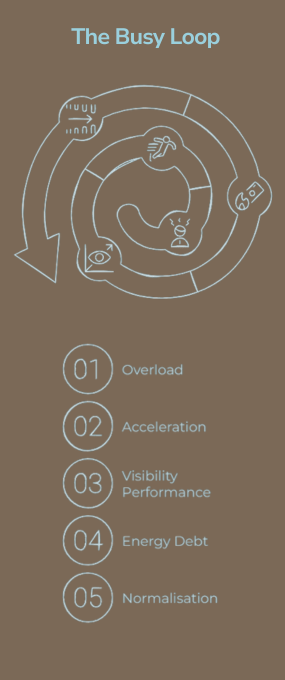
The Busy Loop
This is where everything starts feeding itself.
A decision stays open.
Because it stays open, more coordination is needed.
Because there’s more coordination, you lose capacity.
Because you’re tired, creating clarity becomes harder.
So more decisions stay open.
The loop keeps reinforcing itself.
I don’t think this is because we’re bad at organising ourselves.
Most of us didn’t sit down and design how our business would operate. We added a system here, a process there, solved the next problem, and kept moving. Before long, we were working inside a business that had simply evolved.
Four structural changes that made the biggest difference for me
None of these involve waking up at 5 a.m.
None require another productivity app.
Instead, they’ve changed the structure of how I work.
- Make decisions once and record them.
- Reduce the number of places work can live.
- Treat recovery as part of work, not a reward after it.
- Give strategy a permanent place in the calendar instead of expecting it to happen “when there’s time.”
These aren’t productivity hacks.
They’re design choices.
Four questions worth sitting with
Before trying another system, ask yourself:
- Which decision have I been carrying for months?
- Where does most of my coordination actually happen?
- What am I calling a time problem that’s really a capacity problem?
- If someone looked at how my business currently operates, what would they say had been designed and what had simply evolved?
The biggest shift for me wasn’t learning another productivity technique.
It was realising I wasn’t failing at productivity.
I was trying to run a growing business inside a system that had never been intentionally designed.
Once I started redesigning the work instead of simply trying to become better at surviving it, everything became a little lighter.
Not easy.
Just lighter.
